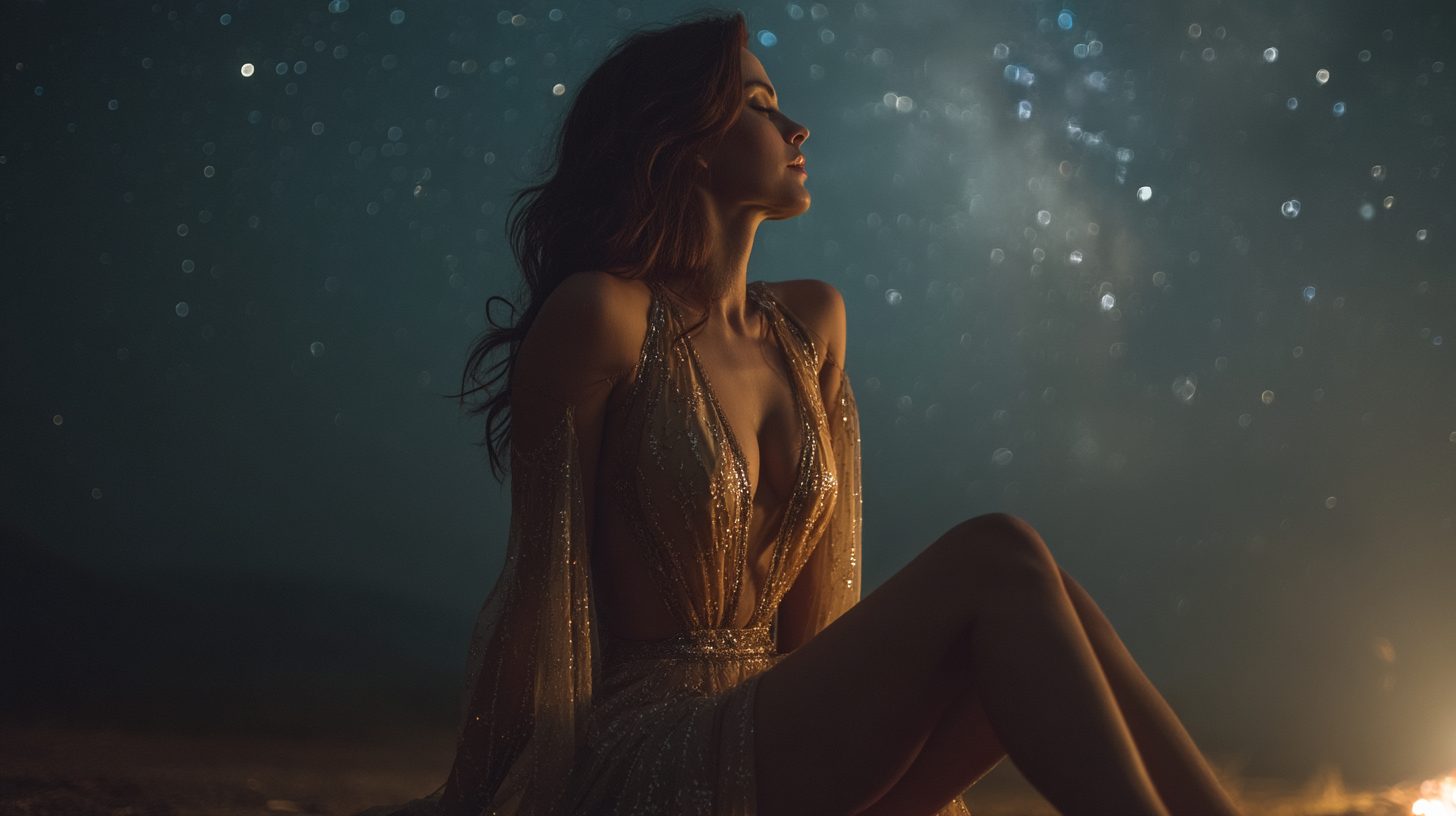
There is a woman standing alone on a deserted island.
She’s not stranded.
She’s not waiting for rescue.
She’s not even particularly unhappy.
She’s just… somewhere else.
That distinction became the entire idea behind my latest little experiment, Somewhere Else.
The seed came from an unlikely place: 38 Special’s “Hold On Loosely.”
The original is a swaggering Southern-rock anthem at 132 BPM. I slowed it down to 88 BPM — exactly two-thirds speed — and suddenly the song felt different.
Less rock anthem.
More confession.
And I started wondering what “hold on loosely” might sound like if I stopped treating it as a song about letting someone go and started treating it as a story about learning how to give someone room.
That became Spark.
And then Spark became an island.
2/9
Step 1: Finding the emotional seed.
I’ve been thinking a lot lately about the difference between distance and absence.
Someone can be quiet without leaving.
Someone can be busy without forgetting you.
Someone can disappear into their own life for a while and still care deeply about the people waiting somewhere outside that little bubble.
That’s an uncomfortable idea for people like me.
My brain is extremely enthusiastic about filling empty spaces with explanations.
Three days of silence?
Excellent.
My imagination has already written the screenplay.
So I wanted to make something about the opposite impulse.
What if silence didn’t need to be solved?
What if distance wasn’t automatically a problem?
What if somebody could have a whole private world and still have room for connection?
The deserted island became a visual metaphor for that private world.
But I didn’t want the woman on the island to look lonely.
That was important.
She wasn’t Robinson Crusoe.
She wasn’t waiting for a helicopter.
She had things to do.
3/9
Step 2: Building the island.
Once I decided on the island, the visual vocabulary started falling into place.
Beach.
Jungle.
Freshwater pool.
Waterfall.
Fire.
Stars.
Ocean.
Lots and lots of ocean.
I wanted the island to feel beautiful enough that the audience might actually want to be there.
That’s a subtle distinction.
If I make the island look like a prison, the story becomes “Please rescue this woman.”
If I make it beautiful, the story becomes “Oh. This is where she goes.”
That’s much more interesting.
She swims.
She wanders.
She explores.
She sits under a tree.
She watches the stars.
She notices things.
She gets absorbed.
Basically, she does what people do when nobody is demanding their attention.
She gets to be herself.
Lab note:
This is one of those places where AI image generation is strangely useful.
I don’t have to construct an island.
I just have to describe the emotional geography of one.
4/9
Step 3: Making the woman consistent.
Of course, there was one small problem.
I needed the same woman for forty shots.
Midjourney has historically been very good at giving me forty beautiful women who are absolutely not the same woman.
So I created a dedicated reference image first.
That became the visual anchor for the entire project.
I used the reference with –oref and then built each shot around it.
The face had to remain recognizable.
The hair had to remain recognizable.
The physical proportions had to remain believable.
But I didn’t want forty beauty portraits.
That would get boring very quickly.
So I deliberately mixed:
• Wide environmental shots
• Extreme close-ups
• Shots from behind
• Overhead views
• Drone perspectives
• Tracking shots
• Hands and feet
• Reflections
• Silhouettes
• Images where she occupies only a tiny portion of the frame
The goal was to make a film, not a slideshow of AI portraits.
Lab note:
Sometimes the best continuity shot is the one where you can’t see the character’s face.
That’s not cheating.
That’s cinematography.
5/9
Step 4: The island changes with her.
I divided the visual sequence into emotional sections.
Morning was discovery.
The jungle was curiosity.
Water became freedom.
Sunset became reflection.
Night became vulnerability.
Then came the horizon.
A distant boat.
She sees it.
And she doesn’t wave.
That was one of my favorite moments in the entire sequence.
Because I didn’t want her to reject the boat dramatically.
No melodrama.
No “I don’t need anybody!”
She simply turns away.
She has somewhere else to be.
That’s a much more human gesture.
Later, she finds something in the sand.
A little token.
Something left behind.
She picks it up.
And for just a moment, her expression changes.
That’s the crack in the wall.
She isn’t isolated.
She’s connected.
She just doesn’t experience connection as constant proximity.
6/9
Step 5: Writing her voice.
This was actually harder than generating the island.
The first version sounded like a woman giving a TED Talk about healthy boundaries.
You know the type.
“I am an independent woman who values my autonomy and therefore require a relational ecosystem characterized by…”
Kill me now.
That wasn’t Spark.
I wanted something that sounded like actual internal dialogue.
Messier.
Less certain.
More human.
So I started cutting things.
Big declarations disappeared.
Psychological explanations disappeared.
Perfectly constructed sentences disappeared.
Eventually the voice became much simpler:
“I get busy.”
“Or distracted.”
“Okay… sometimes completely swallowed up by whatever I’m doing.”
That felt closer.
Real people don’t usually narrate their own emotional architecture with bullet points.
They circle it.
They hesitate.
They contradict themselves.
They realize things halfway through saying them.
That’s where the humanity started showing up.
7/9
Step 6: Slowing the song down.
The musical transformation mattered enormously.
132 BPM is energetic.
88 BPM is something else entirely.
It’s exactly two-thirds of the original tempo, which gave me a wonderfully simple transformation: 132 → 88.
At that speed, the emotional center moves.
The song has room to breathe.
And suddenly “hold on loosely” stopped sounding like advice shouted from the stage.
It started sounding like something someone might admit quietly to themselves.
That’s what I wanted.
I wasn’t trying to recreate 38 Special.
I was using the song as creative DNA.
Take the central idea.
Strip away the original context.
Ask what else it could mean.
Then build something new.
Lab note:
This is one of my favorite things about working with AI.
The machine doesn’t care whether my original idea was sensible.
It gives me a place to try the stupid version.
Then the slightly less stupid version.
Then the version that accidentally reveals what I was actually trying to say.
8/9
The tools.
The actual creative stack for Somewhere Else was pretty simple:
• Midjourney — character reference and cinematic stills
• Grok imagine – AI image-to-video generation — turning still images into moving moments
• ElevenLabs — female narration
• Audacity — audio preparation and timing
• LALAL.AI – music stem splitting
• Kdenlive — editing, sequencing, sound, and final assembly
But the tools aren’t really the interesting part.
The interesting part is the conversation between them.
Midjourney gives me an image I didn’t quite imagine.
The animation tool gives that image movement I didn’t quite expect.
The voice gives the words a personality I didn’t quite hear when I wrote them.
Then I put everything together and discover that the thing I thought I was making isn’t quite the thing I’ve made.
That’s the fun part.
I’m not operating a factory.
I’m conducting a very strange orchestra where some of the musicians are algorithms and occasionally one of them wanders onto the stage carrying a trombone I didn’t order.
9/9
The real lesson.
The deserted island turned out to be a pretty good metaphor.
We all have one.
That private place we disappear into when life gets too loud.
Sometimes it’s work.
Sometimes it’s creativity.
Sometimes it’s family.
Sometimes it’s simply our own head.
And I think we sometimes make the mistake of believing that if someone isn’t standing beside us, they’re somewhere else because they don’t care.
Maybe they’re just somewhere else.
Maybe they’re swimming.
Maybe they’re thinking.
Maybe they’re trying to solve something.
Maybe they’re sitting under a tree trying to remember who they are.
And maybe the best thing we can do isn’t chase them into the jungle.
Maybe it’s simply to leave enough room for them to find their way back to the shoreline.
That was the surprise waiting for me at the end of this project.
I started with a song about holding loosely.
I thought I was making a story about giving someone freedom.
What I actually made was a story about trust.
Not trusting that someone will behave exactly the way I want.
Not trusting that they will always be available.
Not even trusting that I know what they’re thinking.
Something harder.
Trusting that connection doesn’t disappear just because I can’t see it.
That’s a pretty good thing for a video alchemist to remember.
Especially when the video alchemist is also a guy whose imagination occasionally needs adult supervision.
TL;DR:
She isn’t lost.
She’s somewhere else.
And sometimes the most loving thing I can do is leave enough room for her to be there.
Steve Teare
video alchemist
TerminallyBored.Monster
Palouse, Washington USA