There are moments when you realize you have created something completely unnecessary.
I had one of those moments recently.
I invented a word. By accident.
The word is “cak.”
Three letters. One syllable. No actual linguistic pedigree whatsoever.
And then, naturally, I made a six-minute academic lecture explaining it.
The premise was simple: What if there were a word for leaving without saying goodbye?
Not “goodbye.”
Not “farewell.”
Not “see you later.”
Something smaller.
A word that says: I am going now, but I am not gone.
Cak.
It seemed ridiculous.
Which, frankly, was a promising beginning.
2/9
Step 1: Make the word sound real.
The first challenge was to treat the invented word as though it had been hiding in the English language all along.
So I gave it a pronunciation.
A definition.
Grammar.
Etymology.
Historical usage.
Regional variations.
A folk tradition.
And, because apparently I have no adult supervision, a bird.
The imaginary cak-bird became an important part of the mythology.
According to the entirely fabricated tradition, the cak-bird leaves the same nest every season and always returns to it.
Its call?
Cak.
There is no such bird.
But that didn’t stop me from giving it a natural-history pedigree.
Lab note:
One of the wonderful things about making something fictional is that you don’t have to discover the rules.
You get to invent them.
Then, if you are sufficiently committed, you can pretend you discovered them.
3/9
Step 2: Give the lie an academic foundation.
The fake etymology was probably my favorite part.
The supposed origin of cak is “catch you on the backswing,” allegedly used by itinerant workers, railroad crews, and seasonal laborers who were leaving with the intention of returning.
Catch you on the backswing.
Catch-back.
Cak.
Perfect.
Except for one small problem.
There is absolutely no evidence that this happened.
So naturally I invented a 1911 letter from an eastern Washington harvest worker:
“Tell Ma I cacked the fence. Back after freeze.”
The letter does not exist.
The narrator acknowledges that it does not exist.
Then he solemnly explains that the story nevertheless has “the ring of authenticity.”
That, I think, is where the video found its comedic voice.
The joke isn’t that we are making something up.
The joke is that we are taking the act of making something up extremely seriously.
4/9
Step 3: Build a linguistic ecosystem.
Once cak existed as a noun, I couldn’t leave it alone.
It needed verbs.
To cak.
Cacked.
Cacking.
Uncack.
Then came the variations.
A half-cak.
A full cak.
Cak and gone.
No cak needed.
And finally:
Cak me.
That last one changed the emotional center of the whole project.
“Cak me” is not “don’t go.”
It isn’t “take me with you.”
It means:
Go if you must.
But leave as someone who returns.
I liked that.
A lot.
Because underneath all the nonsense, there is something rather human hiding in the joke.
Leaving doesn’t necessarily mean ending.
Sometimes people have to go.
The important thing is whether the departure closes the relationship.
5/9
Step 4: Let language get dirty.
Of course, no invented word survives contact with actual human beings.
Eventually somebody is going to misuse it.
Or sexualize it.
Or turn it into slang.
So the lecture gets progressively more uncomfortable.
“Cak me” develops some decidedly less academic interpretations.
At that point, I resisted the temptation to make the visuals explicit.
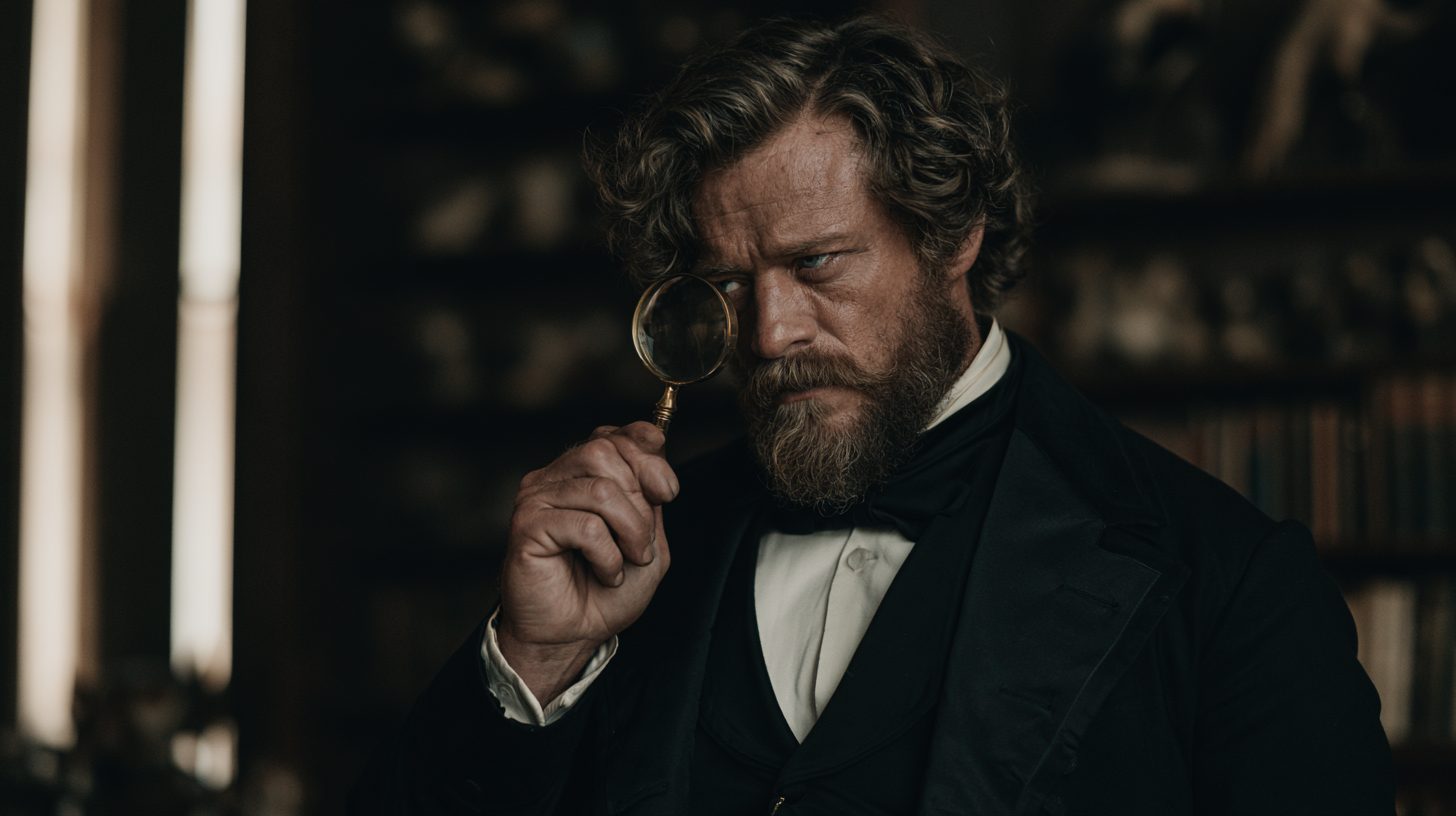
Instead, the joke comes from the narrator’s complete commitment to scholarly analysis.
This is a man delivering a serious linguistic lecture about something that absolutely should not be receiving a serious linguistic lecture.
And that contrast is the engine of the whole film.
Lab note:
Comedy often works better when the creator refuses to acknowledge that anything is funny.
The narrator doesn’t wink.
He doesn’t tell the audience when to laugh.
He simply continues explaining cak as though tenure depends upon it.
6/9
Step 5: Build the visual language.
Because I couldn’t lip-sync the six-minute narration within the budget, I decided not to fight the limitation.
Instead, I embraced it.
The narrator became a voice rather than a talking head.
The visuals became evidence.
Fake archival photographs.
Railroad workers.
Harvest fields.
Old letters.
Natural-history illustrations.
Academic diagrams.
A completely fictional bird.
And, eventually, a red door.
The red door became the visual metaphor for cak.
It closes.
Someone leaves.
Someone remains.
The door stays closed for a while.
And eventually…
it opens again.
That gave me a visual structure I didn’t have when I started.
The door became the word.
Departure.
Absence.
Return.
7/9
Step 6: Make the soundtrack almost disappear.
The original plan was not to bury the narration beneath music.
In fact, I’m using very little music.
The voice gets to carry the lecture.
Then I added a tiny musical punctuation mark: a single piano ping at selected appearances of the word.
Not every time.
That would become a laugh track.
Instead, the ping appears when cak needs to feel important.
Then it disappears during the more ridiculous sections.
At the end, the sound design gets quieter.
A door latch.
The red door.
A pause.
“Cak.”
Then the final image.
The circle remains open.
Lab note:
Sometimes removing things is the most useful form of editing.
I was initially thinking about music, atmosphere, transitions, sound effects, and all the usual things I could pile onto a six-minute video.
Then I realized that silence is also a sound.
Especially when the narrator has just said something completely absurd in a voice that suggests he is about to announce the results of a major scientific discovery.
8/9
The tools
The production stack for this one is fairly simple:
Midjourney — cinematic still imagery, historical scenes, the red door, the imaginary cak-bird and the other visual evidence
Grok — image-to-video animation for selected six-second shots
ElevenLabs — narration
Kdenlive — editing, timing, transitions, Ken Burns movement, sound design and final assembly
Audacity — adjust vocal timing gaps
PhotoFilmStrip — Ken Burns movement, sound design and final assembly
And me — standing in the middle of the orchestra pit.. conducting.
That last part is important.
The AI tools didn’t invent the concept of cak.
They didn’t decide that a fictional railroad-worker etymology would be funny.
They didn’t decide that a red door should become the visual symbol for leaving and returning.
They gave me materials.
I directed the orchestra.
That distinction matters to me.
The interesting part of AI filmmaking isn’t pressing a button and watching something appear.
It’s discovering what happens when you begin improvising with a machine that can give you ten unexpected answers to the question you thought you were asking.
9/9
The real lesson
I started this project because I thought the idea of inventing a word was funny.
And it is.
But somewhere along the way, cak stopped being entirely ridiculous.
A goodbye closes something.
A cak leaves it open.
That doesn’t mean every departure leads to a return.
It doesn’t make promises magically true.
An empty cak is worse than no cak at all.
But there is something valuable in acknowledging that leaving and ending are not always the same thing.
Sometimes the most important thing you can say when you walk away is simply:
I am going.
I am not gone.
The circle remains open.
That may be more meaning than three letters have any right to carry.
Which brings me to the obvious conclusion.
I invented a word.
I invented its history.
I invented its bird.
I invented its grammar.
I invented its academic literature.
And then I made a video to explain all of it.
Completely unnecessary.
Completely fictional.
And, somehow, a little bit true.
Cak.
TL;DR:
I made a six-minute TED Talk about a word that doesn’t exist.
Now I think we probably need the word.
And that is either the triumph of imagination…
or evidence that I have far too much time on my hands.
I’m hoping for the first one.
Steve Teare
video alchemist
TerminallyBored.Monster
Palouse, Washington USA