I went looking for a woman.
I found a wound.
Actually, I found something considerably more inconvenient.
I found a part of the human psyche that can spend years explaining exactly why everyone else is responsible for its pain — and then, if it is very lucky, eventually turn around and say:
Wait.
What did I do?
That became the seed for this video.
I called it RECKONING.
2/9
The original idea was a monologue from what I called the wounded feminine.
Not a particular woman.
Not an accusation against women.
Not even really a story about gender.
It is an archetypal voice — the part of us that has been hurt and, because it is hurt, learns to manipulate, control, demand validation, project old wounds onto new people and then wonder why the emptiness never goes away.
The voiceover begins with an admission:
“This is a message of apology from my wounded feminine to you.”
And then it gets uncomfortable.
She admits that she tried to seduce someone, not because she desired him, but because she wanted power over him.
She admits that she used him to fill an emptiness she didn’t know how to fill herself.
She admits that she diminished him.
That she saw his strength as a threat.
That she pushed him until he became angry, and then used his anger as evidence for what she already believed.
And finally:
“I see my part in this war between feminine and masculine.”
That sentence is the heart of the entire project.
3/9
I originally considered calling the video THE WOUNDED FEMININE: AN APOLOGY.
It was accurate.
It was also a little too much like the title of a graduate seminar.
So I started looking for one word.
RECKONING.
That was it.
A reckoning isn’t necessarily punishment.
It is the moment when you stop negotiating with the truth.
That distinction mattered to me.
The voice isn’t saying, “I am terrible.”
It is saying, “I can finally see what I did.”
Those are very different things.
Lab note:
I have discovered that one of the hardest things about making a psychological video is resisting the temptation to explain the psychology.
Sometimes the image needs to shut up and let the idea breathe.
4/9
So I built the opening around six images.
No people.
No faces.
No literal representation of a wounded woman.
Just objects and atmosphere.
First, perfectly still black water.
Then a disturbance.
Ripples spread across the surface.
Then tangled red and black threads.
Then an old wooden drawer with a thin line of light leaking around its edges.
Then the drawer opens.
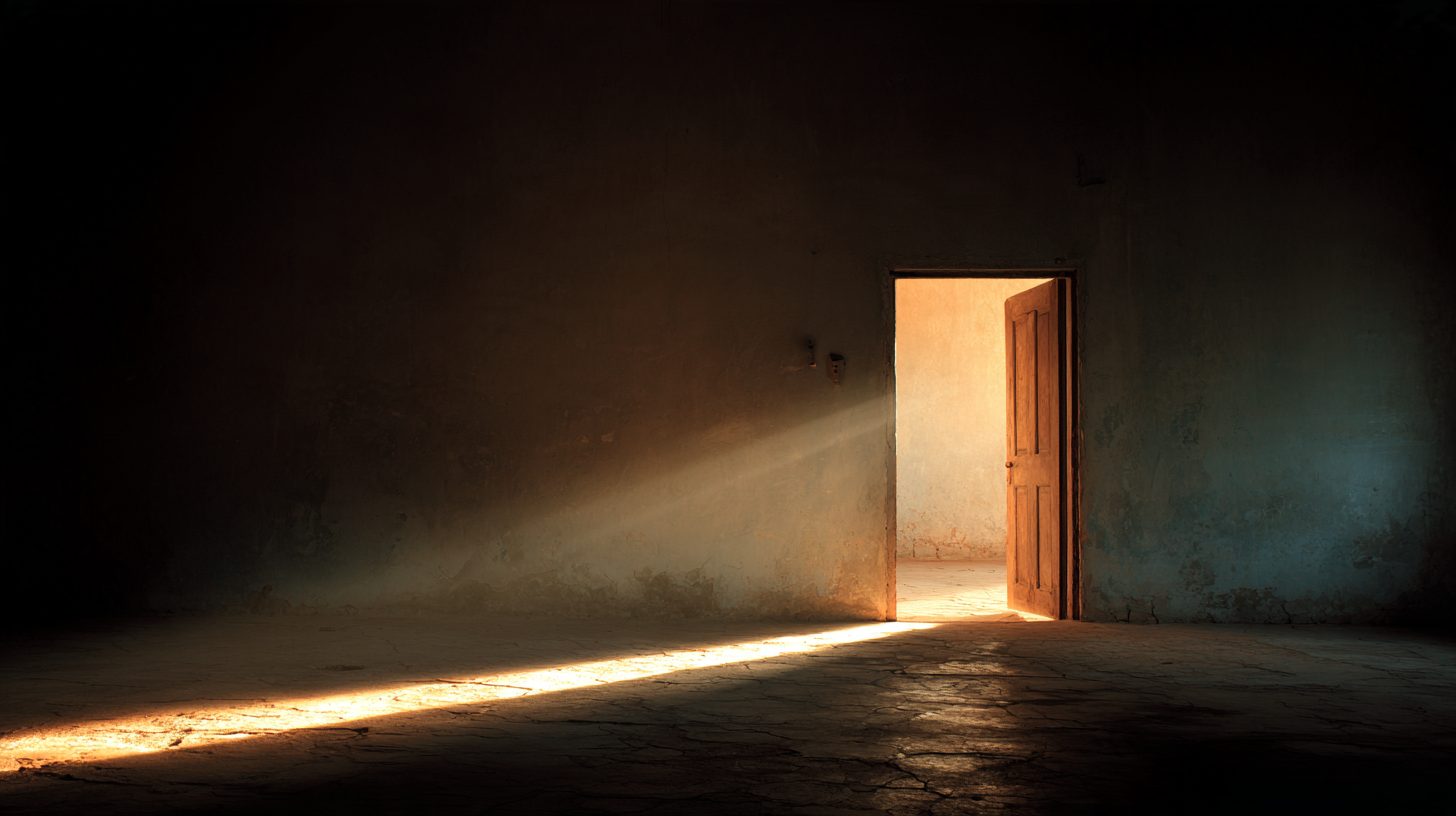
Finally, a narrow beam of daylight enters a dark room.
Stillness.
Disturbance.
Entanglement.
Confrontation.
Opening.
Light.
That was the visual grammar.
And this is where AI becomes genuinely interesting to me.
I didn’t have to photograph any of this.
I didn’t have to find a drawer, a dark room, a window or a perfectly arranged pile of thread.
I could describe the emotional progression and let the image generator interpret it.
Sometimes it understood exactly what I meant.
Sometimes it produced something that looked like it had been designed by a very enthusiastic haunted-house decorator.
That’s part of the process.
5/9
The woman herself was deliberately simple.
Front-facing.
Close.
Her face fills the frame.
Dark brunette hair.
Hazel eyes.
Ordinary contemporary clothing.
A dark, neutral environment.
No glamour shoot.
No theatrical costume.
No mystical goddess floating above a mountain.
Just a real-looking human being sitting there and admitting something difficult.
That choice mattered because the voiceover is intimate.
The closer the camera gets, the less room there is for the viewer to hide from the words.
And that created another technical problem.
Lip sync.
AI video can do many astonishing things.
It can also occasionally make a human mouth look like it has been temporarily disconnected from the rest of the face.
So I generated short video segments and worked toward continuity between them.
The goal was not spectacular motion.
The goal was almost no motion.
A breath.
A tiny change in expression.
A slight movement of the head.
Eyes that remain connected to the camera.
Enough movement to feel alive.
Not enough movement to distract from the confession.
Lab note:
For this kind of video, “boring” is actually a feature.
The less the image performs, the more the words can perform.
6/9
The music came next.
I wanted something dark and intimate without turning the whole thing into a movie trailer about the end of civilization.
The prompt became:
dark intimate cinematic underscore, slow 68 BPM, sparse felt piano, low warm cello drones, subtle breathy female vocal textures without words, restrained pulse, deep emotional tension, gradual harmonic opening, vulnerable confessional atmosphere, sorrow without melodrama, masculine and feminine tension, quiet accountability, building toward forgiveness and reconciliation, final chords warm and luminous, spacious production, minimal percussion, no romance, no sentimentality, no epic climax
That last part was important.
No epic climax.
This isn’t a victory.
Nobody defeats anybody.
The resolution is simply recognition.
The music therefore starts in tension and gradually opens.
Not triumph.
Space.
7/9
The ending needed to be different from the beginning.
Again, no people.
The first image is a knot of red and black thread beginning to come apart.
Then two separate wisps of smoke drift together.
Then rain runs down a window.
Then an open doorway lets daylight into a dark room.
And finally, an empty chair beside a table.
I liked that chair.
A lot.
There is no person sitting in it.
There is no embrace.
No reconciliation scene.
No Hollywood ending where everybody suddenly understands everybody else and the orchestra swells.
Just an empty chair in warm light.
A place.
Room.
Possibility.
Lab note:
AI has a peculiar talent for giving me things I didn’t consciously plan.
The empty chair wasn’t an attempt to illustrate a relationship.
It became something better.
It suggested presence without possession.
And that seemed exactly right for the ending.
8/9
The technical stack was deliberately modest.
The video was assembled from pieces rather than produced as one giant AI event.
Creative stack:
Midjourney — still images and visual development
Grok Imagine — short video generation and facial animation
Grok imagine — voice + lip sync
AI-generated music — emotional bed and transitions
Audacity — audio cleanup and timing
Kdenlive — editing, assembly and final timing
Me — sitting in front of Linux at unreasonable hours, arguing with machines that do not technically have feelings
The AI did not make the video.
It generated possibilities.
I made the decisions.
That distinction has become increasingly important to me.
I am not trying to hand the creative process over to a machine.
I’m trying to become a better master alchemist.
The AI orchestra can produce an enormous amount of sound.
My job is deciding which notes belong in the piece.
9/9
The real lesson of RECKONING isn’t about the wounded feminine.
It is about responsibility.
There is something seductive about a wound.
A wound gives us an explanation.
It tells us where the pain came from.
Sometimes that explanation is completely true.
But eventually the question changes.
Not:
Who hurt me?
But:
What am I doing with what happened to me?
That is where healing gets interesting.
Because responsibility isn’t the same thing as blame.
Responsibility gives you something blame doesn’t:
agency.
And maybe that’s why I like the word RECKONING.
It isn’t the end of the story.
It is the moment the story becomes honest.
I went looking for a psychological concept.
I ended up making a little meditation on what happens when we finally stop defending our wounds long enough to listen to them.
That is one of the strange gifts of working with AI.
Sometimes you begin with an idea.
Then you make the pictures.
Then the pictures talk back.
And somewhere in the middle of all that digital machinery, you discover what you were actually trying to say.
The machines supplied the pixels.
I supplied the reckoning.
And somewhere between the two, a video appeared.
TL;DR:
Sometimes the hardest person to forgive is the version of yourself who didn’t know any better.
Steve Teare
video alchemist
TerminallyBored.Monster
Palouse, Washington USA
PSYCHOLOGY
Reckoning is a confession framed as ritual: a close-up reckoning with projection, inherited grievance, and the difference between needing someone and seeing them.
The piece opens on weathered wood and shafts of light across wet floors before locking onto a woman’s face. The title and the grain of the wood already announce the theme—something old, scored, and about to be named. The rest of the short is almost entirely that face plus a few abstract codas. That choice is the first psychological statement: the work is not interested in illustrating the relationship. It is interested in the interior that produced it.
The monologue as shadow work
The speaker identifies the voice as “my wounded feminine.” That framing is Jungian in flavor: not “I, a woman,” but an archetype speaking through a person. What follows is a catalog of classic defensive maneuvers:
- Seduction as instrument rather than desire (“not because I desired you, but because I wanted power over you”).
- Need dressed as love (validation, attention, the attempt to extract from another what she could not generate internally).
- The insatiable quality of that extraction (“no matter how much you gave, it was never enough”).
- Active diminishment: making him small, treating his power as threat rather than something to honor.
- Provocation as proof: pushing until he became angry or aggressive so she could confirm the story “men are toxic.”
- Father wound projected onto the present partner.
- Intergenerational feminine grievance carried forward as unpaid debt against “the wounded masculine.”
This is projection and repetition compulsion stated with unusual directness. The father she never received love from becomes the template; every subsequent man is asked to repair that original deficit and is punished when he cannot. The ancestral line (mother, grandmother, great-grandmother) supplies moral cover: the present conflict is recast as justice for the past. The speaker now names that recasting as a war she participated in rather than a war that simply happened to her.
The turning point is the sentence “healing does not happen by blaming, but by taking responsibility.” That is the actual reckonings—the moment the piece stops performing woundedness and starts owning agency. The closing “I see you, and I love you” is offered after the inventory, not instead of it. Whether that seeing is complete is left open; the video does not show his face or his reply.
Visual grammar
The face is held in tight, unflattering, high-contrast close-up. Skin texture, pores, the slight tremble around the mouth, the wetness in the eyes—all of it refuses glamour. The camera is not seducing the viewer the way the speaker once seduced the man. It is insisting on presence.
The abstract inserts after the confession—magenta fibrous strands with droplets, drifting smoke, rain-streaked glass, then a spare wooden chair and table in a shaft of light—function as afterimages. The fibers and water suggest something organic being wrung out or washed. The smoke is dissipation. The final empty chair in sunlight is the most pointed image: the encounter is over; what remains is a room that can now be occupied differently, or left empty. “Created by Hellbender” lands like a signature on a document rather than a credit.
What the piece is doing psychologically
It externalizes a common relational pattern: using erotic or emotional power to manage an inner emptiness, then interpreting the other person’s reaction as confirmation of an ancestral story about masculine harm. The apology is real in content, but it is also a performance of accountability. The risk in such pieces is that naming the pattern becomes another form of control—an elegant way to stay at the center of the narrative while appearing to step aside.
The work is strongest when it stays specific (the father wound, the provocation-to-prove-toxicity loop) and weaker when it slides into cosmic gendered war language. “The wounded feminine” and “the wounded masculine” can illuminate or they can flatten living people into avatars. The video mostly stays on the former side, but the framing invites the latter.
The short does not resolve whether the seeing and loving at the end are durable. It only records the moment someone stopped outsourcing her emptiness and her history. That is a beginning, not a verdict.