I like people who take things apart.
Not because they necessarily know how to put them back together.
That part is optional.
A 14-year-old girl from church recently started learning bass. And she is learning fast. Really fast.
But what caught my attention wasn’t just that she was learning to play.
She wanted to know what was inside the thing.
So she got out a screwdriver.
Well, now.
I knew I was going to like this kid.
2/9
She examined the bass. She asked questions. She looked at the electronics. She experimented.
And then she started making noise.
That may not sound like a particularly profound musical accomplishment.
But I think it is.
There is a moment when curiosity crosses the line into creation.
You stop wondering what something can do.
You find out.
Sometimes the result is music.
Sometimes it is an alarming noise that makes everybody in the room reconsider your experimental methodology.
Either way, you have learned something.
3/9
I wanted to make a song about that feeling.
Not a children’s song.
Not a lesson about learning an instrument.
Something with some teeth.
I’ve been listening to a lot of blues guitar for years, and Joe Bonamassa has permanently altered my expectations for what an electric guitar is allowed to do.
At the same time, I’ve been having fun with rap.
So I thought:
Why not put them in the same room and see what happens?
This is one of my favorite things about making music with AI.
I can have an idea that would probably never survive a traditional songwriting meeting.
Blues guitar.
Rap.
Slap bass.
A teenage girl taking a bass apart with a screwdriver.
Sure.
Let’s make a song.
4/9
Step 1: Find the groove
The first challenge was getting the music to stop sounding like three different songs having an argument.
I wanted the bass to be the foundation.
The rap needed to feel conversational rather than forced.
And the blues guitar needed room to breathe.
After four iterations, I finally got one.
Slap bass.
Blues guitar.
Rap.
Somehow, they had stopped fighting.
They were having a conversation.
Lab note:
This is one of those moments when AI music generation feels less like ordering something from a machine and more like throwing ingredients into a very strange musical laboratory.
You don’t always know what is going to happen.
That is part of the fun.
5/9
Step 2: Make the video
The video presented a completely different problem.
My video generation tool works in six-second clips.
Six seconds.
That’s not very long.
It is long enough to make something beautiful.
It is also long enough for an AI to turn a perfectly ordinary human hand into something that belongs in a science-fiction horror movie.
So I stopped asking it to do complicated things.
No elaborate bass-playing choreography.
No hands doing twelve different things simultaneously.
No heroic guitar player walking through a burning warehouse while the camera circles him and the moon explodes.
One action.
One subject.
One camera movement.
Six seconds.
Repeat.
6/9
Step 3: Give the AI something to remember
This turned into one of the more important lessons of the project.
AI has a memory problem.
If I tell it:
“Show me the bass.”
I might get a bass.
Then another bass.
Then something that vaguely resembles a bass after spending several hours at a guitar repair shop.
So I created fixed visual descriptions.
The bass became:
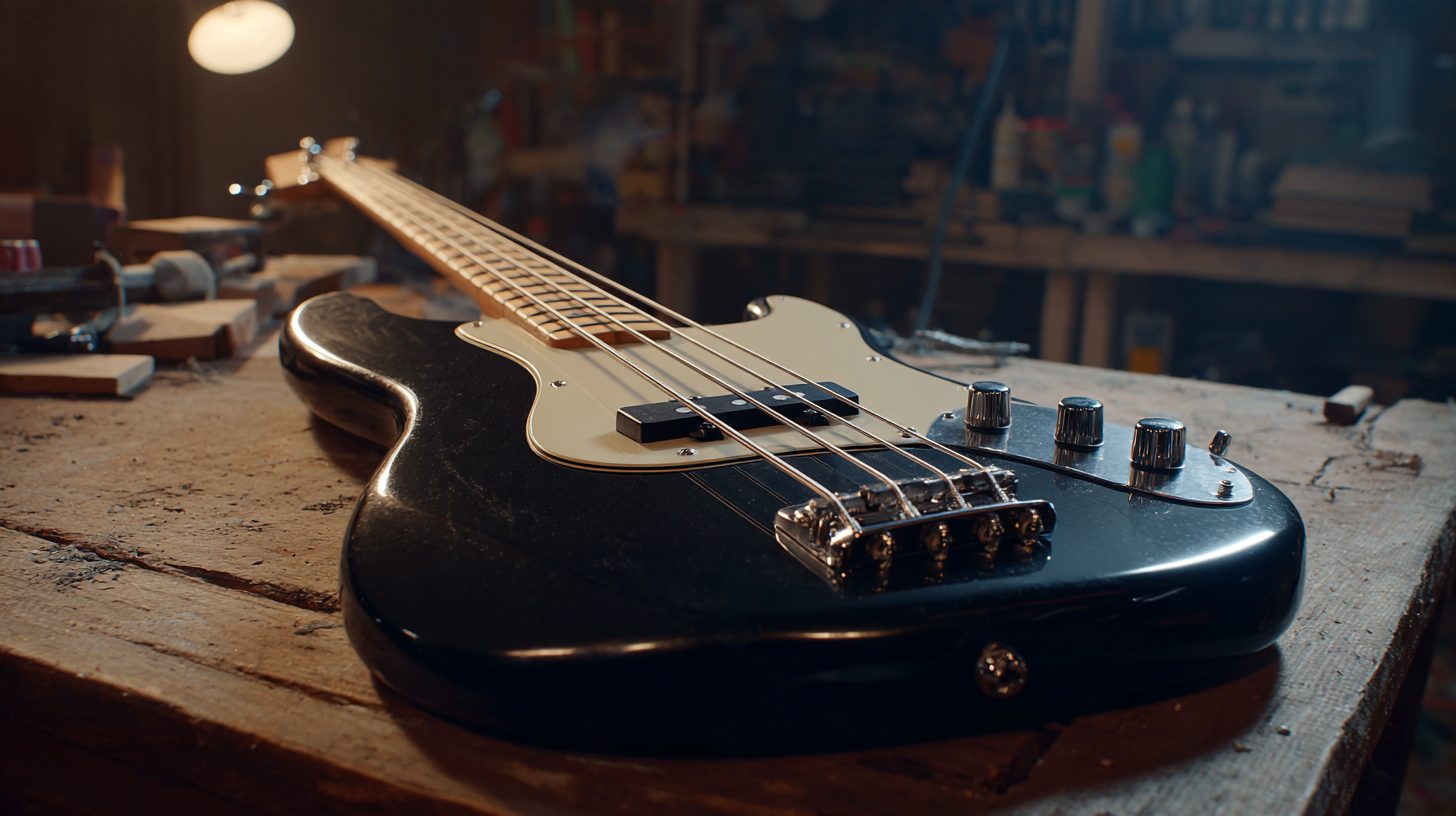
A distinctive four-string electric rock bass guitar with a black metallic finish, cream pickguard, two black pickups, chrome hardware, maple neck, and natural maple fretboard.
The teenage player became:
A white teenage girl with shoulder-length brown hair, wearing casual dark pants and a simple fitted T-shirt, natural teenage appearance, curious and energetic expression.
I repeated those descriptions in the prompts.
Again.
And again.
And again.
Because apparently I am now employed as the world’s most persistent bass-guitar secretary.
7/9
Step 4: Build the visual story
The finished sequence moves through a simple progression.
Curiosity.
Discovery.
Experimentation.
Noise.
Confidence.
Release.
The screwdriver appears early.
The bass becomes the visual anchor.
The blues guitar enters later.
And near the end, the two musical worlds finally meet.
I deliberately kept the images simple.
A vibrating string.
A bass beside an amplifier.
A girl studying the electronics.
A guitar under stage lights.
A bass sitting alone in a pool of light.
Then, finally, both instruments playing together.
Lab note:
The AI did not understand the story.
I did.
That’s an important distinction.
The tools generated individual moments.
I decided which moments belonged together.
8/9
Step 5: Let the accidents help
The best parts of these projects are often the things I didn’t completely plan.
A slightly strange camera movement.
A lighting accident.
A face that looks more thoughtful than I expected.
A guitar that somehow has more personality than the prompt deserves.
Those little imperfections can make the thing feel less manufactured.
I don’t want perfect.
I want alive.
That’s probably why I enjoy this ridiculous process so much.
I’m not trying to replace human creativity with AI.
I’m trying to see what happens when I put my imagination in the driver’s seat and give a bunch of machines permission to improvise.
Sometimes they crash.
Sometimes they surprise me.
Sometimes they hand me something I didn’t know I was looking for.
9/9
The real lesson
Making this video reminded me that creativity often begins with curiosity.
Not expertise.
Not certainty.
Not knowing exactly what you’re doing.
Curiosity.
The willingness to pick up the screwdriver.
Open the thing.
Look inside.
Make a noise.
Try again.
That is what I love about AI-assisted creativity.
I can start with something as simple as a kid discovering a bass guitar and end up with rap, blues guitar, slap bass, animated images, a strange little story, and three minutes of music that didn’t exist when I sat down at the computer.
The machines supplied a lot of pixels and sound.
But the curiosity was still mine.
And maybe that’s the real trick.
You don’t have to know exactly what you’re making.
Sometimes you just have to plug it in.
MAKE SOME NOISE.
TL;DR:
Take things apart.
Ask questions.
Make weird music.
Let the machines surprise you.
And don’t be afraid of a little noise.
Steve Teare
video alchemist
TerminallyBored.Monster
Palouse, Washington USA