I thought I was making a song about neediness. Turns out, I was making a song about the courage it takes to need another human being.
There is a difference. A rather important one, as it happens.
NEEDY: when wanting to be loved feels like a character flaw
I recently started working on a video project built around a poem Tember sent me. The title is NEEDY. All caps. No coy little metaphor to soften the blow.
The poem begins:
“I’m lonely, but don’t hold me, I’m too much to bear
Just love me and tell me that you’ll try to be there”
Well. That’s a bit of a gut punch, isn’t it?
I recognized the contradiction immediately. Wanting somebody close, but being afraid that asking for closeness will drive them away. Wanting reassurance, but feeling embarrassed that you need reassurance in the first place.
And then there is the internal commentary. The part that tells you to stop being weak, get over yourself, fight harder, and quit making such a fuss.
As if loneliness were a character defect that could be corrected with a stern talking-to.
I have some experience with that particular management strategy. The results have been mixed. Mostly mixed.
So I decided to turn Water Bear’s poem into a song and build a video around it. Naturally, this involved recruiting a collection of artificial intelligence tools and attempting to persuade them to understand human emotional nuance. What could possibly go wrong?
1. Finding the emotional center
The first job was to identify what the song was actually about.
On the surface, NEEDY is about loneliness. But loneliness alone didn’t seem sufficient. Plenty of songs explore loneliness. I wanted to get at the peculiar shame that can accompany it.
The speaker doesn’t merely want somebody to stay. She is worried that her need to have somebody stay will make her less lovable.
That’s a different problem.
There is a voice inside her insisting that she shouldn’t need so much. That she should be stronger. That she ought to be able to manage her feelings without asking anybody else for help.
And yet the poem keeps reaching outward.
“Don’t want to scare you away
But just hold tight and take my hand
Tomorrow is a new day”
There it is. The heart of the project.
The speaker isn’t asking for a perfect solution. She isn’t asking somebody to repair her entire life. She wants a little reassurance, a hand to hold, and enough connection to get through a difficult day.
Tomorrow might be better. Right now, though, she needs somebody to stay.
Lab note: One of the things I enjoy about making videos is discovering that the apparent subject of a project isn’t always its deepest subject. You begin with loneliness and discover shame. You begin with shame and discover the longing to be accepted. Keep digging, and sometimes you find something surprisingly universal hiding in one person’s very specific words.
That’s the spelunking part of my creative process. I never know quite what I’m going to find in the cave.
2. Turning a poem into a song
I wanted the music to sound intimate and vulnerable, not theatrical.
The poem didn’t need a giant orchestral production announcing that something emotionally significant was happening. It needed room to breathe.
I explored an atmospheric alternative-pop direction, with a delicate piano motif, ambient synthesizers, clean electric guitar, a warm bass line, and restrained percussion. I imagined a female lead vocal that felt conversational and emotionally exposed rather than polished into oblivion.
The working musical direction was approximately 80 beats per minute in A minor.
The arrangement needed to move gradually. Close and fragile in the verses. More expansive in the choruses. A bridge that strips things back to voice and sparse piano. Then a final chorus that opens into something warmer without suddenly pretending that every problem has been solved.
That last part mattered to me.
I didn’t want a triumphant ending in which the speaker emerges from the emotional equivalent of a thunderstorm wearing a sash that says I’M HEALED.
Sometimes hope is quieter than that.
Sometimes hope is simply the possibility that tomorrow won’t hurt quite so much.
Lab note: Emotional honesty often depends on resisting the temptation to make the ending bigger than the experience. A song can offer hope without promising a cure. In fact, I think that kind of hope can be more convincing.
3. Why I chose black-and-white film noir
Once the musical direction began to take shape, I turned to the visual world.
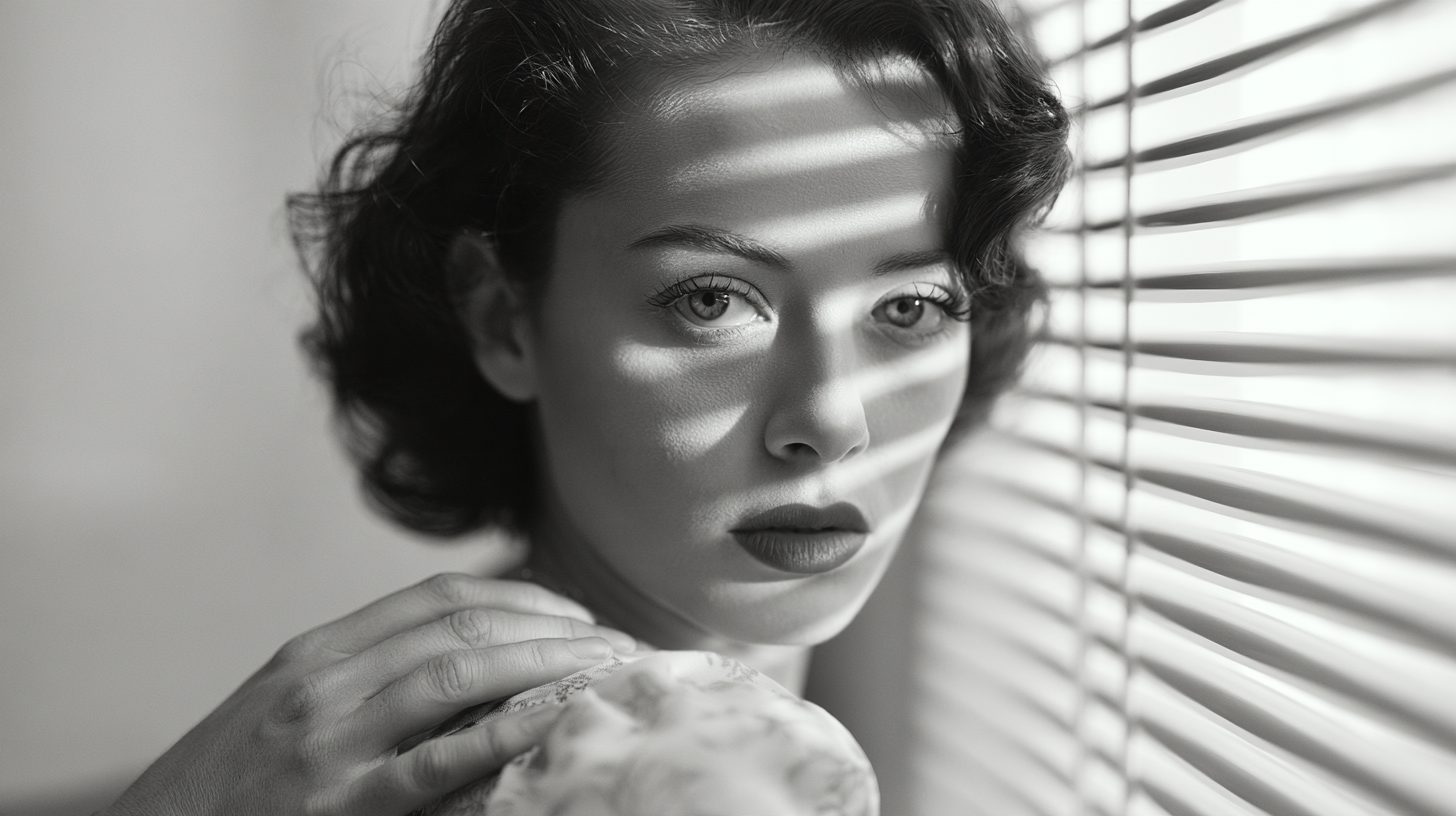
I chose a black-and-white, 1940s film-noir aesthetic.
The decision wasn’t just about making something look stylish. Although, let’s be honest, dramatic lighting and Venetian-blind shadows are difficult for a video alchemist to resist.
Noir gives loneliness a physical environment.
A woman sits alone in a dim room. Rain slides down a window. The city outside is full of people, but none of them seem to be available to her. Shadows cut across her face. An empty chair becomes a reminder of somebody who isn’t there.
The visual language can express an internal state without explaining it.
Black and white also removes the distraction of color. Faces, gestures, light, darkness, and composition have to do more of the emotional work.
I wanted the woman to inhabit a world that looked as though it had been waiting for her sadness long before she arrived.
And I wanted that world to change as the song progressed.
Not by suddenly becoming cheerful. By allowing a little more light into the frame.
4. Building the story one image at a time
For this project, I planned 30 individual Midjourney shots.
Thirty is enough to create a visual progression, but not enough to illustrate every line of a song literally. I had to think in terms of emotional beats rather than simply matching an image to a lyric.
The visual arc moves through several stages.
First comes isolation. The woman is alone with her thoughts, surrounded by the visual language of confinement: dark rooms, rain, windows, hard shadows, and empty space.
Then comes the internal struggle. Her loneliness is complicated by self-judgment. She wants connection, but another part of her seems determined to convince her that wanting it is dangerous.
Next comes the possibility of human contact. A reaching hand. A compassionate presence. The possibility that somebody might remain beside her without demanding that she become a different person first.
Finally, the images begin to make room for morning.
Not a magical transformation. Not a declaration that the struggle is over. Just a little more light, a little more space, and the possibility of another day.
That progression gave me a visual narrative to work with even before the individual shots were generated.
The challenge was getting Midjourney to produce images that belonged to the same imagined film.
I used a shared style reference and seed settings across the prompts. Each prompt also needed to describe its subject and composition independently. Midjourney doesn’t reliably remember a character simply because I used her in the previous prompt. Every image is its own little negotiation.
Which is one of those things that sounds simple until you actually try it.
A style reference can help unify the look, but it doesn’t guarantee identical faces, clothing, or lighting. The prompts have to carry much of the continuity themselves.
Lab note: AI image generation is less like directing an experienced cinematographer and more like working with a gifted artist who has amnesia. You can explain the scene beautifully. You can establish the visual language. Then, on the next shot, your collaborator may decide that the woman has a different face and the room has moved to another continent.
You learn to plan for that. And occasionally you learn to embrace the happy accident.
5. The difference between illustrating lyrics and telling a story
One trap in music-video production is literalism.
If the lyric mentions a hand, show a hand. If it mentions tomorrow, show a sunrise. If it mentions loneliness, put somebody in a room looking sad.
There is nothing inherently wrong with any of those choices. But string enough literal illustrations together and you can end up with a slideshow rather than a story.
I wanted the images to add something to the song.
The woman doesn’t have to be visibly crying in every frame. Sometimes loneliness is an empty space beside her. Sometimes it’s the way she sits in a chair, or how much distance separates her from the light coming through a window.
And when the possibility of connection arrives, the image doesn’t need to announce, “Here is the emotional breakthrough!”
A small gesture can carry more weight than a dramatic one.
The point isn’t to show the audience what to feel. It’s to create a space in which they can recognize something they have felt themselves.
That distinction is important to me. I’m not trying to manufacture an emotional response. I’m trying to make something emotionally recognizable.
6. The tools in my little laboratory
The production process brings several tools together, each with a different job.
Midjourney: Generating the black-and-white noir imagery and exploring compositions, lighting, and emotional expression.
Google Flow Music AI music generation: Developing the musical treatment, vocal character, atmosphere, and arrangement around the poem.
ElevenLabs: Available for narration when a spoken introduction helps establish the emotional premise before the song begins.
Kdenlive: The final assembly room. This is where the individual shots, music, narration, pacing, and transitions become an actual video.
Audacity: Useful for manipulating audio and preparing sound elements when needed.
The important distinction is that the tools don’t make the creative decisions for me. They provide possibilities. I decide which possibilities serve the project, which ones need another attempt, and which ones are technically impressive but emotionally useless.
That last category is surprisingly well populated.
As for the budget, I try to be sensible about what I spend. AI subscriptions and generation limits can make experimentation expensive if you treat every possible variation as a reason to click the button again. I don’t have a useful project-specific total to report here, so I won’t invent one. But it was under $5.
The real investment is attention. Every image needs to earn its place, and every revision should solve a problem rather than merely satisfy the urge to keep tinkering.
I say this as someone who can tinker for hours.
7. Introducing the song with a voice
I also wanted a short male-narrated introduction before the music begins.
The introduction needed to prepare the listener for the central contradiction without explaining the entire song in advance.
The idea was simple: sometimes loneliness sounds like a contradiction. We want someone to stay, but we’re afraid our need will drive them away.
Then the title.
NEEDY.
The word is deliberately uncomfortable. It is the kind of label people use against themselves when they want more comfort or attention than they believe they’re entitled to ask for.
But I wanted the video to question that label.
What if the need itself isn’t the problem? What if the shame surrounding it is what makes the experience so painful?
There is a difference between demanding that another person take responsibility for every feeling we have and admitting that we need connection. Human beings aren’t designed to live entirely inside their own heads, despite the occasional evidence that we keep trying.
The song doesn’t need to settle every question about relationships, boundaries, or emotional responsibility. It only needs to make room for a gentler possibility.
Needing someone doesn’t automatically make you a burden.
8. What this project reminded me about AI creativity
The most interesting part of this process isn’t that AI can generate a convincing noir image. We already know it can produce remarkable pictures.
The interesting part is what happens when I give those pictures a human problem to explore.
A rainy window is just a rainy window until it becomes part of a story about somebody who wants to reach out but is afraid to do so.
A hand extended across a dark room is just a composition until the viewer understands what it costs the person on the other side to accept it.
The technology supplies the raw material. The meaning emerges through selection, sequence, contrast, timing, and context.
That is where I spend my time as the video alchemist. I’m not simply asking an image generator to make something beautiful. I’m trying to orchestrate a series of images that, together with the music, tell the truth about an experience.
And sometimes the process tells me something I didn’t expect to learn.
NEEDY reminded me that we can be remarkably unkind to ourselves for having ordinary human needs. We may treat our longing for reassurance as evidence that something is wrong with us, when it may simply be evidence that we are having a difficult time and could use a little company.
There are certainly times when our needs become overwhelming for other people. Relationships need boundaries, and no one person can meet every need. But that doesn’t mean the need for connection is shameful.
We can learn to ask without demanding. We can give another person room to say no without deciding that their answer proves we are unlovable.
And we can offer ourselves a little patience while we learn the difference.
Lab note: Sometimes a creative project is a way of making an idea visible enough to examine. I start with a poem, build a song around it, assemble images, and discover that the thing I’ve been constructing is also a question I want to sit with.
That is one of the reasons I keep doing this.
Watch the video
NEEDY is a song about the fear that wanting to be loved might make us too difficult to love.
It’s also about the small, stubborn hope that someone might take our hand anyway.
And if tomorrow really is a new day, perhaps we don’t have to solve everything tonight.
Perhaps we can begin with that.
The video alchemist’s moral: You don’t have to stop needing love before you become worthy of receiving it.
Steve Teare
video alchemist
TerminallyBored.Monster
Palouse, Washington USA