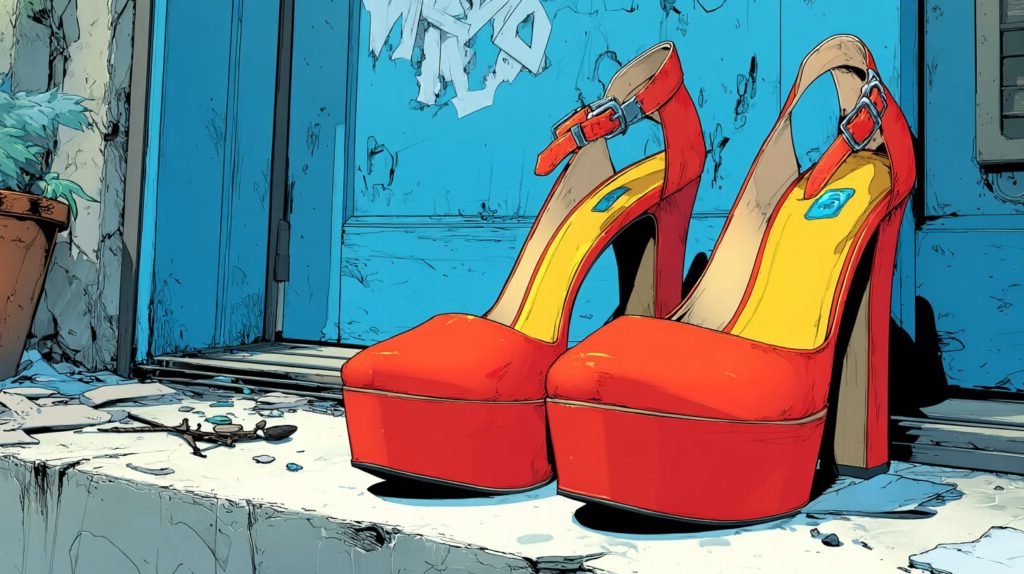
I was deep into another late-night session, staring at yet another batch of Midjourney generations, when I finally laughed out loud.
Lissette was supposed to have elegant red 4-inch stilettos with delicate ankle straps. Instead, she kept showing up in chunkier platforms. Her pleated skirt kept changing length randomly. The gold ball earrings I wanted turned into hoops no matter how hard I fought them.
At some point I realized I wasn’t directing the project anymore.
I was negotiating with it.
And the machine was winning most of the arguments.
Lab note: Sometimes the fastest way forward isn’t winning the fight. It’s choosing which battles actually matter.
The Long List of Compromises
It started small and snowballed.
I wanted a sophisticated, slightly dangerous detective in classic neo-noir photorealism. The AI gave me beautiful but inconsistent images that created jarring discontinuities in both stills and video.
I tried painterly styles — soft brushes, cinematic lighting, moody shadows. They were unpredictable in both stills and motion.
Then I landed on a comic book / graphic novel style using a specific –sref parameter: –sref 1738164590 –sv 4.
Suddenly things started moving. Lip sync worked better. Grok conversions behaved. The character generation became more forgiving. Faster. Less fallout.
What is –sref?
In simple terms, –sref is Midjourney’s “style reference” parameter. It lets you point at an existing image (or a numeric code) and say: “Make everything look like this in terms of color, texture, lighting, and overall aesthetic — but don’t copy the actual content.” It became our anchor for visual consistency.
But the compromises kept coming.
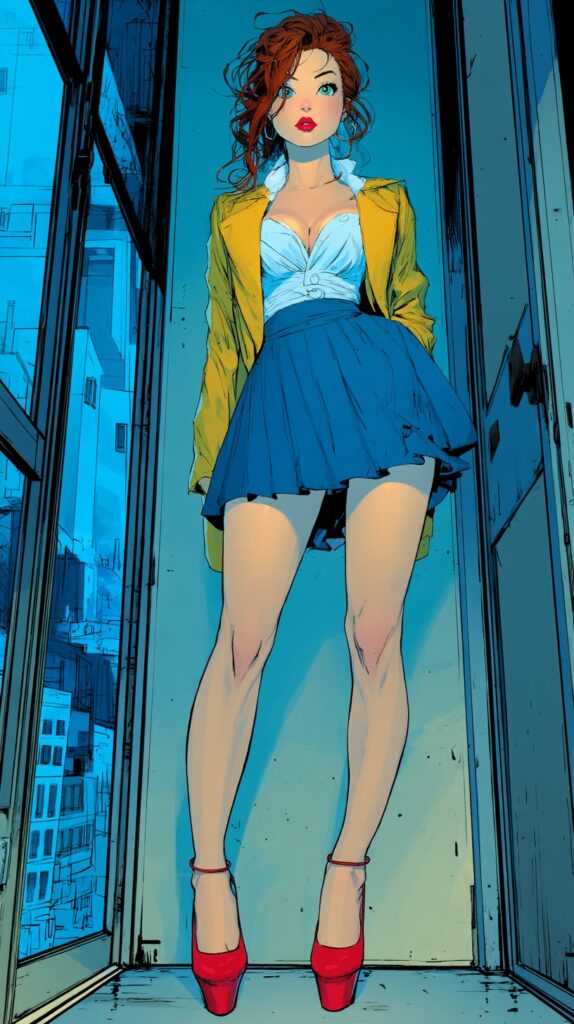
The skirt length? The AI refused to settle on a consistent length. It would randomly produce long skirts, mid-calf, or short versions unless I explicitly forced a miniskirt. After dozens of attempts, I got the pleats the way I wanted through repeated prompting and strong negatives. It wasn’t elegant, but it worked.
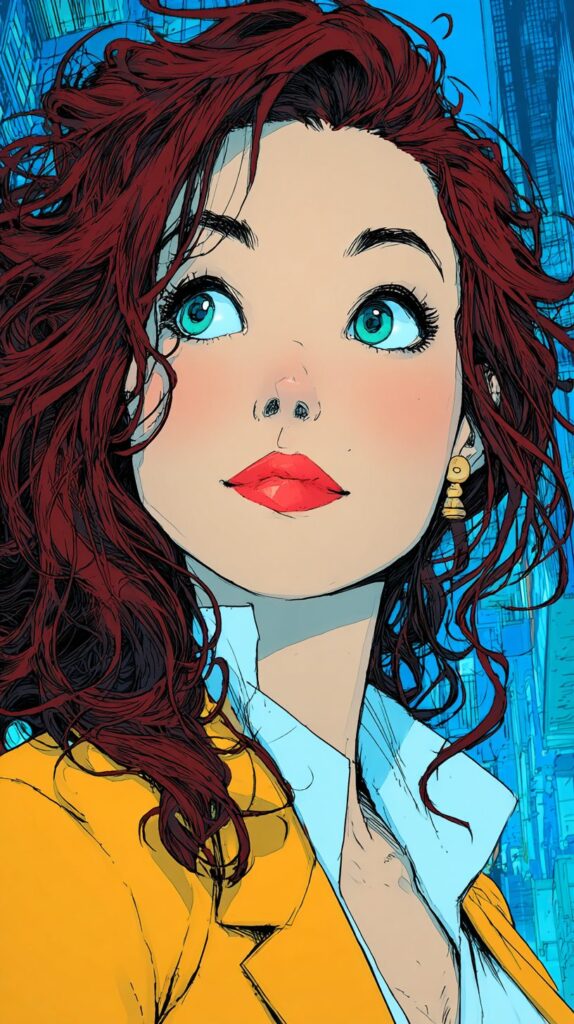
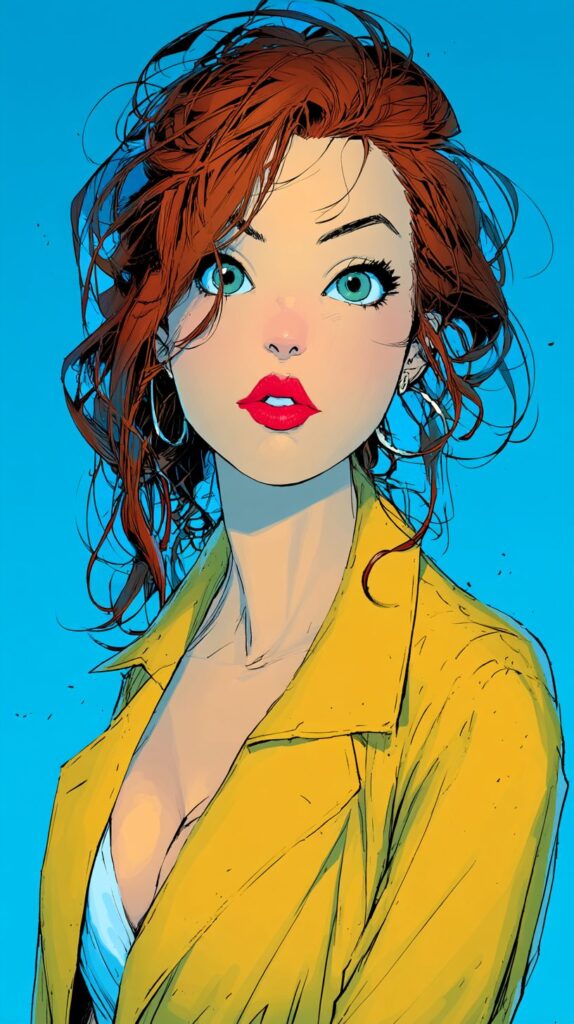
The earrings? Gold ball dangles turned into hoops every single time. Eventually I stopped fighting and embraced the hoops. They look good. They read clearly.
The red shoes? I wanted delicate ankle-strap stilettos. The model kept giving me chunkier platforms. I adapted. They were sexier anyway.
The overall look? I let go of photorealism entirely. The comic book style is more forgiving, more dynamic, and actually works when I ask the pixels to move and speak.
Lab note: The machine doesn’t care about your artistic purity. It cares about patterns. When you stop forcing it to do what it’s bad at, it suddenly becomes very good at what it can do.
What the Medium Forced Us to Do
Every limitation became a creative decision.
I fought for the pleated skirt and eventually got it working through persistent prompting.
I accepted the gold hoops because they pop in close-ups and stay consistent across clips.
I changed the red shoes to a style the AI could render reliably. They were sexier anyway.
I embraced the comic book aesthetic because it was reductive.
Reduction distills complex information into its most essential components, removing unnecessary elements to improve clarity, impact, and user engagement. By focusing on a “less is more” philosophy, designers can enhance comprehension, foster faster decision-making, and create a stronger, more memorable visual identity.
Instead of a photorealistic noir detective story, we’re building something more graphic, more stylized, and — honestly — more suited to the vertical short-form medium we’re targeting.
The story is adapting to the process. And in doing so, it’s becoming something sharper and more interesting than my original vision.
I burned through roughly 450 images just to lock in these consistent elements for future episodes. It wasn’t about credits — we’re on Relaxed Mode in Midjourney — it was pure time consumption. An investment in the future.
Current Creative Stack
- Midjourney with –sref 1738164590 –sv 4 — primary style lock
- Grok Imagine — bulk image-to-video and motion
- WAN — precision shots and lip sync
- ElevenLabs — custom Lissette voice (sexy, calm, observant, slightly world-weary)
- Producer.ai — background music and lyrics
The Real Lesson
I thought I was telling a story through AI.
What I’m actually learning is how to tell a story with AI — by listening to what it does well and letting go of what it resists.
The earrings, the skirt, the shoes, the shift from photoreal to comic style — none of these were failures. They were the machine showing me the path of least resistance… and the path of greatest possibility.
Sometimes the best creative choice is knowing when to stop fighting and start dancing with the tool in front of you.
The work is breathing now. Not exactly the way I imagined at the start, but in a way that feels alive.
TL;DR: I wanted photorealistic noir with perfect shoes and delicate earrings. The AI kept giving me comic book energy, hoops, and simpler silhouettes instead. So I stopped fighting and started adapting. The project just got better for it.
— Steve Teare
video alchemist
TerminallyBored.Monster
Palouse, Washington