I created at a single still image of Ellie standing in the garden, rain just beginning to catch in her auburn hair. It looked beautiful. Elegant. Perfectly composed.
But it didn’t breathe.
That familiar itch hit me — the one that says “this is nice, but it’s dead.” So I did what any terminally bored creator does at 2 a.m.: I started feeding it into Grok Imagine’s image-to-video and asked it to make the stillness come alive, one micro-moment at a time.
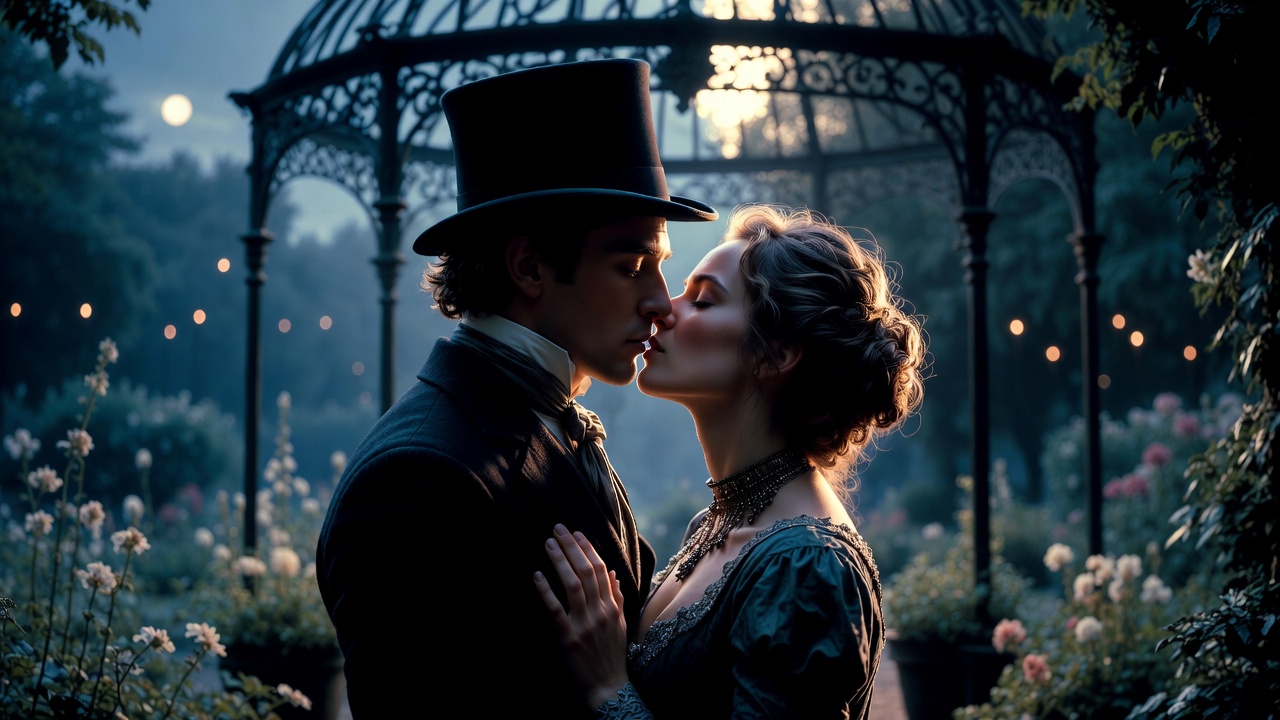
What began as a simple experiment with 1-minute “needle drop” audio clips has quietly turned into something kinda cool: Lace and Thunder — a slow-burn vertical short series set in a dark, overgrown Victorian rose garden where modern rock music collides with restrained, rain-soaked romance.
It started with an accident.
I uploaded a 60-second epic re-imagining of “Seven Nation Army” (just audio, no visuals) and forgot to take it down. The next morning it had 800 hundreds more views than usual. That tiny moment of serendipity made me wonder: what if I turned my seven needle drops into a connected story?
Not flashy superhero stuff. Not dystopian cyberpunk. Just quiet emotional presence. A strong-willed woman named Ellie. A thoughtful man named Julian. Rain on silk. Eyes that linger a second too long. The kind of romance that feels like it’s happening in real time, even though it’s built from stills and micro-motion.
Making Stillness Breathe
I approached this like a video alchemist, not a director with a big crew.
First, I created rock-solid character references for Ellie and Julian. Then I wrote detailed still prompts for each shot in the seven episodes. Once I had the stills, I converted them into video prompts designed for Grok Imagine’s image-to-video — keeping everything extremely restrained.
The video prompts are deliberately minimal:
- Locked composition, preserve original framing
- Begin in complete stillness
- Very subtle environmental movement (wind on fabric, rain on skin, petals drifting)
- Minimal physiological motion (soft breath, slight head tilt, gentle gaze shift)
- Low-frequency micro-events (a slow blink, a subtle flush, fingers almost touching)
- Extremely slow, almost imperceptible camera moves
No big gestures. No dramatic spins. Just life in the small fractions of a second.
Lab note: The real magic happened when I stopped trying to animate everything and started protecting the stillness. The less it moved, the more the pixels started to feel like a living person.
For the 5-second opening hook of each episode, Ellie delivers one quiet spoken line (“They can’t take this from me…”, “He sees me… really sees me.”, etc.) with soft lip-sync. Underneath, I’m laying in a feathered cello tonal effects — one sustained tone per episode, perfectly matched to the key of the main song track. It creates this beautiful, consistent sonic thread across the whole series.
The Creative Stack
- Character & Still Images: Midjourney (with heavy use of –cref for consistency)
- Image-to-Video: Grok Imagine image-to-video
- Editing: Kdenlive
- Voice: Planned lip-sync on the 5s hooks
- Music Beds: my tonal effects library
- Main Audio: My 7 re-imagined epic needle drops (Seven Nation Army through Whole Lotta Love)
- LALAL.AI: stems (vocal splits)
What I’m Learning
The biggest discovery so far is how much restraint matters.
When you give AI too much freedom to move, it often goes full soap-opera. But when you anchor it to a strong still and only allow tiny, staggered, unsynchronized micro-motions… something human emerges. The work starts to breathe on its own.
I’m also learning that consistency isn’t boring — it’s the soil good stories grow in. Locking Ellie’s face, her gown, the garden’s moody lighting, and even the sonic texture with cello tones is turning seven separate clips into something that feels like one continuous world.
Lab note: Happy accidents are still showing up. Some of the micro-motions Grok Imagine added were better than what I wrote. That’s the part I live for.
TL;DR
I’m building a quiet, rain-soaked Victorian romance series called Lace and Thunder using AI stills + image-to-video, micro-motion prompts, and cello tones. The goal isn’t spectacle. It’s presence. Making pixels feel like they have a pulse.
It’s early days, but I’m already addicted to the process.
What do you think — does “something wild is waking up” hit different when it’s whispered over a dark rose garden?
— Steve Teare
video alchemist
TerminallyBored.Monster
Palouse, Washington