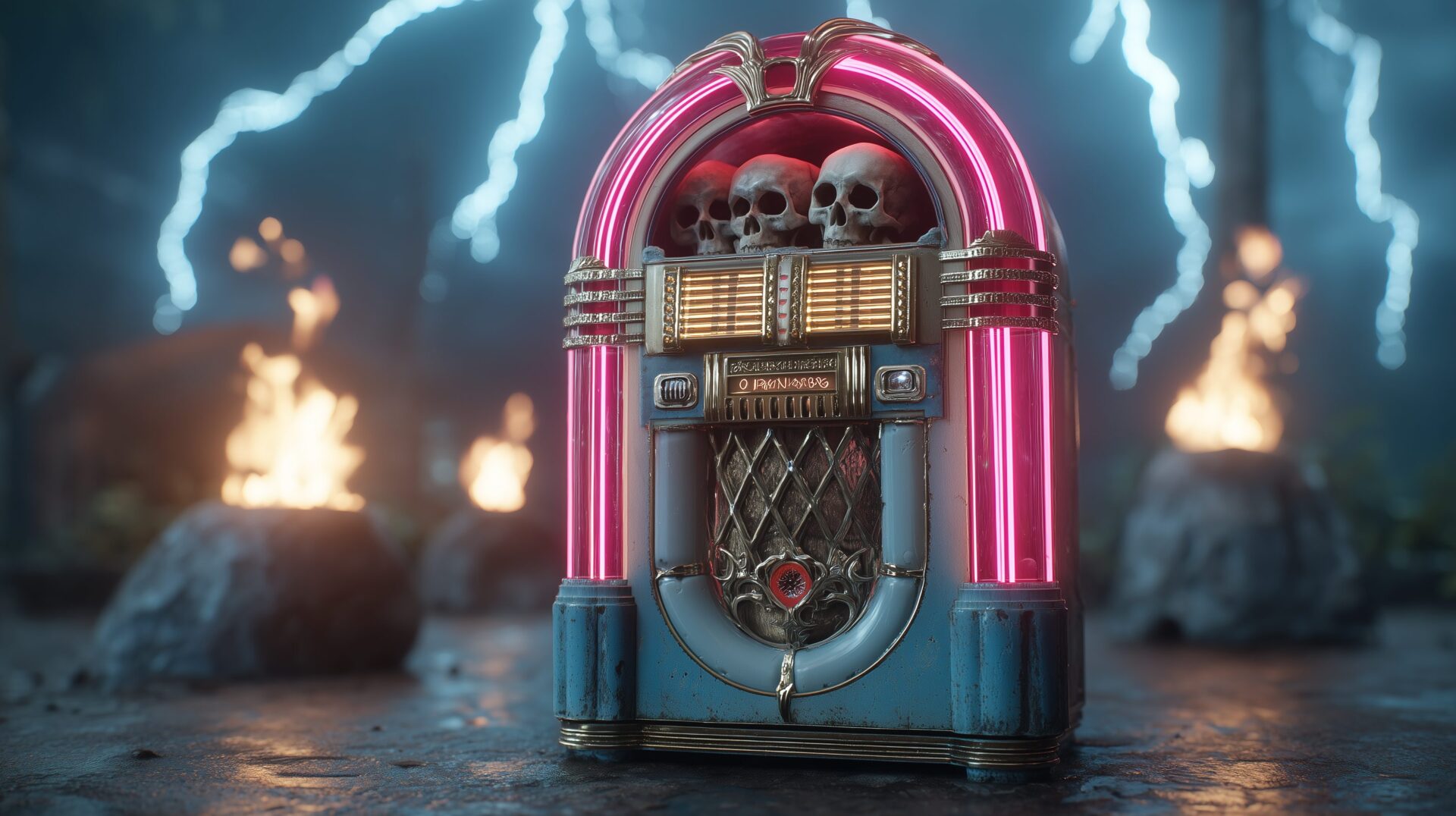
Last night felt less like “music production” and more like arguing with a haunted jukebox.
I would ask the AI for A Major.
It would smile politely and hand me D minor.
Again.
And again.
At one point I genuinely started wondering if the model had emotional baggage around major keys.
The weird part?
Sometimes the “wrong” answer sounded better than the correct one.
That’s where things got interesting.
2/9
The Setup
I’ve been experimenting with cinematic “needle drop” workflows using AI-generated instrumentals.
The idea is simple:
- Find a song whose lyrics fit the emotional moment in a film.
- Find a cover version with the right vocal energy.
- Split the stems:
- vocal
- instrumental
- Analyze the isolated vocal for:
- key
- tempo
- emotional texture
- Generate an entirely new cinematic instrumental underneath it.
Not a remix.
Not karaoke.
A re-imagining.
The goal is that strange little cinematic moment where the audience suddenly goes:
“…wait. I know this song.”
But now it feels dangerous.
Or lonely.
Or industrial.
Or emotionally radioactive.
3/9
The First Big Discovery:
AI Has “Key Gravity”
This was the first wall we slammed into repeatedly.
The model absolutely prefers certain keys depending on genre.
Examples:
- Blues prompts drifted toward E and A.
- Cinematic dark orchestral kept landing in D minor.
- Cyberpunk industrial almost always wanted E minor.
- “Grand uplifting” major-key prompts suddenly sounded like Disney princess montage music.
Lab note:
The AI doesn’t think in music theory.
It thinks in probability clouds.
When you say:
“dark cinematic orchestral”
…it isn’t hearing:
“please compose in A major.”
It’s hearing:
“what statistically resembles dark cinematic orchestral music?”
And apparently the answer is:
“minor keys forever.”
Which honestly explains a lot about modern trailers.
4/9
The Near-Miss Problem
The second discovery was even stranger.
The AI often landed close to the requested key…
but not actually there.
Examples:
- wanted Eb → got D
- wanted A → got G or B♭
- wanted C minor → got E minor
At first I thought the detector tools were broken.
Nope.
The AI really was drifting.
Lab note:
I suspect flat keys and less-common tonal centers simply have weaker representation in training data.
The model “rounds” toward familiar tonal neighborhoods.
Like a GPS that keeps insisting you probably meant Starbucks.
5/9
The Real Breakthrough:
Energy Matters More Than Harmony
This changed everything.
We stopped obsessing over key accuracy and started focusing on pulse, aggression, and emotional movement first.
That’s when things suddenly began working.
One experiment generated this:
Cyberpunk industrial cinematic
aggressive distorted synth bass
heavy rhythmic electronic pulse
dark futuristic atmosphere
120 bpm
Requested key:
C minor
Actual result:
E minor
And honestly?
It sounded incredible.
Nasty.
Sharp.
Alive.
When we pitch-shifted it mathematically into C minor…
…it technically matched better.
But it lost some of its teeth.
That was the moment the light bulb went on.
6/9
Polytonality Is Not a Bug
This may have been the most important discovery of the entire session.
The “wrong-key” E minor instrumental underneath the C minor vocal sounded better than the corrected version.
Why?
Tension.
The harmonic clash created friction.
And friction created emotional electricity.
Suddenly the track felt:
- modern
- unstable
- cinematic
- expensive
Instead of “musically correct,” it felt emotionally dangerous.
And honestly?
Film scoring has been doing this forever.
The audience doesn’t sit there analyzing intervals.
They feel pressure.
Momentum.
Suspense.
Release.
Lab note:
I think AI music workflows accidentally reward producers who think emotionally instead of academically.
7/9
The Workflow That Finally Started Working
After several hours of chaos, accidental fairytale orchestras, key hallucinations, and weird DSP failures…
…we finally stumbled into something resembling a repeatable process.
Current SOP:
- Generate for energy first
Ignore exact keys initially.
Chase pulse and emotional force. - Use genre “gravity” strategically
If cyberpunk loves E minor…
let it cook there. - Compare the vocal afterward
Sometimes the mismatch sounds better. - Use DSP pitch shifting only when necessary
Mathematical shifts preserve groove better than generative edits. - Never shift the vocal if it already feels emotionally right
Preserve the human imperfections. - Build intro space manually
Let the instrumental breathe before vocals enter.
This one was huge.
The AI always wants to start EVERYTHING IMMEDIATELY.
Humans need anticipation.
Silence matters.
Breathing room matters.
The drop matters.
8/9
Tools & Creative Stack
For this experiment:
- Flow Music – AI music generation platform
- LALAL.AI – Stem separation tools
- tunebat.com – Key/BPM analysis
- Kdenlive – Offline mixing
- Human stubbornness
- Mild existential exhaustion
Lab note:
The AI was actually decent at sketching possibilities.
But the final emotional precision still required human judgment at every stage.
Especially mixing.
The AI mixes kept sounding mushy.
Like everything had been wrapped in wet velvet.
Usable for proof-of-concept.
Not final cinema-quality work.
Yet.
9/9
The Real Lesson
I went into this thinking the goal was harmonic perfection.
Now I’m not so sure.
What actually made the strongest moments work was:
- energy alignment
- emotional pulse
- tension
- restraint
- contrast
Sometimes the “wrong” key carried more truth than the mathematically correct one.
That feels important beyond music.
Maybe creativity isn’t always about removing friction.
Maybe sometimes the magic lives inside the unresolved tension itself.
TL;DR
AI music models appear to optimize for genre probability more than strict key accuracy.
So the current winning strategy seems to be:
Generate for emotional force first.
Fix technical details second.
And occasionally trust the beautiful accident more than the theory textbook.
Honestly?
That feels very human.
Steve Teare
video alchemist
TerminallyBored.Monster
Palouse, Washington USA