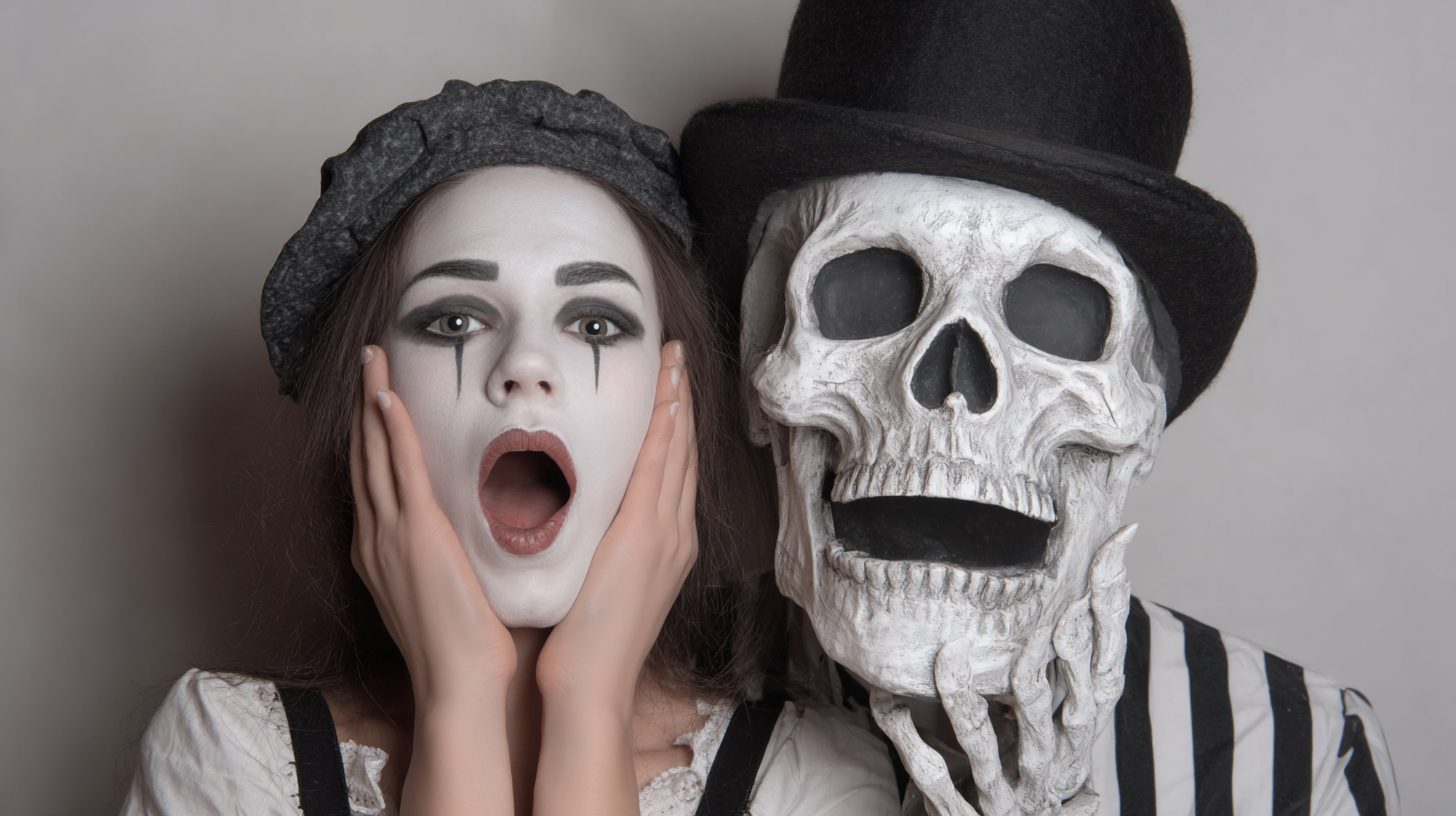
Which, honestly, sounds less like filmmaking and more like a nervous breakdown sponsored by Adobe.
This entire video started because I was listening to The Logical Song again late at night and suddenly realized the song wasn’t about education.
It was about formatting.
About how people slowly convert themselves into survivable social interfaces.
Not through violence. Through calibration.
Tiny corrections.
Tiny hesitations.
Tiny edits to emotional bandwidth.
And somehow this became a 90-second surreal film involving:
- a female mime
- an evil clown
- a skull-model woman
- and me trying to emotionally art-direct AI image generators at 3AM while muttering things like:
“NO. MORE EXISTENTIAL. LESS HOT TOPIC.”
Creative life is beautiful.
2/9
The original mistake
My first concept was way too abstract.
You know the kind:
- identity fragmentation
- symbolic perception systems
- recursive self-performance dynamics
- emotional stabilization architecture
Which sounds fascinating until you realize:
AI image generators do not care about your psychological taxonomy.
They want:
- wardrobe
- lighting
- lens choice
- physical space
- visual action
Lab note:
This happens constantly with AI filmmaking.
You think you’re directing meaning.
But meaning only emerges after you direct surfaces with enough consistency.
That changed the entire project.
Instead of making “concepts,” I started making physically photographable moments.
That was the breakthrough.
3/9
The three performance states
The film eventually stabilized around three recurring figures.
Not characters exactly.
More like emotional operating systems.
- The Female Mime
She became the embodiment of controlled invisibility.
Perfectly expressive.
Perfectly contained.
Completely ignored.
She presses against invisible walls because she lives inside emotional geometry nobody else acknowledges.
Honestly, she might be the saddest figure in the film.
- The Evil Clown
Not evil in the horror-movie sense.
More like:
performing emotional readability so aggressively that authenticity disappears underneath the noise.
His smile arrives before the emotion does.
That detail mattered enormously.
Lab note:
Tiny timing mismatches are psychological gold in AI-generated imagery.
The human brain notices micro-wrongness instantly.
- The Skull Model
This one surprised me.
She became the aestheticization of emotional contradiction.
Not hiding pain.
Not expressing pain.
Curating pain.
Making it beautiful enough to survive social perception.
Which feels painfully modern.
4/9
The real breakthrough
The biggest leap happened when I stopped treating the three figures as separate people.
Instead:
they became three adaptive reactions to being perceived.
That changed everything visually.
The mime reduces signal.
The clown amplifies signal.
The skull-candy woman edits signal into consumable form.
Suddenly the whole project locked together emotionally.
And weirdly…
the more specific the visuals became,
the more universal the emotional effect became.
That’s one of the strangest things about AI filmmaking right now.
Specificity creates emotional ambiguity better than abstraction does.
5/9
Building the image system
I ended up constructing the entire film around one consistent visual grammar:
Genre:
surreal cinematic drama grounded in realism
Color palette:
- muted earth tones
- washed institutional greens
- sodium-vapor yellows
- selective pastel accents
Lighting philosophy:
only practical light sources
- windows
- streetlights
- fluorescent fixtures
- vanity mirrors
No magical floating glows.
No random cyberpunk nonsense.
I wanted the world to feel emotionally wrong while still physically believable.
That distinction matters.
Tools used:
- Midjourney – still image generation
- ElevenLabs – voiceover
- Kdenlive – editing software
- LALAL.AI – stem separation
- ChatGPT – prompt generation
6/9
The narration problem
The voiceover was harder than the visuals.
My first draft sounded like a psychology lecture written by a malfunctioning philosopher.
Which is apparently my natural state.
The real challenge was:
how do you imply identity adaptation without explaining it directly?
The solution was compression.
Instead of naming the states, I reduced them into felt behaviors:
“Sometimes I would disappear a little.”
“Other times I would become too much.”
“And sometimes… I would make everything look right.”
That was enough.
The audience does the assembly internally.
Lab note:
Good narration doesn’t explain the image.
It creates pressure against the image.
7/9
The accidental emotional hit
There’s one shot I didn’t expect to affect me.
The final hallway shot.
No characters.
No performance.
Just the empty institutional hallway under flickering fluorescent lights.
That shot somehow became the emotional center of the film.
Because after 90 seconds of adaptive identity performance, the absence of performance suddenly feels enormous.
Not triumphant.
Not healed.
Just…
quiet.
I think that’s the emotional territory I’m most interested in lately.
Not transformation.
Suspension.
The moment before the nervous system decides who it needs to become.
8/9
What AI actually contributed
This is the part people still misunderstand.
AI did not “make the film.”
AI accelerated visual improvisation until hidden structure revealed itself.
That’s very different.
The emotional architecture still came from human pattern recognition.
Human memory.
Human discomfort.
Human longing.
But AI allowed me to iterate visually at the speed of intuition.
That changes storytelling profoundly.
You stop planning images.
You begin discovering them.
Happy accidents stop feeling accidental after a while.
They start feeling collaborative.
Which is either inspiring or deeply concerning.
Possibly both.
9/9
The real lesson
I started this project thinking it was about identity.
But somewhere during the iterations, it became about adjustment.
The thousand tiny calibrations people make to remain socially survivable.
That’s why the mime mattered.
Why the clown mattered.
Why the skull-candy woman mattered.
They weren’t villains.
They were adaptive technologies.
And honestly?
Most of us are switching between versions of ourselves all day long without even noticing.
Maybe creativity is one of the few places where the switching slows down long enough to actually see it happening.
Or maybe I just spent too much time directing emotionally exhausted clowns inside Midjourney.
Hard to say.
Steve Teare
video alchemist
TerminallyBored.Monster
Palouse, Washington USA