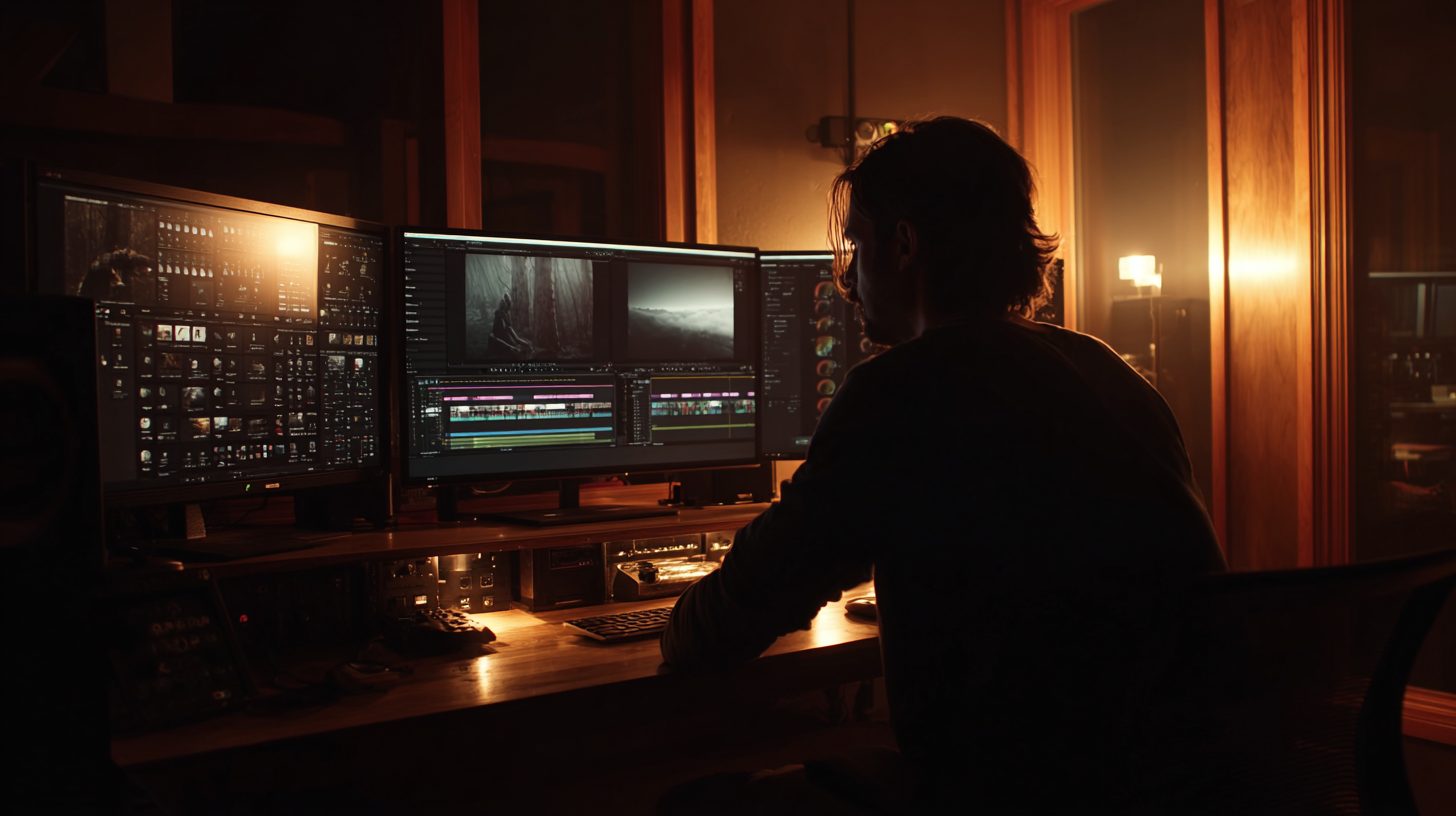
I sat in the quiet of my Palouse studio last night, watching another 3-minute vertical short take shape on the Kdenlive timeline.
The characters blinked, the rain fell naturally, and the needle-drop hit exactly when the emotion crested. For a moment it didn’t feel like code and pixels. It felt like breathing.
I’ve been chasing this feeling for months, making daily visual poetry and short atmospheric stories under The Ophelia Film Company banner. The Google Bot chat about Chinese AI micro-dramas lit a spark. Those billion-dollar 1-minute episode factories got me thinking: could I build something just as efficient, but with soul? Turns out the answer was yes, and the total cost per finished 3-minute episode landed at about three dollars and seventy-five cents.
Lab note: The real win wasn’t the low price. It was discovering how a few deliberate human choices could make the AI feel like a true collaborator instead of a blunt instrument.
The seed idea that started it all
I wanted vertical 9:16 shorts that could live on mobile, deliver emotional punches, and still carry my personal flavor — noir edges, relational presence, gothic atmosphere, and those sudden needle-drop lyric moments that turn a story into something bigger. Traditional production was impossible on my budget and schedule. So I reverse-engineered the micro-drama pipeline and adapted it to my Linux Mint workflow.
The result is a repeatable assembly line that moves from raw idea to finished export in a single focused session. Here’s exactly how it works.
Step 1: Story and shot list in ChatGPT
I start simple. I feed ChatGPT a basic premise and ask it to break the 3-minute piece into 6-second beats. Each beat gets a tight description focused on emotion, action, and framing.
I then run the shot list through a custom macro-instruction I built. The macro turns those shots into ready-to-use Midjourney prompts. It automatically adds character references, vertical 9:16 framing, and cinematic details. This single macro saves me hours of repetitive typing.
Step 2: Character consistency with Midjourney and Midbot
I generate the key reference images in Midjourney using Relax mode through the Midbot Chrome extension. This keeps costs extremely low.
The magic happens with two parameters I now use religiously:
- –cref [URL] –cw 100 for full wardrobe and setting lock when I need absolute character continuity.
- –cw 0 when I want the same face but allow natural variation in angle, clothing, or environment.
Lab note: Switching between these two on the fly was the single biggest leap in visual coherence. The characters now feel like real people instead of drifting clones.
Step 3: Bringing stills to life with Grok Imagine
This is where the alchemy happens. I feed the best Midjourney stills directly into Grok Imagine for 6-to-10 second video clips.
I keep prompting minimal on purpose. I let Grok’s internal vision engine do its thing. The key is preparing strong “impending action” stills in Midjourney — a hand mid-slam, rain already streaking down a window, eyes caught in a moment of realization. Grok picks up that latent energy and animates it beautifully.
I’ve tried more directive prompts and over-directed motion. They usually look worse. Trusting Grok’s autoregressive intuition produces far more natural micro-motions, blinks, breathing, and subtle head turns.
Step 4: Voice and emotional range with ElevenLabs
I write voice scripts and cut it into short 6-second clips. I generate the voiceover in Grok imagine (shes, “What are you doing?” Then I use the ElevenLab Voice Changer feature to lock in custom consistent character voices across the entire piece.
The emotional range here is ridiculous. A whisper, a breaking voice, a sudden shout — Grok and ElevenLabs handles all of it with convincing presence.
Step 5: Music, stems, and needle-drops
I generate the core soundtrack in Flow Music. I crop 1-minute of downloaded song lyrics in Audacity before running the chosen 1-minute section through LALAL.AI. I only pay for the short segment I actually need.
For the final lyrical 60 seconds, I often switch to a completely different singing character and aesthetic. This creates a music-video-style emotional release. I match tonal sound effects to the key of the music so the transition feels seamless rather than jarring.
Step 6: Assembly and polish in Kdenlive
Everything comes together in Kdenlive on Linux Mint.
Kinetic subtitles appear only when the Flow Music vocal enunciation needs help. Otherwise, I let the music and images carry it. A simple song title in the corner during the needle-drop gives the whole piece a polished, intentional feel.
My current creative stack
- Story & shot list: ChatGPT
- Character images: Midjourney (Relax mode via Midbot)
- Video clips: Grok Imagine (image-to-video)
- Voice: Grok imagine and ElevenLabs Voice Changer
- Music: Flow Music
- Stem isolation: Audacity + LALAL.AI (targeted 1-minute segments)
- Editing: Kdenlive on Linux Mint
Total variable cost per finished 3-minute episode: roughly $3.75 when I stay disciplined with re-rolls and only process the audio clips I actually use.
The real discoveries
The biggest lesson wasn’t technical. It was learning when to direct the AI and when to get out of its way. Grok Imagine rewards strong starting images and minimal prompting. Midjourney rewards smart use of –cw values. Kdenlive rewards small, repeatable habits like saved title templates.
I also learned that happy accidents still matter. A Grok-generated blink at exactly the right moment, an unexpected rain animation, or needle-drop music that somehow captured the exact mood I was chasing — these moments remind me that I’m not just operating software. I’m conducting an orchestra of models.
Lab note: The friction is still there. Character consistency can break. Grok sometimes interprets motion in surprising ways. But those imperfections often become the most human parts of the final piece.
TL;DR
A repeatable $3.75 pipeline for 3-minute vertical AI shorts: ChatGPT macro → Midjourney refs with smart –cw usage → Grok Imagine auto-motion and voice → ElevenLabs voice changer → Flow Music needle-drop → Kdenlive assembly on Linux Mint. The tech is powerful, but the human choices around trust, timing, and emotional framing make it sing.
I’m still iterating. Some nights the pipeline flows like water. Other nights I fight it for two hours and end up with something better than I planned. That tension feels exactly right for this stage of AI creativity.
Pixels don’t breathe. You do.
Steve Teare
video alchemist
TerminallyBored.Monster
Palouse, Washington USA