Sometimes a video starts with a story.
Sometimes it starts with a feeling you don’t quite know what to do with.
This one started with two songs that, when I put their vocal stems together, seemed to be having a conversation with each other. One voice was asking how you let someone walk away. The other was staring at the empty space afterward.
That was enough.
I called the video The Road Between Us.
And, as usual, I had absolutely no idea what I was doing when I started.
2/9
The strange thing about this project is that it wasn’t really about telling someone else how I feel.
It was about figuring out what to do with the feeling myself.
I’ve been thinking a lot lately about attachment, distance, waiting, and the peculiar human tendency to turn silence into an entire screenplay.
So I decided to make a piece of medicine.
Not medicine for anybody else.
For me.
The raw material came from vocal stems from “Waiting for a Girl Like You” and “Against All Odds.” I edited the vocals into a single narrative, rearranging and trimming them until they sounded less like two songs and more like one internal monologue.
The first version was over five minutes.
That was not going to work.
Nobody, including me, needed five minutes of Steve staring dramatically into the emotional abyss.
So I started cutting.
3/9
The editing became surprisingly revealing.
There were lines I couldn’t bring myself to remove because they were doing something psychologically important.
One particular line stayed:
“You’re the only one who really knew me at all.”
That one was not negotiable.
Another line became important for a completely different reason — the idea of someone making you feel alive.
That was the heart of the project.
Eventually I got the vocal down to 2:49.
Perfect.
Short enough to breathe.
Long enough to hurt a little.
Lab note: There is something useful about imposing a hard runtime on an emotional piece. Feelings want to sprawl. Editing makes them tell the truth.
4/9
Then I needed a story.
My first thought was a crossroads.
Two people meet. They travel together. Eventually their roads divide.
Simple.
Except that I have learned the hard way that “simple” and “easy for AI” are two completely different things.
I briefly considered magical threads connecting the characters.
Beautiful metaphor.
Terrible production idea.
Getting AI to consistently remember an invisible metaphysical thread while also remembering the characters, costumes, environment, lighting, geography, and emotional continuity seemed like an excellent way to spend the rest of my natural life.
So I simplified.
No magic threads.
No complicated mythology.
No queen.
No prophecy.
No ancient curse.
Just a man.
A woman.
A road.
And a reason they eventually have to go in different directions.
5/9
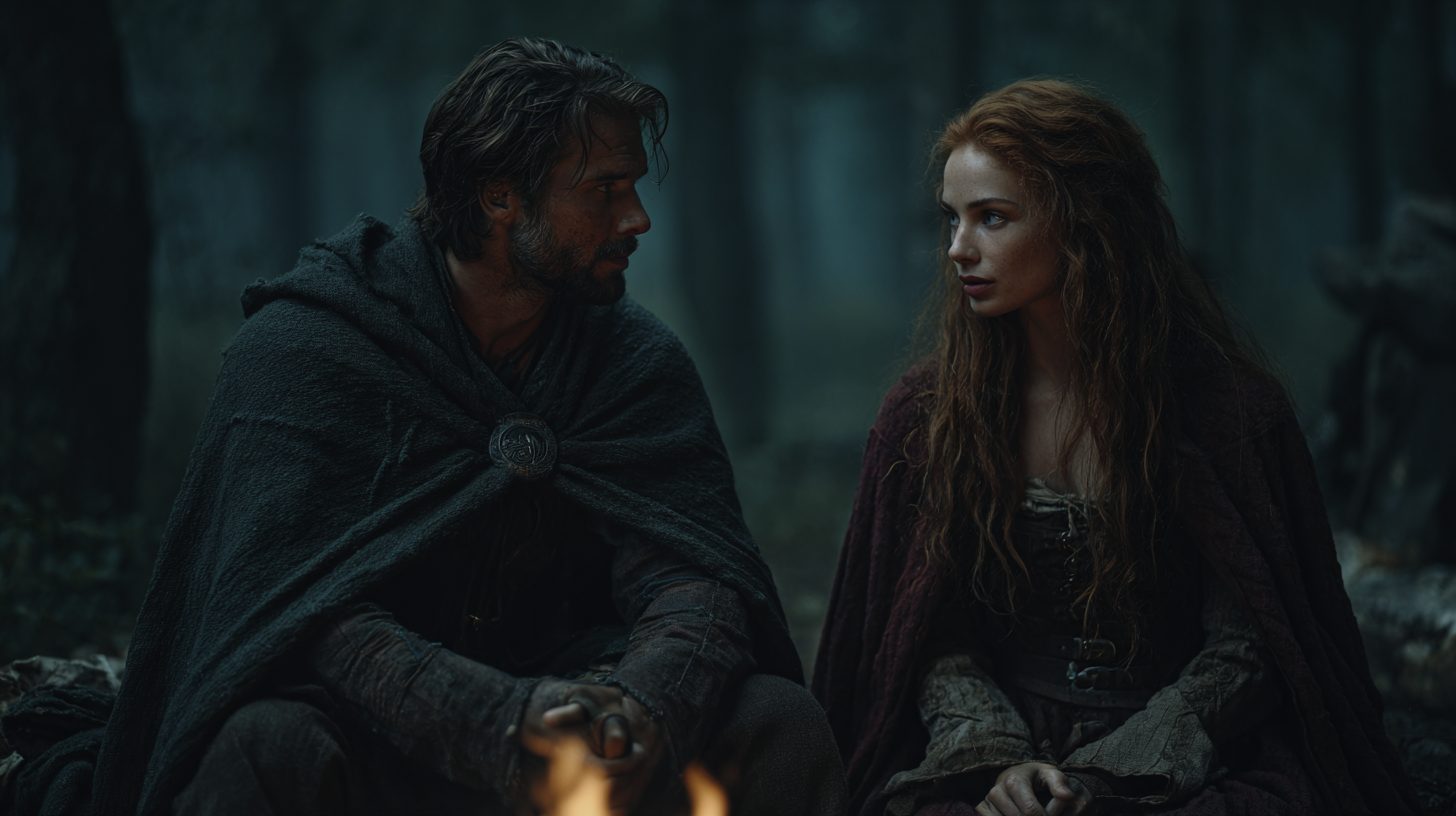
The resulting story became The Road Between Us.
A solitary traveler has spent a long time moving through the world alone.
Then he meets a woman on the road.
They travel together.
They talk.
They laugh.
They camp beside a fire.
They cross bridges and meadows and mountains.
The man begins to feel alive again.
And then they reach a crossroads.
Their destinations are different.
Neither person is wrong.
Neither person has betrayed the other.
They simply cannot continue on the same road.
That distinction mattered to me.
Because I didn’t want to make a story about abandonment.
I wanted to make a story about separation without making separation mean that the connection was meaningless.
Those aren’t the same thing.
6/9
The visual design was deliberately simple.
I created very specific descriptions for both characters so I could repeat them in every Midjourney prompt.
The man is a weathered medieval traveler with dark brown hair, gray-blue eyes, a short beard, charcoal clothing, and a forest-green cloak.
The woman has long copper-red hair, green eyes, a burgundy traveling dress, and a muted blue-gray cloak.
They each have a horse.
His is black.
Hers is chestnut.
That’s it.
Those details became my visual anchors.
I generated 30 shots, moving through the story from solitude to companionship, separation, and finally a tiny possibility.
Lab note: AI doesn’t need me to give it a complicated story. It needs me to give it a collection of things it can actually draw.
That may sound obvious.
It took me many generations to discover it.
7/9
The ending is my favorite part.
Years have passed.
The man has gone home.
He has continued living.
He isn’t sitting at the crossroads for ten years staring down the road like some medieval version of a sad parking attendant.
He works.
He rides.
The seasons change.
He remembers.
And then one evening, he sees a rider in the distance.
We never find out who it is.
That’s intentional.
Maybe it’s her.
Maybe it isn’t.
The story ends before the answer arrives.
I like that better than a tidy reunion.
Because the emotional question isn’t really “Will she come back?”
The more interesting question is:
“What do I do with my life while I don’t know?”
8/9
The technical process was a wonderfully messy collection of little problems.
The vocal edit had to be shortened.
The drone underneath the voices needed to have movement without becoming a melody.
The story had to be visually understandable without narration explaining every metaphor.
Midjourney had to produce characters who looked like the same people across very different locations.
Then the individual images had to become moving shots.
And finally everything had to be assembled so the music, voices, images, movement, and emotional arc felt like one piece.
My creative stack for this one included:
Midjourney — character design and cinematic stills
Grok imagine – AI video generation — turning the still images into moving shots
Audacity — vocal and audio editing
Kdenlive — assembly, timing, transitions and final edit
LALAL.AI – vocal stem separation
The important part wasn’t any individual tool.
It was the conversation between them.
One tool would create something slightly wrong.
I’d notice something interesting about the mistake.
Then I’d change the next prompt.
Then the next image would suggest something I hadn’t originally imagined.
That’s where the alchemy happens.
9/9
The biggest discovery for me was that the story became less about waiting and more about continuing.
That’s a subtle difference.
Waiting can become a way of putting your life on hold.
Continuing means you can carry the memory of someone without requiring the future to resolve itself immediately.
The man in this story doesn’t stop loving the experience he had.
He doesn’t pretend it didn’t matter.
He doesn’t force the other person to return.
He simply keeps walking.
And maybe, someday, the roads meet again.
Maybe they don’t.
Either way, the road still exists.
Lab note: I started this project trying to express longing. Somewhere along the way, the AI and I accidentally made a story about acceptance.
That seems to happen to me a lot.
I start out thinking I’m directing the machine.
Then somewhere around shot 23, the machine starts telling me what I was actually trying to say.
That’s probably why I keep doing this.
I’m not really making movies with AI.
I’m using AI as a strange, occasionally infuriating mirror.
And sometimes the mirror knows me better than I expected.
The Road Between Us is one of those little pieces.
Not a message to anyone.
Not a request.
Not a promise.
Just a road, two travelers, and the possibility that sometimes loving a moment means allowing it to remain a moment.
And then continuing down your own road.
Steve Teare
video alchemist
TerminallyBored.Monster
Palouse, Washington USA