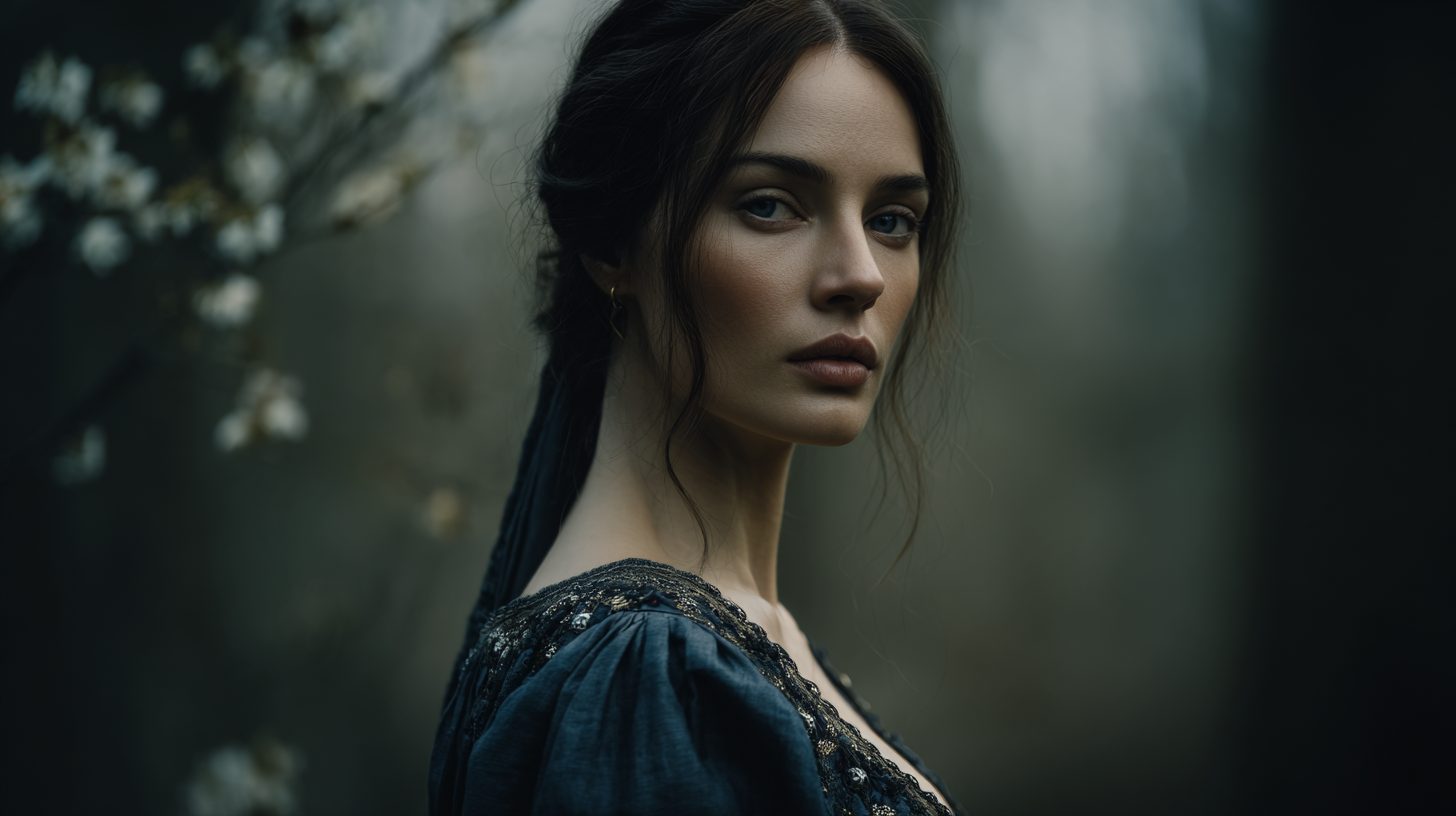
“I get up in the evening…”
That line was enough to give me the opening image.
Not a beautiful woman. Not a castle. Not even the forest.
A person sitting in the fog with absolutely nowhere to go.
I wanted to make a video for “Dancing in the Dark,” but I didn’t want to make another music video where people look dramatically miserable for three minutes and then suddenly discover true love because somebody happens to be attractive in soft lighting.
I wanted the darkness to mean something.
The starting point was simple: What happens when you’re tired of being tired?
Not necessarily depressed. Not necessarily broken. Just… hollow. The kind of boredom that isn’t really boredom at all. It’s the feeling that something inside you has gone quiet.
And then somebody appears.
Maybe they don’t fix anything.
Maybe they just remind you that you’re still alive.
Lab note: That distinction turned out to be the entire movie.
2/9
Step 1: Building the emotional weather.
I began with a Gothic world because, frankly, Gothic architecture is cheating.
Give me a ruined castle, wet stone, fog, moonlight and a few crooked trees and I can make existential despair look positively magnificent.
The opening needed to feel cold.
Empty streets. Massive stone structures. A solitary figure. Fog swallowing the distance.
The woman appears almost as another piece of the landscape.
She’s beautiful, but she isn’t introduced as a romantic prize. She’s simply there — another lonely person occupying the same emotional weather.
That was important.
The man is tired of himself.
The woman is not there to rescue him.
She’s there because she is lonely too.
And that changes everything.
Lab note: AI image generation is particularly good at atmosphere. Give it a detailed emotional environment and it will often give you something more interesting than the literal instructions. The trick is recognizing when it has accidentally understood what you’re trying to say.
3/9
Step 2: Finding the spark.
The visual turning point comes when the lyrics finally ask for help.
That’s where the film starts moving.
The woman reaches.
She looks back.
She runs.
And suddenly the Gothic world isn’t a prison anymore. It’s a place to run through.
This was one of those cases where editing and image generation started talking to each other.
I could generate a beautiful image of somebody standing in fog all day long. That’s easy.
But movement is harder.
Running people. Flowing clothing. Consistent faces. Hands that actually look like hands. Bodies that don’t suddenly acquire extra joints because the AI has decided anatomy is merely a suggestion.
Ah, yes.
The glamorous life of the video alchemist.
There were plenty of rejected generations.
Some were technically beautiful but emotionally dead. Others had exactly the right expression but looked like they belonged in an entirely different movie.
And occasionally the AI would produce something wonderfully strange that was better than what I had asked for.
Those are the moments I keep.
Lab note: I have learned to stop treating the AI as a vending machine. I’m not ordering an image. I’m negotiating with an extremely imaginative, occasionally unreliable collaborator.
4/9
Step 3: Making the dance mean something.
The obvious interpretation of “Dancing in the Dark” is romance.
Mine became something slightly different.
The dance is a choice.
The characters could remain alone.
They could remain safe.
They could remain in the fog.
Instead, they move toward each other.
The first physical contact is tentative. Then it becomes playful. Then intimate. Eventually the dance takes over the entire visual language of the piece.
Hands.
Faces.
Bodies turning.
Running.
Embracing.
Kissing.
And finally dancing.
I wanted the central metaphor to become almost embarrassingly literal:
You can’t start a fire without a spark.
So I made the spark physical.
Two people who have been emotionally cold discover that contact itself can generate heat.
Not permanent heat.
Not necessarily a happily-ever-after.
Just enough to remember what warmth feels like.
And sometimes that is a pretty big deal.
5/9
Step 4: Letting the characters breathe.
One of my favorite parts of the process was discovering that the woman couldn’t remain mysterious forever.
At first she is almost spectral.
Serious.
Still.
Remote.
Then something changes.
She smiles.
Then she laughs.
Then she is outside in an enormous landscape with her head thrown back and her eyes closed.
That progression became more important than any particular plot point.
Because the movie wasn’t really about two people falling in love.
It was about one emotional state transforming into another.
The woman begins as part of the darkness.
By the end, she’s fully alive inside it.
And the man changes because he chooses to move.
That’s the subtle part.
Nobody rescues anybody.
They participate.
Lab note: This is one of the reasons I like working with AI-generated imagery. I can discover a character emotionally through hundreds of tiny visual experiments. Sometimes I don’t know what the character is becoming until I see her become it.
6/9
Step 5: The Gothic forest becomes a playground.
The forest starts out threatening.
Roots.
Fog.
Black branches.
Wet ground.
Moonlight barely getting through.
But once the characters begin moving, the same forest changes.
It’s still dark.
That’s important.
I didn’t want a giant Disney sunrise to announce that everybody is fixed now.
The darkness remains.
They simply stop being afraid of it.
That became the visual philosophy of the whole piece.
The goal isn’t to defeat the dark.
It’s to dance in it.
That’s much more interesting.
The music helps enormously here. Slowing the song gives the images room to breathe. Gestures become larger. A glance lasts longer. A hand reaching for another hand becomes an event instead of a transition.
And suddenly the song isn’t merely accompanying the pictures.
It’s telling the pictures how fast to feel.
That’s one of those tiny technical decisions that can completely change the emotional temperature of a video.
7/9
Tools & Creative Stack
The basic laboratory for this one was deliberately simple.
Midjourney
For the characters, Gothic environments, moonlit forest, castle imagery and the evolving visual language.
Kdenlive
For assembly, timing, transitions, overlays, dissolves, speed decisions and the final emotional rhythm.
Audacity
The slowed-down version became the spine of the entire piece. Slowing the track gave the visual material enough space to become sensual and dreamlike rather than simply energetic.
My own increasingly obsessive brain
Still unfortunately required.
The hardest technical problem wasn’t generating pretty pictures.
It was continuity.
A character has to look like the same person from shot to shot. Clothing has to make sense. Lighting has to belong to the same world. A forest can’t suddenly become a completely different forest because the AI got excited.
So I kept repeating physical descriptions, lighting conditions, wardrobe details and cinematic vocabulary.
It is not glamorous.
It works.
Lab note: AI filmmaking is probably 30 percent generating things and 70 percent politely explaining to the machine that no, the woman did not suddenly become somebody else’s cousin.
8/9
The Real Lesson
When I started this project, I thought I was making a romantic fantasy.
I don’t think that’s what I made.
I think I made a little movie about loneliness discovering that it doesn’t have to remain lonely.
That’s different.
The characters don’t solve each other’s lives.
They don’t escape into some perfect kingdom where nothing hurts anymore.
They simply find each other in the dark.
And then they dance.
That seems almost ridiculously simple.
But the older I get, the more suspicious I become of complicated answers to simple human problems.
Sometimes we need somebody to talk to.
Sometimes we need somebody to make us laugh.
Sometimes we need somebody who understands the strange thing we’re trying to make.
And sometimes we just need to stop standing there in the fog and move.
The video became a kind of emotional experiment for me.
What if the spark isn’t something you wait for?
What if you have to risk moving toward it?
That idea has been following me around ever since.
Lab note: The best projects don’t always tell me what I wanted to say. Sometimes they tell me what I was actually thinking.
9/9
I like the fact that this one doesn’t end by conquering the darkness.
The darkness is still there.
The fog is still there.
The world is still complicated.
But the people inside it are no longer standing still.
That’s probably the part that feels most honest to me.
I make these strange little movies because I’m fascinated by the places where technology, imagination and human emotion collide.
Midjourney gives me the raw material.
The music gives me the emotional gravity.
The editing gives me rhythm.
But somewhere in the middle of all that machinery, something unexpectedly human can happen.
A character smiles.
Two people reach for each other.
A lonely forest becomes a dance floor.
And for a few minutes, the darkness isn’t something to escape.
It’s where the dance happens.
That’s the magic trick.
Or maybe it’s just what happens when you keep making things long enough.
Either way, I’ll take it.
Steve Teare
video alchemist
TerminallyBored.Monster
Palouse, Washington USA