I was wrong.
The yellow dress was only the doorway.
The real song became about what happens when a memory that haunted you for fifty years finally stops asking to be rewritten.
It asks something else instead:
What are you going to do with the life you have now?
2/9
The song is called “Living That Night.”
It began with a memory from when I was eighteen.
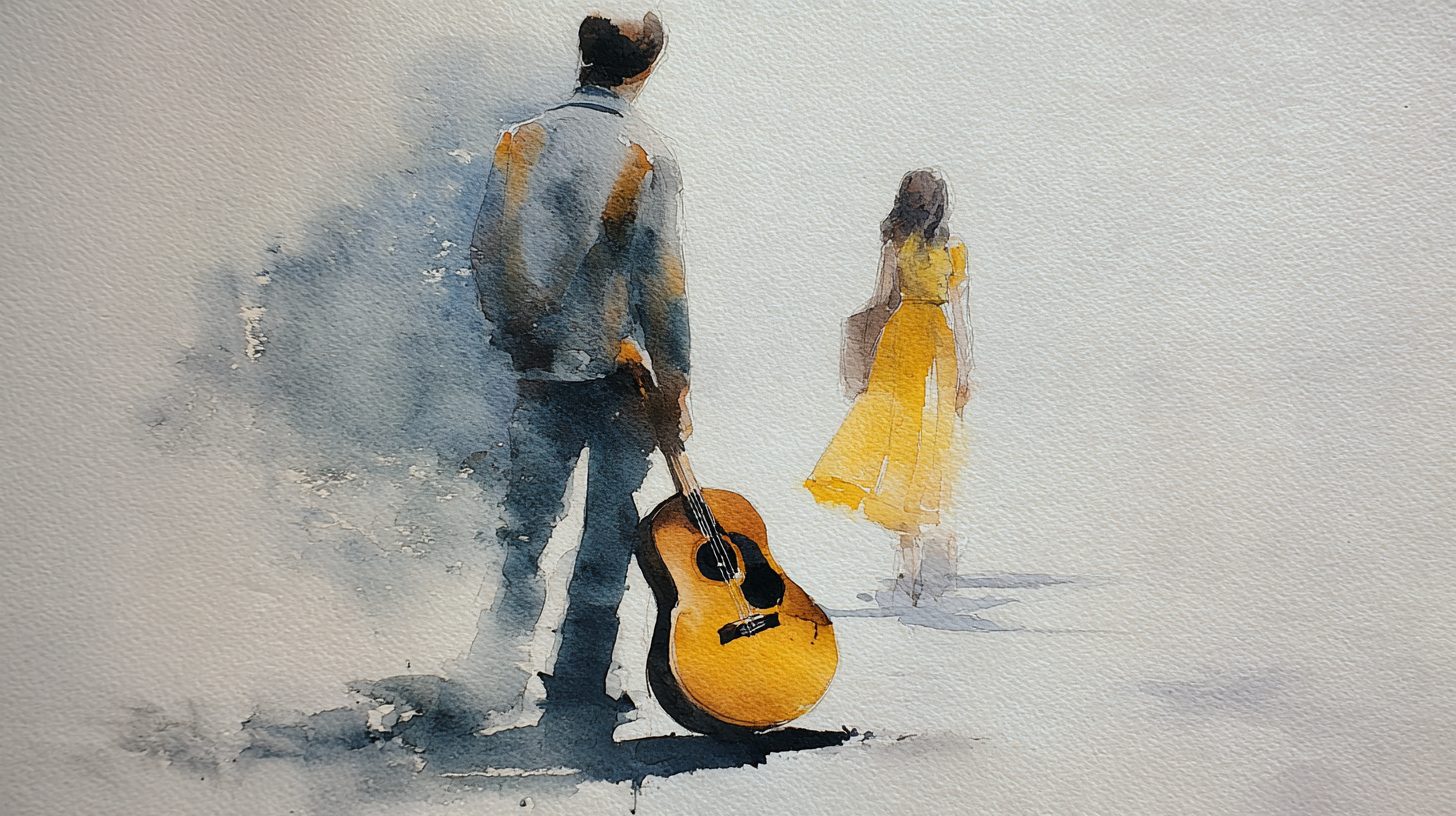
There was a girl in a short yellow summer dress. She came to one of our band gigs. I knew she wanted me to talk to her.
And I was scared.
So I did nothing.
That little moment became one of those strange pieces of unfinished business that the brain can apparently store indefinitely.
Fifty years is a long time to carry a question.
3/9
The question wasn’t really, “What would have happened if I’d talked to her?”
I couldn’t possibly know that.
The deeper question was:
Why was I so afraid?
And then, much later in life, something happened that changed the meaning of the memory.
Someone became a catalyst.
Not a substitute.
That distinction matters.
She didn’t become the girl in the yellow dress. She helped me understand the frightened boy who had been standing there all those years ago.
That was the beginning of the song.
4/9
The first version of the lyrics was much too explanatory.
I did what writers do when they don’t trust the audience.
I explained everything.
Fortunately, I caught myself.
The final lyric is much leaner:
“Yellow dress
Kansas summer
Dust and heat
And open sky.”
That’s enough.
The listener doesn’t need a lecture about what it means.
They can feel it.
Lab note:
Sometimes the most important thing you can remove from a song is the explanation of the song.
5/9
Then came the music.
I wanted something dark, atmospheric and slightly mysterious.
Not a traditional ballad.
Not country.
Not Americana.
I wanted space around the vocal. A slow, hypnotic pulse. Deep bass. Organic percussion. Ambient textures. Processed guitar. A feeling that something emotional was happening underneath the words.
The vocal needed to sound like someone remembering something rather than performing a song about remembering something.
That’s a subtle difference.
And AI music is surprisingly good at subtle differences — once you stop asking it to behave like a vending machine.
6/9
Then I decided on watercolor.
This was partly aesthetic and partly practical.
I didn’t want photorealistic recreations of the past.
Memory isn’t photorealistic.
Memory cheats.
It leaves things out. It changes colors. Faces disappear. One moment bleeds into another.
So I asked Midjourney for paintings rather than photographs.
Cold-press paper.
Visible pigment.
Soft edges.
Layered washes.
Bleeding colors.
Loose brushwork.
And one recurring visual element:
yellow.
7/9
There are 26 illustrations in the video.
I didn’t try to animate them.
Instead, I’m treating them as paintings and applying very restrained Ken Burns movement — slow pushes, slow pans, occasional pullbacks.
Seven seconds is roughly the natural rhythm of each image.
That creates something I really like.
The paintings don’t have to move.
The viewer moves through them.
That’s a different kind of animation.
Lab note:
Sometimes the best way to make an AI image feel alive is to leave it alone.
8/9
The visual story gradually changes.
At first, yellow belongs to the girl.
Then it becomes summer light.
Then a distant light.
Then a doorway.
Then a glow in the present.
By the end, the yellow isn’t really about her anymore.
It’s about possibility.
That’s the part I didn’t plan at the beginning.
It emerged while I was making the thing.
Which is one of the reasons I keep doing this.
AI is most interesting to me when it stops being a tool for executing an idea and becomes part of the process that discovers what the idea actually is.
9/9
The final lyric is:
“I was afraid.
Not tonight.”
That’s it.
No resurrection.
No rewriting the past.
No pretending the fifty years didn’t happen.
Just the recognition that the past can remain exactly where it belongs while the present becomes something different.
That’s what “Living That Night” finally became.
Not a song about the girl in the yellow dress.
A song about the boy who couldn’t step forward —
and the man who finally can.
TL;DR:
I started with a fifty-year-old regret, turned it into a song, painted it in watercolor, and discovered that the second chance wasn’t about changing the past.
It was about showing up for the present.
Sometimes the AI doesn’t make the art.
It helps you discover what you were actually trying to say.
Steve Teare
video alchemist
TerminallyBored.Monster
Palouse, Washington USA