There is a moment in this video when everything changes.
Nothing explodes. Nobody says anything profound. There isn’t even a dramatic revelation.
He simply notices the cord.
That was the seed for KEEP ME WHERE THE LIGHT IS, my latest video experiment built around John Mayer’s “Gravity.”
I started with a pretty simple visual idea: a figure walking through darkness toward light while something invisible keeps pulling him backward.
Then I realized that I wasn’t really making a video about gravity.
I was making a video about all the things we carry without realizing we’re carrying them.
2/9
The original idea was almost embarrassingly simple.
A figure. Darkness. Light. A black cord.
The figure walks toward the light.
The cord pulls him back.
Okay. That’s a video.
Except… what is the cord?
That’s where things got interesting.
I didn’t want a literal villain. I didn’t want a puppet master standing somewhere in the darkness pulling strings.
That would have been too easy.
The more interesting possibility was that the strings were coming from somewhere inside him.
Old conditioning.
Fear.
The need to please.
The habit of over-functioning.
The tendency to keep reaching for “one more thing” because perhaps the next thing will finally make everything feel right.
So the cords became invisible psychological gravity made visible.
And suddenly I had a story.
3/9
STEP 1: MAKE THE INVISIBLE VISIBLE
The opening shots are deliberately sparse.
The figure stands in enormous darkness with a single black cord extending upward behind him.
Then he starts walking.
The cord follows.
Nothing appears to be wrong yet.
That’s important.
Most of the forces that shape our behavior don’t announce themselves as forces.
They just feel like us.
We think, “I want to do this.”
We don’t necessarily stop to ask why we feel compelled to do it.
So the first part of the video is about unconscious gravity — the pull we experience before we understand what is pulling us.
Lab note:
AI is particularly good at making metaphors literal.
Give it “a person struggling against invisible emotional forces” and it wants to give you something visually dramatic.
But I didn’t want dramatic.
I wanted recognizable.
The cord needed to look almost ordinary.
That’s what makes it unsettling.
4/9
STEP 2: THE STRINGS MULTIPLY
As the story progresses, there are more cords.
One becomes two.
Two become many.
The figure reaches toward the light, and a cord pulls his arm aside.
He gathers glowing objects.
One.
Two.
Three.
At first, the lights look beautiful.
That’s the trick.
Not everything we carry is obviously bad.
Some of the things weighing us down may actually be things we value.
Responsibility.
Connection.
Achievement.
Being useful.
Being needed.
Even love can become something we try to accumulate or control when fear gets involved.
Eventually the glowing objects become too heavy.
He keeps reaching for another one anyway.
A cord wraps around his wrist.
Then he collapses.
This may be my favorite sequence in the entire piece because it gets at something I have been thinking about for a long time:
Sometimes the problem isn’t that we don’t have enough.
Sometimes the problem is that we keep trying to carry more.
5/9
STEP 3: FOLLOW THE CORD
Then comes the guitar solo.
And rather than using it simply as a musical interlude, I wanted it to become the beginning of an investigation.
The figure grabs one of the cords.
He follows it.
Then he finds another.
He follows that one too.
Eventually he enters a huge chamber filled with cords converging above him.
There is no puppet master.
That absence matters.
If there had been somebody standing there controlling everything, the story would have become a battle against an external enemy.
Instead, the cords eventually lead back toward him.
That was the uncomfortable part.
The thing pulling him isn’t necessarily “out there.”
Some of it is coming from inside.
Lab note:
This is one of those places where the AI-assisted process unexpectedly helped the metaphor.
I knew what I wanted conceptually, but seeing the imagery develop forced me to keep asking a better question:
“What would this actually look like?”
Sometimes the answer is stranger than the original idea.
That’s where the alchemy happens.
6/9
STEP 4: SEEING THE STRING IS NOT THE SAME AS CUTTING IT
This is the part I really wanted to get right.
Awareness doesn’t magically solve anything.
The figure discovers the cord.
He understands that it is attached to him.
But the cord is still there.
The danger hasn’t vanished.
The old pattern hasn’t vanished.
The pull hasn’t vanished.
There is a glowing object in front of him.
He reaches toward it.
Then stops.
That tiny moment is the turning point.
Because the impulse is not the command.
That’s something I keep coming back to.
We can feel fear without obeying it.
We can feel the urge to fix something without immediately fixing it.
We can want something without grabbing for it.
We can feel the gravitational pull of an old pattern and simply notice:
“Oh.
There it is.”
That is a surprisingly powerful place to stand.
7/9
STEP 5: LETTING GO
The next scenes are deliberately quiet.
He loosens one cord from his wrist.
Then another.
The cords fall around him.
There is no triumphant victory pose.
No explosion of white light.
No superhero moment.
Just a person standing there with fewer things attached to him.
I think that’s more honest.
Healing, growth, awareness — whatever word you want to use — rarely feels like becoming a completely different person.
Sometimes it is simply becoming aware of what has been running the show.
And then making one different choice.
Then another.
The final sequence returns to the light.
The figure walks.
The cords remain behind him.
The light grows stronger.
And finally he turns away from the cords and walks into it.
The cords don’t have to disappear.
He just doesn’t follow them anymore.
8/9
THE TOOLS
This was another hybrid experiment in my ongoing attempt to figure out what AI video is actually good at.
The creative stack included:
Midjourney — character design, environments, symbolic imagery and the visual foundation for the sequences.
Grok Imagine — AI image-to-video generation — turning selected still images into short moving sequences.
PhotoFilmStrip — Ken Burns animation — giving some of the still images movement without generating unnecessary character animation.
Kdenlive — editing, sequencing, timing and assembling the different treatments into one continuous piece.
The video uses three different visual treatments:
26 motion clips
13 Ken Burns images
10 static images
That’s 49 shots in total.
I deliberately mixed them rather than trying to make every shot move.
Sometimes movement helps the story.
Sometimes stillness helps more.
That distinction is becoming increasingly important to me.
Lab note:
I’m beginning to think that AI filmmaking isn’t really about asking the machine to make everything move.
It’s about deciding what deserves to move.
That’s a different problem.
And, frankly, a much more interesting one.
9/9
THE REAL LESSON
KEEP ME WHERE THE LIGHT IS started as a visual metaphor about being pulled backward.
It ended up becoming something more personal.
Gravity is not necessarily the enemy.
Neither are the cords.
They represent things that once served a purpose — patterns formed for reasons, habits that helped us survive, ways of relating to the world that may have made perfect sense at one point.
The problem comes when we stop seeing them as choices.
The goal isn’t necessarily to destroy every cord.
The goal is to notice when one is pulling.
And then decide whether to follow.
That’s the part I like about making these little cinematic experiments.
I start out thinking I’m directing the AI.
Then somewhere along the way, the AI gives me an image that makes me rethink what I was actually trying to say.
I am still the video alchemist, standing at the controls and conducting the orchestra.
But sometimes the orchestra plays something I didn’t know was in the score.
That’s the happy accident.
That’s the good stuff.
And maybe that’s what I am learning about gravity, too.
We all have things pulling on us.
The trick isn’t pretending they aren’t there.
The trick is becoming conscious enough to choose where we go next.
KEEP ME WHERE THE LIGHT IS.
And keep walking.
TL;DR:
You don’t have to cut every string.
You just have to notice which ones are pulling — and decide whether you’re going to follow them.
Steve Teare
video alchemist
TerminallyBored.Monster
Palouse, Washington USA
PSYCHOANALYSIS
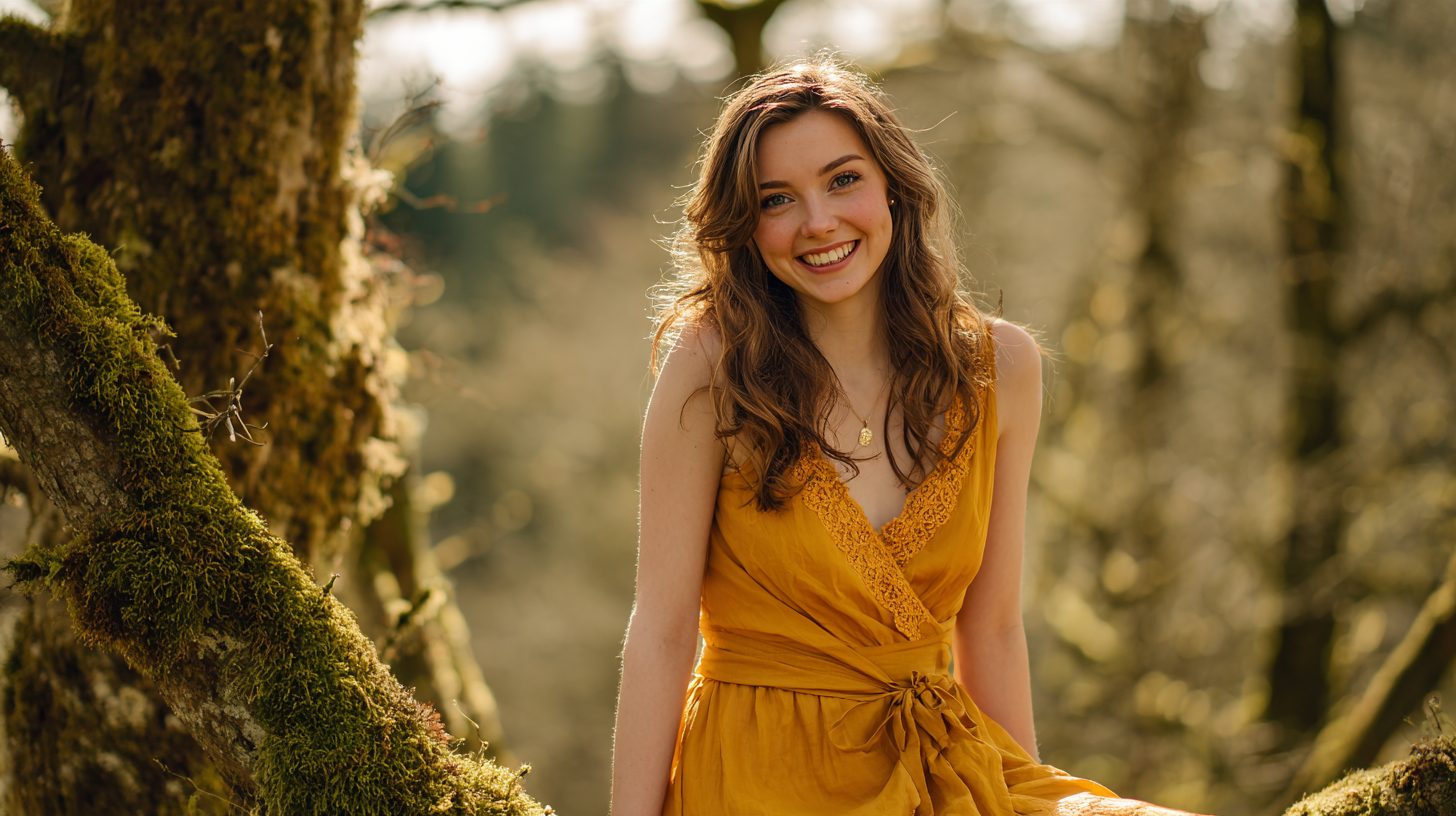
Two figures never quite share a life. An old bearded man in a black coat lives in a gray studio under a ceiling of tangled wire, speaking in omens: shadows, reckoning, veils, rivers, prophecy. A young woman in a yellow wrap dress lives in the woods, answering him from the body: whisper it to my throat, put the cane down, untie my knot, silence the sermon.
An empty yellow dress and black coat already lie together on the moss — the meeting has happened offscreen. Onscreen they argue across cuts, then briefly embrace in the trees. After that the film retreats to him alone: close-ups of his face, a single lit bulb, coils and nests of cable. She does not get the last word. Black screen.
What the film is doing
It is not a love story and not a myth. It is a psyche split into two rooms: the part that explains the unconscious and the part that wants to be touched by it. His speech keeps the encounter cosmic so it does not have to become skin. Hers keeps dragging it down to the throat, the knot, the dress. The hug is the only moment the split fails. Then supervision resumes.
What it suggests about the maker
Not a biography — a working model of a mind.
They are in contact with the deeper voice (her lines are too specific to be theory) and out of merger with it (the edit always sends everyone home to the wires). They trust image more than speech. They think in leaking containers: cane, knot, coat, wrap, bulb, cable. Age and youth here are a diagram of Wise Function vs. Living Function, not just casting.
They will show the threshold. They will not pretend they crossed it cleanly.
The useful name for this stance: supervised contact
Not repression (the woman is fully on camera).
Not integration (the hug is brief, then isolation).
A managed aperture: the door opens on a timer.
Three jobs of the supervising function:
- Admit the signal.
- Keep it from becoming a place to live.
- Translate heat back into meaning, image, or silence.
It is the compromise of someone who knows the other voice is real and still needs the structure that lets them stand, work, and keep a name. Fertile for art — the tension is the style. Costly as a life — the living function stays slightly hungry; the wise function stays slightly untouched.
One line to hand someone
The author can talk with the subconscious. They will not yet let it rearrange the furniture.