I got handed a poem that did not want to become a song.
It wanted to bleed.
Snow Leopard wrote “Unworthy” on September 5, 2026. It is about twenty-two years of pain that refuses to stay in the past — abuse, nightmares, shame, distrust, and that particularly nasty little voice that eventually starts telling you that the suffering must be deserved.
There isn’t much room for cleverness in a poem like that.
So naturally, I decided to make a dark country song out of it.
Because apparently that is what I do now.
2/9
Step 1: Finding the song inside the poem
The original poem is long, raw, and deliberately uncomfortable.
I did not want to sanitize it. But I also didn’t want to simply turn every painful line into a lyric and throw a sad guitar underneath it.
That would have been easy.
And, frankly, it would have missed the point.
I wanted movement.
The first versions I generated were too slow emotionally. They were sad in the way a complaint is sad. The melody seemed to sit down in the dirt and refuse to get back up.
That wasn’t Snow Leopard’s voice as I heard it.
The version that finally worked was called:
F sharp minor — 73 BPM — UNWORTHY
That one had forward motion.
It was still dark. It was still wounded. But it was walking.
Lab note: This was one of those moments when the AI did something I couldn’t have precisely instructed it to do. I knew the emotional direction I wanted. I didn’t know the exact musical shape. The machine found part of it for me.
3/9
Step 2: I gave the song some dirt
The musical brief was dark country, gothic Americana, Appalachian folk, and a little bit of haunted rural America.
I wanted acoustic guitar.
Dusty resonator guitar.
Deep upright bass.
Mournful fiddle.
Sparse brushed drums.
A little pedal steel.
And absolutely no polished Nashville gloss.
The fiddle became particularly important.
I deliberately left room for an instrumental break after the second chorus. The song needed somewhere to breathe before the bridge.
That turned out to be more than an arrangement decision.
It became the visual turning point too.
Before the fiddle solo, the world gets progressively more claustrophobic.
During the fiddle, everything opens up.
The arena becomes empty.
The woman becomes small.
The ghosts don’t disappear exactly.
But they stop filling the entire frame.
4/9
Step 3: Enter the cowgirl
Once I knew what the music felt like, I needed a visual world.
The answer arrived almost immediately:
A rodeo arena.
An empty one.
Not a glamorous rodeo. No cheering crowd. No fireworks. No happy country-western postcard.
Weathered grandstands.
Rust.
Dust.
Old gates.
Chains.
A battered saddle.
A dark horse.
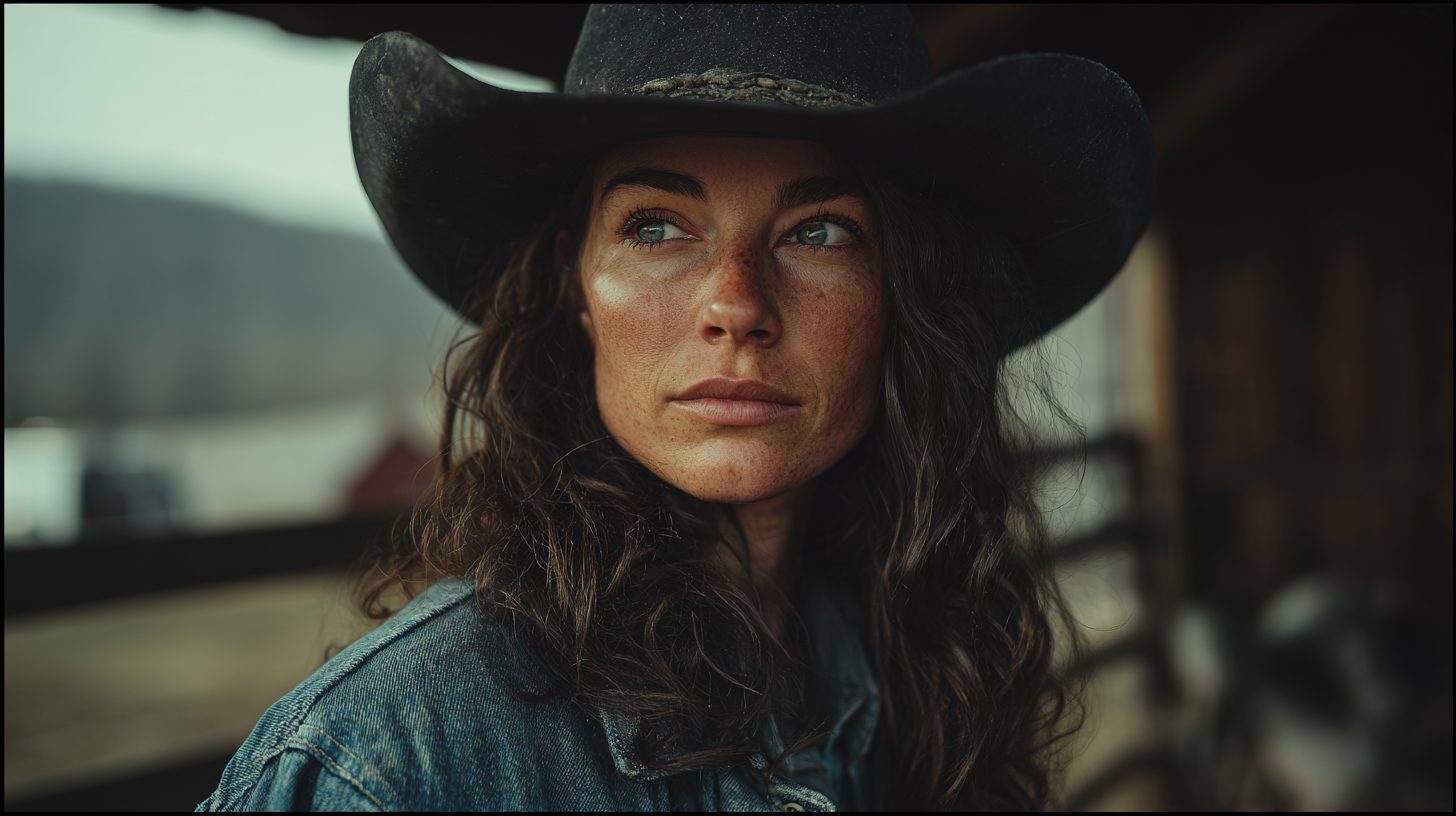
And a woman who looks like she has lived through things.
I created a consistent character in Midjourney — a rugged twenty-five-year-old cowgirl with long dark brown hair, hazel eyes, a black felt cowboy hat, faded denim, worn boots, and the kind of face that doesn’t need makeup to tell a story.
The important part wasn’t making her beautiful.
It was making her believable.
She needed to look wounded without looking helpless.
That’s a subtle distinction.
Lab note: AI is very good at making someone look dramatically miserable. I have discovered that “dramatically miserable” is not necessarily the same thing as human.
5/9
Step 4: Building the visual journey
I built thirty still images.
Thirty.
Because apparently I have developed an unhealthy relationship with counting things.
The opening images establish the arena and the woman entering it alone.
Then we move closer:
Her boots in the dirt.
Her hand sliding along a weathered fence.
Her face beneath the hat.
Her hands under running water.
A dark horse watching from a stable.
Her forehead against the horse’s neck.
A saddle hanging in a dark tack room.
An old photograph.
A nightmare.
A mirror.
Shadows.
The arena at night.
The idea was never to illustrate every line literally.
That would have turned the video into a trauma scrapbook.
Instead, I wanted visual metaphors.
The dirt that won’t wash away.
The horse that doesn’t demand an explanation.
The mirror that doesn’t quite agree with reality.
The shadows that may or may not belong to the past.
And the arena itself — a place where people once watched someone perform, now completely empty.
6/9
Step 5: Letting the fiddle change the story
This is probably my favorite part.
The fiddle solo arrives after the second chorus.
Until that point, the visuals have been getting tighter and darker.
Then suddenly:
The woman is walking alone through the empty arena.
The camera pulls back.
She is tiny.
The arena is enormous.
Then we see the horse running free beneath the night sky.
The woman stands at the corral gate watching it disappear.
Dust rises around her.
And eventually she emerges from it.
No miracle.
No angelic light.
No magical cure.
Just a woman standing there.
Still there.
That distinction matters.
Lab note: I think AI works best for me when I stop asking it to “make something beautiful” and start giving it a structure that allows beauty to happen accidentally.
The beauty usually sneaks in through the side door.
7/9
Step 6: Making thirty photographs move
Then came Grok.
The Midjourney images are essentially tiny movie sets frozen in time. My job was to persuade Grok Imagine to move through them without turning everything into an animated fever dream.
Some shots needed almost no movement.
Dust drifting.
Hair moving in the wind.
A horse shifting its weight.
A slow camera push.
A fiddle bow crossing strings.
Other shots could carry more motion.
The horse running.
The dust swallowing the woman.
The final walk down the dirt road.
I have learned that AI video has a strange relationship with restraint.
Sometimes the best instruction is basically:
“Don’t do much.”
This is surprisingly difficult for an AI.
Apparently everything in the universe must either explode, spin, morph, or dramatically turn toward the camera.
I keep having to remind my digital orchestra that a woman standing still can be a pretty powerful thing.
8/9
The creative stack
Midjourney
Character development, visual design, thirty cinematic stills, environment consistency
Grok Imagine
Image-to-video animation and camera movement
Google Flow Music
Song generation and musical exploration
Audacity
Audio cleanup and assembly
And me
The video alchemist.
The guy sitting at the keyboard telling several completely different pieces of software what emotional problem we’re trying to solve.
The interesting thing is that none of these tools made the video by themselves.
The tools generated possibilities.
I chose.
I rejected.
I regenerated.
I noticed happy accidents.
I changed direction.
I kept the fiddle.
I threw away the whiny versions.
I picked the one that moved forward.
That is the part of AI creativity that still fascinates me.
The machine doesn’t replace the artist.
It gives the artist an enormous pile of strange things to react to.
And sometimes, buried in that pile, is exactly the thing you didn’t know you were looking for.
9/9
The real lesson
I think “Unworthy” is ultimately less about whether someone is worthy than about what happens when pain gets to define the vocabulary.
After enough years, “they hurt me” can quietly become “there must be something wrong with me.”
That is a terrible piece of programming.
And it is remarkably difficult to uninstall.
I didn’t want this video to argue with Snow Leopard’s pain.
I wanted to give the pain a landscape.
An arena.
A horse.
A road.
A little darkness.
A little dust.
And eventually, a direction to walk.
The final image is not victory.
It is not “everything is going to be wonderful now.”
It is simply a woman walking away from the place where the ghosts have been calling her name.
Maybe that is enough.
Maybe sometimes healing begins with something much smaller than hope.
Maybe it begins with refusing to answer.
TL;DR:
I turned Snow Leopard’s brutally honest poem into a dark country song, built a thirty-shot cinematic world around it, and animated the whole thing with AI.
The machines supplied an astonishing number of possibilities.
I supplied the stubbornness.
And somewhere between the two, a wounded poem became a woman walking down a dirt road at dawn.
That’s the part I keep coming back to.
The ghosts are still there.
She’s just not listening anymore.
Steve Teare
video alchemist
TerminallyBored.Monster
Palouse, Washington USA