I started this one with a woman behind a wall.
Not metaphorically. At least, not at first.
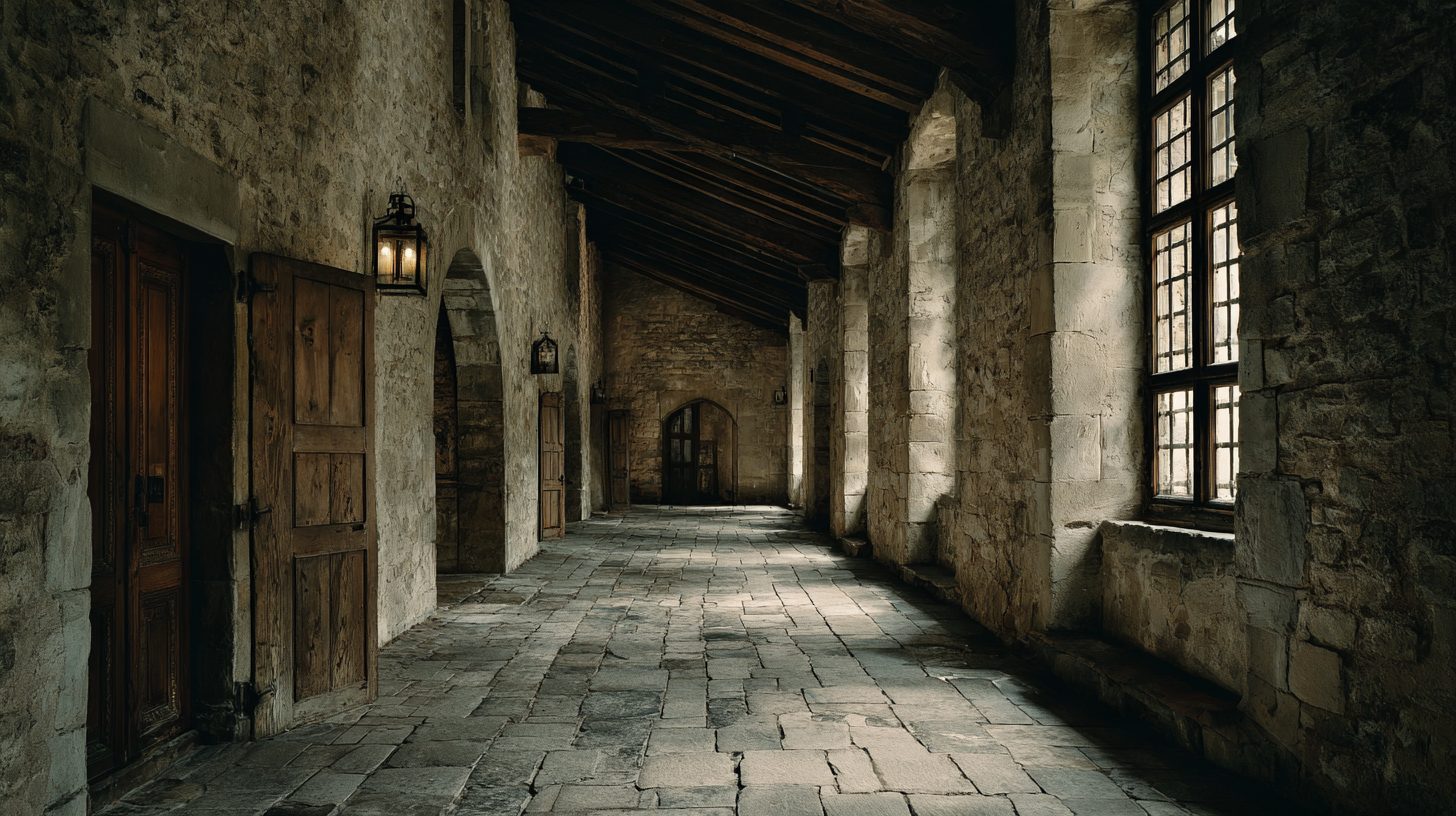
I wanted a castle. An old one. Huge stone walls, dark forests, misty mountains, heavy wooden doors. The sort of place where you immediately assume something important happened there a very long time ago.
Then I started wondering what those walls were for.
And that turned out to be the actual story.
NO ENDING is an AI-generated fairy tale about boundaries, curiosity, friendship, and the peculiar experience of discovering that someone can become important to you without becoming necessary.
That last part turned out to be the tricky bit.
2/9
The original idea was much less specific.
I knew I wanted two people who were somehow connected, but I didn’t want to make them a conventional couple. No romance plot. No rescue fantasy. No “you complete me.”
Actually, I wanted to avoid almost every fairy-tale shortcut I could think of.
No handsome prince.
No wicked queen.
No enchanted sword.
No dragons.
And definitely no kissing in front of a sunset while orchestral music announces that everyone is now emotionally sorted out.
That seemed like a good place to start.
The story became about a woman who had spent years learning how to control access to her life.
Her walls were not a prison.
They were hers.
That distinction mattered.
3/9
Step 1: Build the world
I went into Midjourney looking for a world that felt ancient without looking like somebody had just rented a medieval costume.
The castle needed to feel inhabited by history rather than designed by a theme park.
So I kept coming back to:
weathered gray stone
dark green forests
mist
old wood
narrow windows
rocky paths
distant mountains
quiet water
The palette stayed deliberately restrained.
Charcoal. Forest green. Brown. Muted blue. Soft amber. Pale silver.
Nothing glowing. Nothing sparkly. Nothing that screamed MAGIC!
I wanted the strange part of the story to come from the people, not from visual effects.
Lab note:
This is one of those places where AI is surprisingly useful.
I can describe an emotional environment in a handful of words and let the machine go wandering through its visual vocabulary.
Sometimes it comes back with exactly what I meant.
Sometimes it comes back with a castle that appears to have been designed by a committee of very enthusiastic wizards.
You learn to recognize the difference.
4/9
Step 2: Give the woman some walls
The woman was more important than the castle.
I gave her a very specific visual identity: mid-40s, dark brown wavy hair, brown eyes, an ordinary but graceful build, and a simple charcoal-green dress.
No crown.
No jewelry.
No elaborate princess hair.
She needed to look like a real woman who happened to live in an impossible place.
More importantly, she needed to look self-contained.
That was the emotional anchor.
She isn’t waiting for somebody to rescue her.
She isn’t secretly incomplete.
She has a life.
She has boundaries.
She knows how to say no.
And then a strange man shows up outside her walls.
He doesn’t demand anything.
That is the beginning of the problem.
5/9
Step 3: The strange man
The man was designed almost as the opposite of the usual fairy-tale hero.
No armor.
No sword.
No crown.
No dramatic horse.
No windswept hair suggesting that he has been genetically engineered for romantic poster art.
He is simply a lean, weathered man in a charcoal coat with slightly untidy dark hair and a short beard.
His defining characteristic is restraint.
He waits.
He listens.
He talks.
He doesn’t invade her space.
Most importantly, he doesn’t knock.
He doesn’t ask to come inside.
He just sits down outside the walls and starts talking.
That became one of my favorite ideas in the whole thing.
Because there is something very different about someone who doesn’t need access to you in order to be interested in you.
Lab note:
I think AI helped me discover this more clearly than I would have if I had tried to write a traditional plot.
Once I started making images, the visual rules began telling me what the story was actually about.
6/9
Step 4: The door
The door became the central visual metaphor.
Early in the story, doors are closed.
Then there is a crack of daylight.
Later, one opens inward.
But nobody forces it.
That was important enough that I kept rebuilding shots until the imagery said exactly that.
A boundary isn’t necessarily rejection.
A closed door doesn’t necessarily mean “go away.”
Sometimes it means, “This is my space, and I decide when it opens.”
And sometimes the healthiest thing someone can do is simply sit outside the door and wait.
Not endlessly.
Not manipulatively.
Just without demanding entry.
There are also several shots where the two characters occupy the same landscape without moving toward each other.
That was deliberate.
I didn’t want every visual metaphor to become “two people getting closer.”
Sometimes connection means walking in the same direction while still leaving several yards of space between you.
7/9
Step 5: The voice gives it away
I decided the fairy tale needed a storyteller.
So I created a male introduction that sounds like someone who has been telling stories for a very long time and has developed a healthy skepticism about them.
It begins:
“Once, in a place that may or may not have existed…”
And then he proceeds to explain what the story does not contain.
No dragons.
No enchanted sword.
No handsome prince.
No wicked queen.
So far, nobody has been turned into a frog.
Which is probably for the best.
Then the narrator hands the story to the woman.
“Once upon a time, there was a woman who lived behind walls.”
And suddenly we’re inside her head.
I liked that transition.
The storyteller gives us the fairy tale.
She gives us the truth.
8/9
The Tools
Midjourney — environments, characters, establishing shots, interiors, landscapes
Grok Imagine — image-to-video animation
ElevenLabs — narration and character voices
Google Flow Music — original cinematic underscore
Audacity — audio cleanup and mixing
Kdenlive — editing, timing, layering, and final assembly
And a ridiculous number of tiny decisions made by the human sitting in front of the computer.
The music was intentionally restrained.
Felt piano.
Warm cello.
Delicate harp.
Subtle strings.
A little mystery.
A little melancholy.
No heroic crescendo.
No giant fantasy finale.
I also used sound effects very sparingly.
A knock.
A door closing.
A long wooden creak as the door opens.
Footsteps.
Wind.
And then, near the end, almost nothing.
That silence matters.
9/9
The strangest part of making NO ENDING was discovering that the ending was the point.
The story keeps moving toward some conventional resolution.
The woman opens the door sometimes.
She realizes the walls can protect her without keeping everyone out.
She discovers that someone can become important without becoming necessary.
Then the narration changes.
Until that moment, she has been “she.”
Suddenly:
“That frightened me a little.”
“I had begun to care.”
And finally:
“I just don’t know how our story is supposed to end.”
Cut to black.
No “The End.”
No explanation.
No answer.
Lab note:
I think that may be the most honest ending I have made.
AI video has taught me that I don’t always have to know what I’m making before I start making it.
Sometimes I build a castle because I like the way it looks.
Then I put a woman inside it.
Then I put a strange man outside it.
Then I give them a door.
And somewhere between the prompts, the failed generations, the editing, the music, the voices and the happy accidents, the machine and I discover what the story was trying to say.
The real lesson, for me, is this:
Connection doesn’t have to erase boundaries.
Affection doesn’t have to become possession.
Being important to someone doesn’t mean becoming necessary to them.
And a story doesn’t always need to tell us how it ends.
Sometimes it is enough to know that two people are still walking.
Still curious.
Still talking.
Still leaving the door open sometimes.
Maybe that’s not an unfinished story.
Maybe that’s just what real stories look like.
TL;DR:
I made a fairy tale about two people who don’t rescue each other, don’t complete each other, and don’t even know how their story ends.
Apparently I needed a castle and several thousand AI-generated pixels to figure out that uncertainty can be a perfectly good ending.
Steve Teare
video alchemist
TerminallyBored.Monster
Palouse, Washington USA
Restore the missing YouTube linkClarify the film’s actual ending