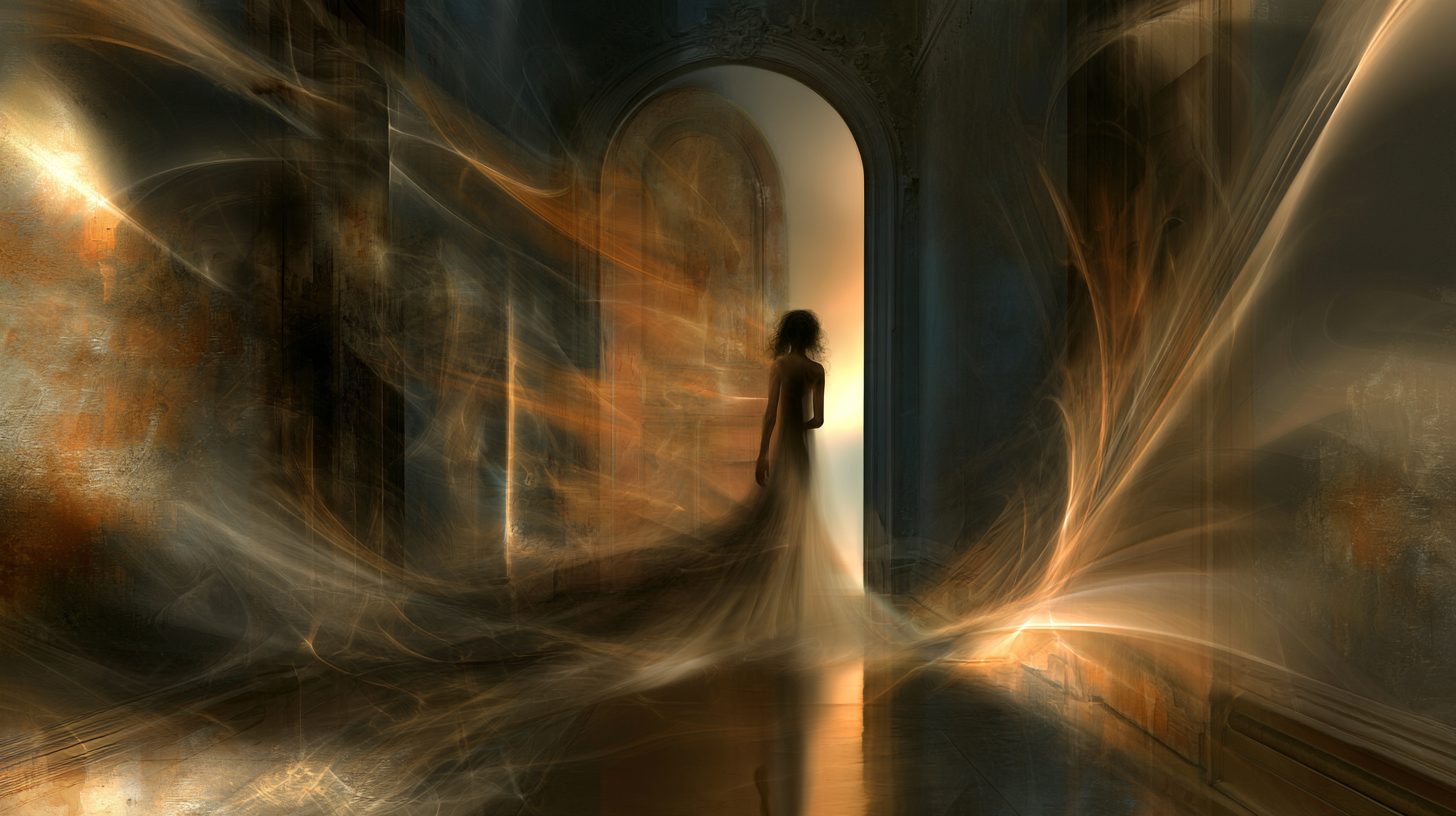
I opened a door and let the colors take over
I started this one with a simple question:
What if a color could be an invitation?
Not a metaphor I needed to explain. Not a psychological exercise. Not another video where I spend three minutes trying to tell you what the thing means.
Just a woman in the night, a little mystery, and a door that probably shouldn’t be there.
That sounded like a pretty good place to start.
The song is called “Show Me Your Color,” and somewhere along the way I realized I wasn’t making a music video about escaping ordinary life.
I was making the escape itself.
2/9
The first problem was the song
The original idea was playful romantic fantasy.
A woman leaves the ordinary world behind for a few hours. She changes colors. Doors appear. There is someone waiting on the other side. Maybe they dance. Maybe they almost touch. Maybe nothing actually happens.
And that “maybe” is important.
I didn’t want this to become a literal story about two people falling in love. That would have been much too easy.
I wanted the space between things.
The glance.
The almost-touch.
The door before it opens.
The color that means something, but only to the people playing the game.
Lab note:
I have discovered that “subtle” is considerably harder to make than “obvious.”
AI is very good at obvious.
Give it “romantic fantasy” and it wants to throw roses, sunsets, couples, flowing gowns and approximately seventeen thousand sparkles at you.
I had to keep saying, in effect, “Yes, but less.”
3/9
Step 1: Build the visual language
I settled on an ethereal romantic aesthetic and used a single visual reference throughout:
–sref 3702
Then I locked the rest of the Midjourney parameters:
–v 8.2 –seed 777 –s 250 –c 10
That fixed seed was useful because I wanted the images to feel like they belonged to the same dream.
Not necessarily the same physical place.
The same dream.
That’s an important distinction.
The first images are relatively ordinary. A woman comes home. She closes a door. She turns off a light. She notices a dress.
Nothing particularly strange happens.
Yet.
Then the first color appears.
Pink.
And suddenly the ordinary world develops a door where there wasn’t one before.
That’s the moment the video changes its rules.
4/9
Step 2: Every color becomes a doorway
The visual progression became the backbone of the whole video.
Pink opens the first door.
Then comes midnight blue.
Then red.
Then silver.
Then gold.
Each color creates a slightly different emotional space.
Pink feels like invitation.
Blue feels like mystery.
Red feels like mischief.
Silver feels like possibility.
Gold feels like freedom.
I wasn’t trying to create a rigid symbolic dictionary. I didn’t want the viewer thinking, “Ah yes, according to Steve’s official color taxonomy, burgundy represents…”
No.
It’s a feeling.
That’s enough.
Lab note:
One of my favorite things about working with generative tools is that sometimes I don’t know what a visual means until I see it.
That’s backwards from traditional filmmaking.
And I like it.
I can write a prompt intending to create one thing, get something slightly different, and discover that the accident was actually more interesting than my original idea.
5/9
Step 3: Keep the man mysterious
This was another deliberate choice.
I didn’t want a handsome guy staring into the camera like the cover of a romance novel.
The male presence stays mostly anonymous.
A silhouette.
A shadow.
A reflection.
A pair of hands.
Someone standing on the other side of a lake.
Someone almost close enough to touch.
That gave the woman something much more interesting than a romantic hero.
It gave her control of the fantasy.
She chooses the doors.
She chooses the colors.
She decides when to approach and when to walk away.
Even when he finally appears beside her, the important thing isn’t who he is.
The important thing is that she invited him into her world.
And even then, the video refuses to tell us exactly what happens.
6/9
Step 4: The almost-touch
There are two moments I particularly wanted to get right.
The first is when their hands reach toward each other over the water.
They touch.
Sort of.
The second is during the dance, when their fingertips come close again.
Still not quite.
That little space between two hands became more interesting to me than an actual kiss would have been.
Because imagination gets to do the rest.
Lab note:
There is a strange creative lesson hiding in that.
Sometimes the most effective way to show intimacy is to stop before the obvious thing happens.
The viewer supplies the missing piece.
AI is actually pretty good at helping with this because it has no idea what my missing piece is.
Which means I get to decide.
7/9
Step 5: Let the dream become impossible
By the end, we have wandered pretty far from the bedroom where we started.
There is a moonlit garden.
A lake with an enormous blue moon.
A corridor glowing red.
A room full of impossible mirrors.
A golden ballroom.
A rooftop above a sleeping city.
And finally, one last door.
This is where the video could have become ridiculous.
Instead, I wanted it to become quiet.
The fantasy doesn’t explode.
It doesn’t reveal a secret universe.
It simply opens into morning.
She walks through.
And the strange thing is, she doesn’t seem disappointed.
She doesn’t need to stay there forever.
She had the experience.
Maybe that’s enough.
8/9
The tools
Midjourney
Visual development and all 30 still images
Grok Imagine
Image-to-video animation for selected moments
Google Flow Music
The Song
Audacity
Audio cleanup and assembly
Kdenlive
Final video editing, timing, transitions and synchronization
The most important tool, however, was iteration.
I made a lot of decisions by looking at an image and saying:
“Nope.”
Then trying again.
Then:
“Closer.”
Then:
“Oh. That’s actually better.”
That last one is the magic word in this whole business.
“Oh.”
That’s the moment when the machine stops being merely a machine that is following instructions and starts giving me something I didn’t quite know I wanted.
I don’t think that makes the AI the artist.
I think it makes the process collaborative.
I’m still the guy standing over the orchestra waving the little stick.
It took 12 iterations to get the song right.
Just an orchestra where half the musicians occasionally wander off and come back playing something completely different.
9/9
The real lesson
I think I finally figured out what I wanted this video to be.
An escape.
Not an explanation for why someone needs to escape.
Not a lecture about responsibility, identity, adulthood or the burdens we carry.
Just an open door.
For a few minutes, you can leave the daylight at the doorway.
You can change your color.
You can walk barefoot through a moonlit garden.
You can dance with someone whose face you never quite see.
You can almost touch.
And then you can come home.
Maybe that’s what I like about making these things.
I don’t have to solve the world.
I can make a little world where something beautiful happens.
Lab note:
The trick isn’t getting AI to make exactly what I imagined.
The trick is imagining something worth chasing, then paying attention when the machine takes me somewhere I didn’t expect.
That’s where the interesting stuff happens.
TL;DR:
Sometimes you don’t need to find the right door.
You just need to notice that one appeared.
And open it.
Steve Teare
video alchemist
TerminallyBored.Monster
Palouse, Washington USA
PSYCHOLOGY
The piece says it is not a psychological exercise. The song does not agree.
The split that actually runs it
The chorus says “we don’t live here anymore.” The edit walks her back into morning, undisappointed, as if the other world were a rented room. That is the real structure. The wish is exile from the assigned self. The construction is a vacation with a return ticket. One voice wants the name left at the door for good. The other voice needs to know the door still opens the other way.
“Take off my name” is the most naked line, and the note never touches it. Leaving daylight, turning out the lights, and not telling him where she is going are all versions of the same move: disappearance without explanation. The color is the alibi. It lets her be findable without being legible.
Color is a test, not a mood board
Your later key and the lyric key do not match, and the lyric key is the more honest one.
In the note, pink is invitation, blue mystery, red mischief, silver possibility, gold freedom. In the song, red means trouble, silver means stay, gold means maybe run away. The essay has already domesticated the threat. Gold-as-freedom is what you call flight once you have decided the flight was beautiful. Silver-as-possibility is what you call “stay” once staying sounds like a trap. The song still knows the code is ambivalent. The note wants it to be a feeling palette.
“Show me your color. Don’t tell me” is not only an invitation. It is an examination. She withholds the rule (“I know exactly what I’m doing. I just won’t tell him why”) and then requires him to produce evidence of an interior she will not accept in words. Asymmetric disclosure. She may be seen. He may not explain himself. That is control dressed as romance, and the note admits the control while calling it her ownership of the fantasy. Both readings are true. Agency and avoidance are sharing the same hands.
The man has to stay unfinished
A silhouette, a reflection, hands over water, a face you never quite get. That is not only good staging. An actual other person would have a motive, a wrong kiss, a color that meant something you did not assign. The almost-touch is the point because contact would collapse the projection. Imagination is asked to finish the gesture so the gesture cannot disappoint. Intimacy here is safest at the distance where it is still yours.
“Maybe we’re dancing. Maybe we’re dreaming” keeps even the event optional. If nothing quite happened, nothing can be lost.
Ophelia, corrected
The channel name is doing work the video will not say out loud. The inherited Ophelia is looked at, flowered, moonlit, and does not come back. This woman gets the garden, the impossible moon, the mirrors, the ballroom, and then the morning. She is allowed the ornate disappearance and refused the drowning. That is the hidden rebuttal: the spectacle of coming apart, with the ending rewritten so she is not punished for it.
The last door opening onto ordinary light, and her not seeming disappointed, is the containment fantasy. Regression is permitted if it is reversible. The song is less sure. “We don’t live here anymore” does not sound like someone who expects breakfast.
What the note is defending
The note insists this is an escape, not an account of why anyone needs one. That refusal is part of the piece. She will not tell him why. You will not tell the viewer why. The demand on the audience is the same demand on the man: see it, do not interpret it, show rather than tell. Asking for the hidden message after writing that it is not a psychological exercise is the same game one level up.
Nothing in the video is a coded confession of a specific event. The hidden message is structural. A self that wants to be unrecognizable for a while, found only by someone who can read a private signal, kept in charge of how close that someone gets, and guaranteed a morning to return to. The beautiful part is the door. The anxious part is the need to prove it still closes.
So the message is not “romance” and not “color symbolism.” It is a wish to step out of the assigned self, stay in control of how close anyone gets, and still have a door that leads home.