I thought I was making a love story.
I was wrong.
Or at least that is what happened somewhere between the first image prompt and the 65th six-second shot.
The project is called SEPARATE BUT TOGETHER.
That title turned out to be less of a title and more of an instruction.
Two people meet. They notice each other. They move closer. And yet neither one is asked to surrender anything.
No rescue.
No possession.
No grand declaration that changes everything.
Just two people discovering that closeness does not necessarily require becoming one thing.
That idea has been rattling around in my head for a while. I finally decided to see what would happen if I let AI help me turn it into a little cinematic story.
Of course, “little” is a dangerous word in my workshop.
Especially when I have Midjourney running.
Lab note: I apparently still have not learned that six seconds is a perfectly respectable length of time when you have to generate every six seconds separately.
2/9
The first thing I needed was a story.
Not much of one, really.
The final narration is only about a minute and a half long.
That fact became important later.
At the beginning, I was still thinking in terms of the longer seven-minute story I had originally imagined. Somewhere along the way, the story distilled itself.
The characters became simpler.
The language became quieter.
And the relationship became less about what happens between them and more about what does not happen.
He sees her.
She sees him.
Neither moves.
Then she takes one step.
He doesn’t step back.
That was enough.
The entire emotional architecture of the piece started growing around that moment.
I wanted the two voices to feel like two interior lives rather than two actors having a conversation.
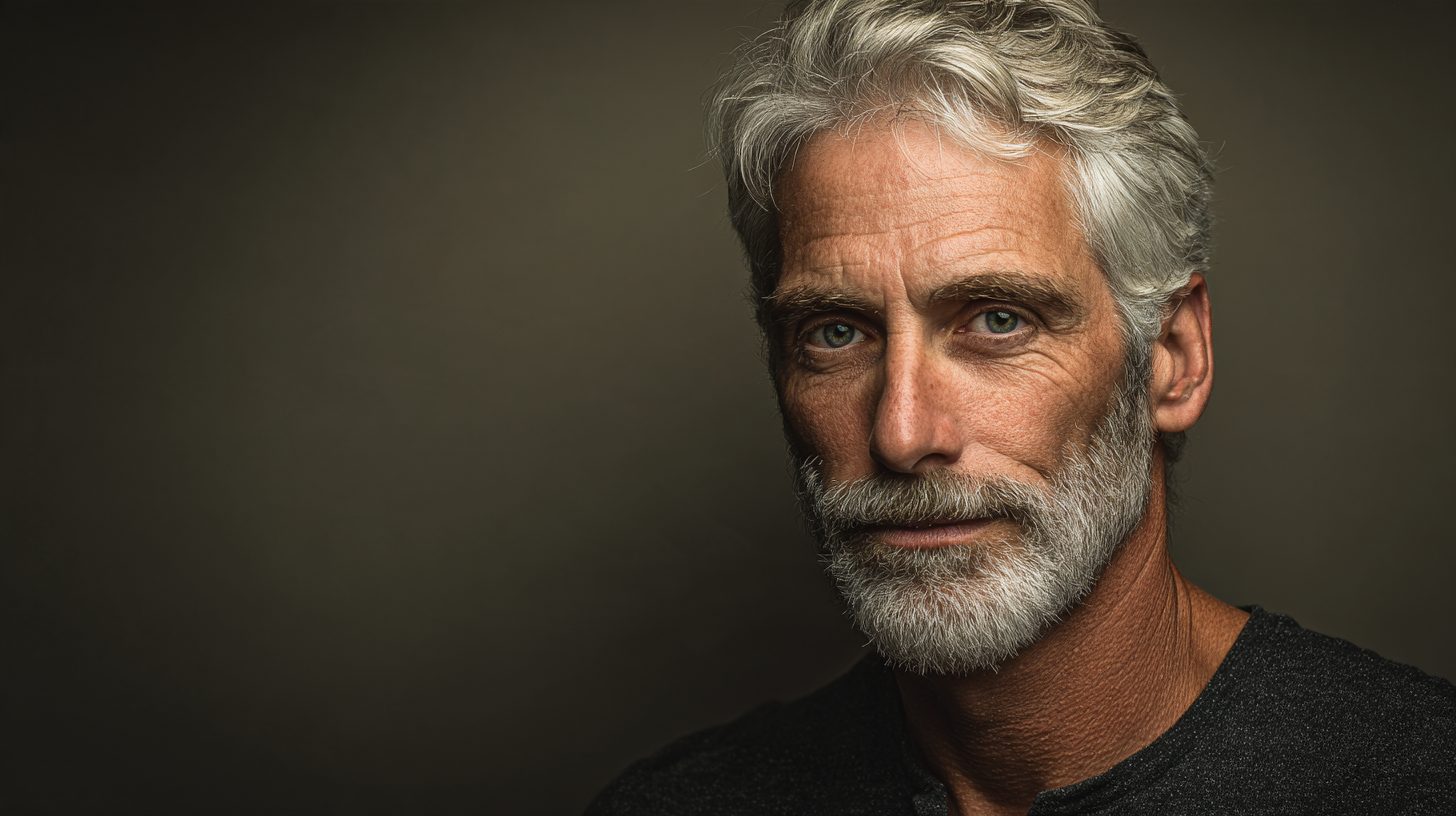
His voice needed to feel contained. Grounded. A little weathered.
Hers needed to feel observant, warm, intelligent, and quietly strong.
Neither voice should sound like it is trying to seduce the audience.
This isn’t really a romance.
It is recognition.
There is a difference.
Lab note: Sometimes the most interesting thing a character can say is nothing at all.
3/9
Then came the visual problem.
I wanted the images to feel cinematic without looking like a collection of beautiful AI pictures.
That distinction matters.
A beautiful picture is easy.
A sequence that feels like somebody intentionally made a film is considerably harder.
So I started building the shots around movement, distance, eyelines, physical space, and emotional progression.
The characters needed to remain separate visually even when they were becoming connected emotionally.
That meant I couldn’t simply throw them together in a series of increasingly romantic close-ups.
The space between them had to mean something.
The road mattered.
The trees mattered.
The walking mattered.
The pauses mattered.
And, because I am apparently incapable of doing anything the easy way, I built a fairly large shot list.
Sixty-five shots.
For a 4:30 video, six seconds per shot means I actually need 45 shots.
Yes.
I know.
I can hear you laughing.
I was overproducing by 20 shots.
Fortunately, I was using relaxed generation mode, so at least I wasn’t watching credits disappear at high speed.
I was, however, watching the queue run.
4/9
At the time of writing this, the automated generation is doing its thing.
And that is one of the strange realities of working this way.
Once the machine starts generating, I am no longer entirely in control of the process.
I can plan.
I can specify.
I can obsess over prompts.
Then I hit the button and wait to see what the machine thinks I meant.
Sometimes it gets it.
Sometimes it gets something better.
Sometimes it produces something that makes me wonder whether we were discussing the same planet.
The 65-shot problem is actually useful in one respect.
I don’t have to make every shot work.
I can make the film out of the best material.
That is a very different creative process from trying to force every generated image into the final timeline.
The machine can give me too much.
My job is to curate.
Lab note: AI generation has turned me from a guy who makes things into a guy who makes things, rejects things, rearranges things, argues with things, and occasionally admits that the machine accidentally had a better idea.
That last part is important.
Happy accidents are part of the medium now.
5/9
Then there was the voice.
I built the dialogue for two voices, HIM and HER, and mapped specific lines to lip-sync shots.
That sounds simple until you actually try to get a voice-production system to understand what you mean.
The dialogue had to be organized so I knew which voice belonged to every line.
Then I had to assign those voices in ElevenLabs.
And then I discovered something wonderfully small and irritating.
The female voice kept pronouncing the word “separate” incorrectly for the meaning I intended.
Not catastrophically wrong.
Just wrong enough to make me stop the entire production and stare at the screen.
The word needed to be the adjective/noun pronunciation.
So I added a pronunciation entry:
Adjective / Noun: Pronounced SEP-uh-rut
And suddenly the voice understood what I had been trying to tell it.
Lab note: There is something deeply amusing about spending serious creative energy on the emotional architecture of a film and then having the entire thing temporarily held hostage by one word.
But that is the real process.
The glamorous part of AI filmmaking is mostly invisible.
A lot of it is telling the machine, “No. That isn’t what I meant.”
6/9
The music turned out to need rethinking too.
Originally, I was thinking about the piece as a longer story with a song attached.
Once I realized the actual dialogue was only about a minute and a half, that changed the musical question completely.
I didn’t want the music fighting with the voices.
I didn’t want a huge emotional score telling the audience what to feel.
And I definitely didn’t want to turn this quiet little story into a movie trailer.
So I went back to genre first.
Not instrumentation.
Not chord progressions.
Genre.
Ambient cinematic.
That was the answer.
The prompt became:
Ambient cinematic, intimate, spacious, ethereal, warm, restrained, reflective, organic textures, subtle piano, soft atmospheric pads, delicate strings, slow evolving harmonies, gentle pulse, emotional restraint, quiet wonder, bittersweet, cinematic depth, gradual warmth, spacious reverb, no dramatic climax, contemplative, tender
That feels much closer to the story.
The music doesn’t need to announce the meaning.
It needs to leave room for the meaning to arrive.
That is a subtle distinction, but I think it may be one of the most important discoveries in the project.
7/9
There is another thing I like about this particular experiment.
The title keeps becoming more literal as I work on it.
SEPARATE BUT TOGETHER.
The characters are separate.
The voices are separate.
The images are separate.
The generated clips are separate.
Even the creative tools are separate.
Midjourney makes the images.
ElevenLabs makes the voices.
The editing software assembles everything.
The music comes from somewhere else.
And somehow the finished piece can become one thing.
That feels like a pretty good description of AI filmmaking in general.
I am not asking one machine to make a movie.
I am orchestrating a collection of very different systems and trying to get them to cooperate.
But occasionally something clicks.
An image lands.
A voice says a line exactly right.
A musical texture appears underneath the narration.
A pair of characters suddenly looks like they belong in the same world.
Those moments are the reason I keep doing this.
8/9
The real lesson isn’t that AI can make cinematic images.
We already know that.
The interesting part is what happens when the tools start influencing the story itself.
The limitations become creative constraints.
Six-second clips change the rhythm.
Lip-sync requirements change the dialogue.
Voice pronunciation changes the wording.
Generated images change the visual language.
The music changes when I finally understand the actual length of the film.
And somewhere in all that friction, the original idea gets refined.
That is the part I find fascinating.
I start with an intention.
The machines push back.
I adjust.
They surprise me.
I adjust again.
Eventually, something emerges that neither of us completely planned.
Lab note: The goal isn’t to make AI do exactly what I imagined.
If that were the goal, I could just make a movie the old-fashioned way and spend the next three years looking for money.
The goal is to give the machines enough direction to participate in the discovery.
I am still the director.
Still the editor.
Still the one deciding what stays and what gets thrown away.
But I am also listening.
9/9
So SEPARATE BUT TOGETHER is becoming a little meditation on connection.
And, unintentionally, a little meditation on making things with machines.
Two people can remain separate and still create something together.
So can a human and an AI.
Maybe that is why the title keeps feeling more appropriate every time I work on it.
The finished film will be much shorter than the first version I imagined.
The dialogue is only about a minute and a half.
The final video will be around 3:00 minutes.
And somewhere in that small amount of time, I hope there is enough room for the viewer to feel something without being told exactly what that something is.
That is what I am after.
Not spectacle.
Not technical perfection.
Presence.
Two people standing in the same world.
Two voices telling the story from different sides.
Separate.
But together.
And perhaps that is the whole trick of this strange new medium.
The machines can generate the pixels.
They can generate the voices.
They can generate the music.
But somebody still has to decide what matters.
That part is still wonderfully, stubbornly human.
Steve Teare
video alchemist
TerminallyBored.Monster
Palouse, Washington USA