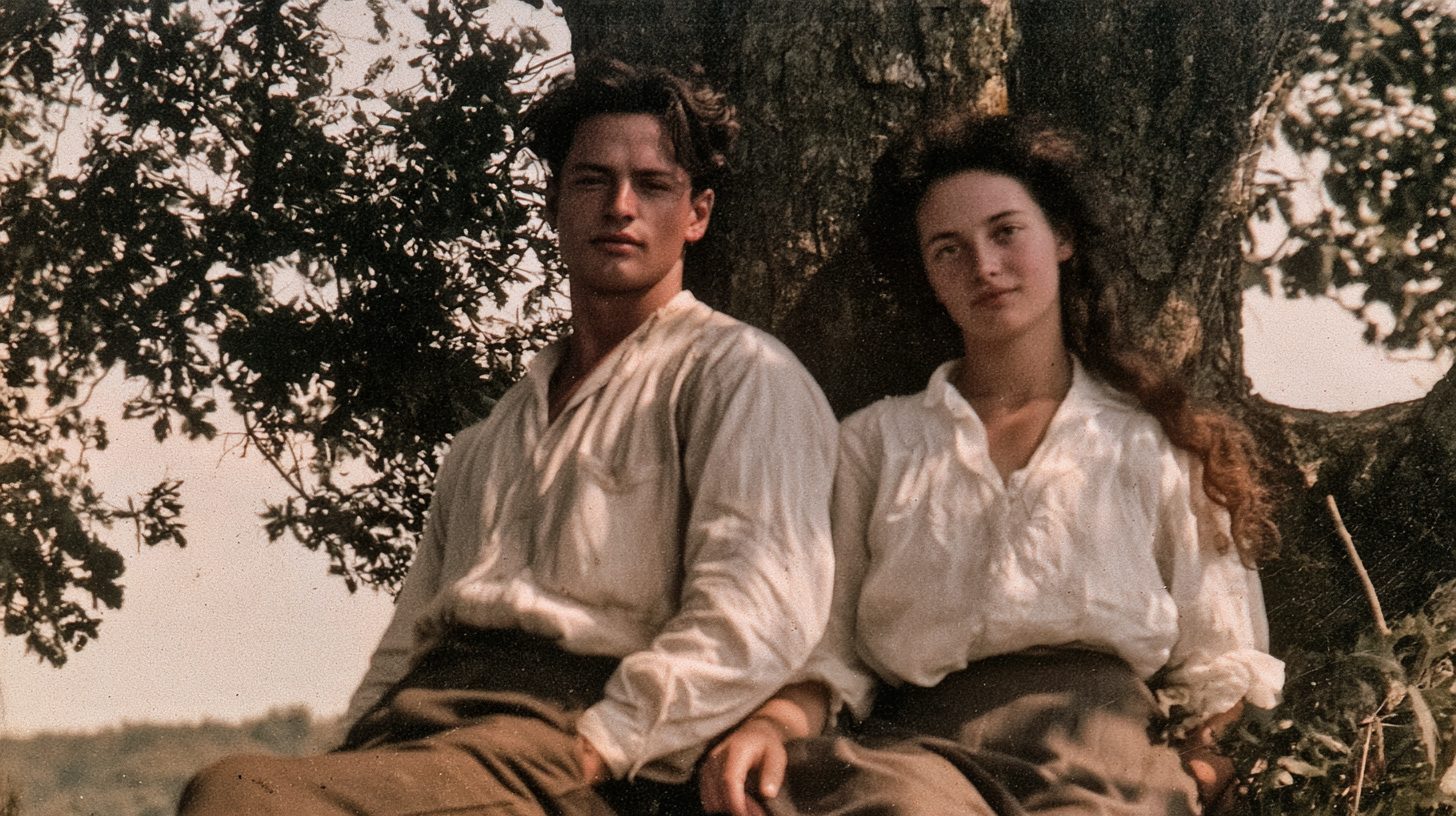
I never knew what love sounded like
I have a theory that some of us can live with a terrible soundtrack for so long that we forget it is playing.
No one could love you.
You know that by now.
If you’ve heard that often enough, you may eventually stop arguing with it. You build a life around it. You learn to expect rejection, to distrust kindness, and to interpret loneliness as confirmation that you were right all along.
And because you’ve never heard anything else, you assume this is what life sounds like.
That was the idea behind my latest video, I NEVER KNEW.
It began with a question: What happens when someone who has spent a lifetime believing he is unlovable discovers that somebody actually loves him?
Not somebody who tolerates him. Not somebody who finds him useful. Somebody who sees him.
And loves him.
2/7
The soldier was never really the point
I decided to tell the story through an American soldier in World War I.
He’s young, far from home, and carrying the usual burdens of war. But the most important battle in this story isn’t happening in the trenches. It is happening inside his head.
He misses the girl he left behind. He remembers her face, their ordinary moments together, and the feeling of being someone who might actually belong in the world.
I wanted the battlefield to feel cold, confining, and almost relentlessly monochrome. The memories of home would be warmer, but not sugary sweet. I wasn’t interested in producing a recruitment poster for romantic love.
The woman isn’t a reward for surviving the war. She’s a person who knows him, sees something in him that he has trouble seeing in himself, and loves him.
That distinction matters.
The soldier’s problem isn’t simply that he is lonely. It is that he has mistaken his loneliness for evidence.
3/7
Building the images with Midjourney
The first part of the process was developing a visual vocabulary that could carry the emotional story without requiring a caption to explain every frame.
I wanted recurring images of the soldier in the trenches, studying a photograph, reading a letter, or sitting alone while the war continued around him. I also wanted the girl to feel alive in his memories, not like a sepia-toned ghost.
So I built a sequence of thirty Midjourney prompts.
Each prompt needed to do two jobs. It had to describe a plausible World War I setting, with appropriate clothing, equipment, and architecture. And it had to express a particular emotional state.
A close-up of a soldier holding a photograph is easy enough to generate. A close-up that conveys the peculiar bewilderment of a man who has just discovered that he might be loved is a more interesting problem.
I used visual contrasts to help tell the story:
- Mud, smoke, barbed wire, and cramped trenches against open fields, a farmhouse, and a railway platform.
- Cold gray and charcoal against restrained amber and golden light.
- The soldier alone with a photograph against the eventual presence of the woman herself.
- Guarded expressions against the small, almost involuntary changes that happen when someone begins to feel safe.
Lab note: I wanted the color to change the emotional temperature without announcing, “Attention, viewer! A healing experience is occurring!”
Subtlety is harder to prompt than explosions. Apparently, artificial intelligence has no particular objection to explosions.
4/7
The lyrics tell us what the images cannot
The lyric begins with a statement that sounds almost casual:
I thought I knew the music.
I’d heard it all my life.
Then comes the old refrain:
No one could love you.
You know that by now.
The narrator has lived inside that belief so long that he doesn’t recognize it as a prison. He thinks it is his home.
That is the part I find most compelling. We don’t always recognize the things that confine us, particularly when we have mistaken them for facts about ourselves.
The turning point is remarkably small:
Then you really saw me.
No elaborate declaration. No explanation of what she sees. No inventory of his virtues.
Just that.
And something filled the silence.
A melody I’d never heard.
I wanted the music metaphor to remain slightly mysterious. He doesn’t immediately understand what is happening to him. He only knows that the old explanation of his life no longer accounts for what he is experiencing.
Then the words arrive:
You love me.
Oh.
That’s what this is.
I like the pause after “You love me.” It gives the discovery a moment to register. The narrator isn’t delivering a speech about self-esteem. He’s trying to comprehend something that contradicts the story he has lived with for years.
5/7
Why I changed the ending
My first visual plan ended with the soldier still alone, looking toward the horizon. It was a quiet, ambiguous ending. It fit the introspective character of the song, and it left room for the viewer to contemplate his internal transformation.
But something about it bothered me.
The ending felt lonely. Downbeat. Unresolved.
I could explain what the soldier had discovered, but I wasn’t letting the audience experience the consequence of that discovery.
So I considered a reunion.
He comes home. She is waiting. They see each other across a little distance, and then they move toward each other.
I don’t want a melodramatic sprint across a railway platform. I don’t need a cinematic kiss or a sunset that looks like it was commissioned by a greeting-card company.
I want the moment when they finally meet.
And I want the camera to stay on his face.
Because the real ending isn’t that the soldier has returned home. It’s that he is standing in front of the person who loves him, and he is finally beginning to understand what that means.
The reunion makes the internal discovery tangible. The woman is no longer a photograph or a memory. She is there. He can see her, and she can see him.
Lab note: Sometimes a story needs one more scene, not because the audience can’t understand the ending, but because understanding isn’t quite the same as feeling it.
6/7
The hard cut to black
I also decided that the video should end with a hard cut to black rather than a fade.
That might sound like a minor editing decision. It isn’t.
A fade-out would allow the emotion to dissolve gradually. A hard cut ends the image while the feeling is still present.
They meet. We see their faces. We see the recognition.
Then black.
I don’t want to show them walking away together into an uncertain future. I don’t want to summarize what their lives will become. I want to stop at the moment when the truth has finally reached him.
The war has filled his world with noise. His own inner voice has told him for years that he is destined to be alone.
But now there is something else.
He has discovered a melody he never knew existed.
And the old music, the refrain he mistook for truth, is exposed for what it was.
Noise.
The cut to black leaves the audience with the music rather than another image to interpret. It also gives the ending a little courage. We don’t need to explain everything that comes after the moment of recognition.
We only need to let that moment happen.
7/7
What I learned from this one
AI video-making is a curious mixture of directing, writing, engineering, and occasionally negotiating with a machine that seems determined to misunderstand the assignment.
The tools can produce beautiful images. But beauty alone doesn’t make a story. Thirty attractive pictures can still add up to nothing more than thirty attractive pictures.
The work is in deciding what each image contributes, what it withholds, and how one image changes the meaning of the next.
The soldier’s journey gave me a way to explore something that matters to me: how a belief about ourselves can become so familiar that we mistake it for reality.
And how being seen by another person can disrupt that belief.
Not by magic. Not because another person can do all our healing for us. But because genuine love can introduce evidence that our old internal story never knew how to explain.
The video alchemist’s job is to arrange the images, the music, and the silences so that the audience has a chance to experience that discovery rather than simply hear about it.
I never knew.
Sometimes those three words describe the beginning of an entirely different life.
Steve Teare
video alchemist
TerminallyBored.Monster
Palouse, Washington USA
PSYCHOLOGY
“I NEVER KNEW | The Music of Being Loved” (The Ophelia Film Company) is a short AI cinematic piece about a young American WWI soldier who has long treated the refrain “No one could love you. You know that by now” as the soundtrack of his life. He experiences it as familiar and therefore true—home rather than prison—until being truly seen by the woman he left behind introduces a contradictory melody. The piece ends on recognition without resolution: the old music is revealed as noise.
Core psychological structure
The central mechanism is an internalized negative core belief operating as a self-reinforcing schema. The soldier does not merely feel unlovable; he has adapted to the belief so thoroughly that it organizes his perception. Loneliness is read as confirmatory evidence rather than a temporary condition. Kindness or the possibility of love is either distrusted or fails to register as real because it contradicts the organizing narrative. This is classic schema maintenance: attention, memory, and interpretation filter for consistency with the old refrain. The war setting functions as an externalized version of the same condition—cold, confining, monochrome, isolating—while the memories of the girl remain warmer yet still framed by the belief that he is only temporarily or partially known.
The turning point is a corrective emotional experience centered on being seen. The lyrics mark it precisely: “Then you really saw me. And something filled the silence. A melody I’d never heard.” Recognition (“You love me. Oh. That’s what this is”) is not framed as sudden self-esteem or a speech of worthiness. It is the registration of contradictory evidence. The old belief no longer fully accounts for the present experience. This creates the classic cognitive dissonance of schema disruption: once the organizing story is punctured by lived evidence, the question opens—“What else have I mistaken for the truth all those years?” The music metaphor is effective because it captures how a familiar internal monologue can feel like reality itself rather than a voice that can be distinguished from other possible voices.
Attachment and identity layers
From an attachment perspective, the piece depicts the long-term residue of rejection or conditional regard that has been metabolized into an avoidant or dismissive stance toward closeness. The soldier can carry the photograph or letter and still treat the possibility of being loved as already disproven. The reunion (revised from an earlier ambiguous ending of the soldier alone at the horizon) makes the internal shift tangible by showing the moment of recognition on his face—without melodrama, sprint, or kiss. The hard cut to black after that recognition is psychologically coherent: the discovery itself is the event; full integration or a guaranteed future is not yet available and is not claimed. The piece treats the corrective experience as real but incomplete—enough to reveal the old refrain as noise, not enough to erase years of adaptation.
The woman is not positioned as a reward or fantasy object but as a full person whose seeing supplies the missing evidence. This avoids the common narrative trap in which the love interest exists primarily to heal the protagonist’s wound. Instead, the wound is the protagonist’s prior inability to register being loved when it is offered.
Aesthetic and formal choices
The visual contrasts (cold trench grays versus warmer but still realistic home light; guarded expressions versus subtle signs of safety; the soldier alone with a photograph versus the woman’s actual presence) keep the emotion subtextual. The AI medium is used to construct plausible period textures and emotional temperature rather than spectacle. The lyrics carry the internal narration that images alone cannot, preserving the sense that the old belief was not merely an idea but a lived auditory and affective environment. The ending’s refusal of resolution leaves the new melody present without converting it into certainty. This matches the creator’s stated intent: the discovery feels courageous precisely because it exposes the familiar prison without guaranteeing the future.
Overall reading
The video stages a precise psychological transition: from a belief so habitual it has become the perceptual background, to the registration of evidence that the background is not the whole of reality. It treats self-worth not as something the soldier must generate internally through will or insight, but as something that can be introduced by another person who sees him accurately. The war is secondary; the real battlefield is the internal soundtrack. The piece is restrained about claims of healing and precise about the mechanism of disruption. That restraint is itself psychologically coherent with the experience it depicts—recognition arrives, the old music is revealed as noise, and the rest remains open.