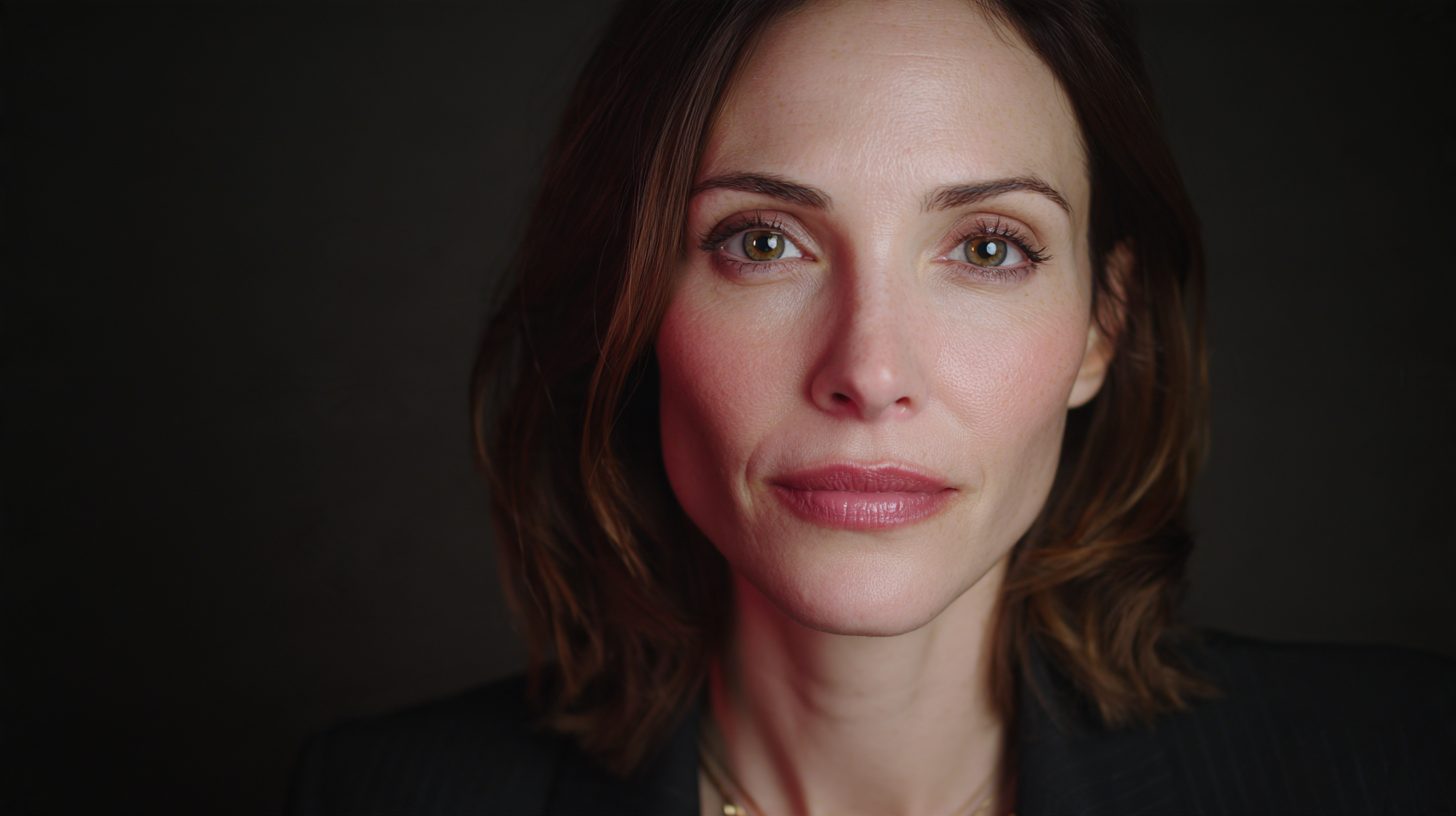
I wanted her to come closer. I wanted her to stay back.
And somewhere in that contradiction, a song began to take shape.
DESIRE ME, BUT DON’T TOUCH ME
There is a particular kind of tension that interests me. You want to be seen, but being seen makes you vulnerable. You want someone to come closer, but you need to decide how close. You want to be desired without surrendering control of the distance.
That is the territory of my latest video project, DESIRE ME, BUT DON’T TOUCH ME.
I wasn’t interested in making a video about a wounded woman who needed rescuing. I wanted a woman with presence. A woman who knows the effect she has on someone and isn’t afraid to use it. She draws you in, retreats, watches to see whether you’re still there, and decides for herself when the distance should disappear.
The contradiction is the point.
2/9
THE CHARACTER IS THE STORY
I started with a simple visual idea: a woman in a dark, cinematic environment, dressed in black with a crimson-red skirt and black ankle boots. The red gives her a visual signature against the darker palette. Her wardrobe stays consistent because I want the viewer concentrating on her behavior, not wondering whether the AI has decided to send her shopping between shots.
She is forty, brunette, fit, and magnetic. But those are just the specifications. They don’t tell us who she is.
That has to come from what she does.
Does she approach the camera or turn away? Does she hold a gaze? Does she pause long enough to make the silence uncomfortable? Does she retreat because she has changed her mind, or because she wants to see what happens when she does?
Those tiny decisions carry the emotional story.
Lab note: A character description gives an AI something to draw. A sequence of meaningful actions gives the character somewhere to go.
3/9
THE DISTANCE IS PART OF THE DESIRE
The central visual problem was translating a psychological tension into physical movement.
I built the shot sequence around approach and retreat. She comes closer, creates distance, checks the space between herself and the viewer, and tests the attention she is receiving. The camera becomes the other presence in the room, even when no second character appears.
I don’t need to show another person reaching for her. The space itself can communicate the relationship.
A glance can be an invitation. Turning away can be a refusal, a test, or simply a decision to take a moment for herself. The meaning depends on what came before and what follows.
That is why the order of the shots matters. Thirty individually attractive clips would not necessarily make a story. I need each clip to contribute something to the progression.
The goal is for the viewer to feel the push and pull rather than have it explained.
4/9
DIRECTING AN AI THAT DOESN’T REMEMBER WHAT IT JUST DID
This is where the video alchemist earns his imaginary lab coat.
Grok Imagine can produce compelling moving images, but generating a series of clips that belong to the same visual world requires planning. Every shot is another opportunity for the character, wardrobe, lighting, or physical details to wander off and do something unhelpful.
Consistency isn’t automatic.
So I developed a shot list and repeated the important character and wardrobe details wherever they mattered. The black jacket, black top, crimson-red skirt, bare legs, and black ankle boots are not incidental decorations. They are continuity anchors.
I also have to think about what the camera is doing, what the woman is doing, and how much movement a particular moment actually needs.
A dramatic sequence can be ruined by asking for too much. Sometimes a controlled glance is more useful than a complicated turn. Sometimes stillness gives the next movement its power.
Lab note: The trick isn’t to make every shot spectacular. It’s to make every shot belong.
5/9
RHYTHM ISN’T JUST SOMETHING YOU HEAR
The music is dark, edgy blues rock. I wanted a driving bass line, punchy drums, sharp guitars, and a groove that makes you want to move. Not a fragile, breathy performance drifting through an atmospheric fog. This woman has too much presence for that.
The visual editing needs to respect the music’s physical energy.
A cut can land on a beat. A glance can become a rhythmic accent. A retreat can interrupt the momentum just long enough to make the next approach feel stronger.
The contrast between movement and stillness is especially useful. If everything is intense, nothing feels intense for very long. The quieter moments give the harder ones somewhere to go.
I want the viewer to feel the groove and the tension at the same time.
That means the editing isn’t simply a matter of arranging attractive AI clips in sequence. It’s another layer of performance, even though the performer is generated.
6/9
THE TOOLS AREN’T THE DIRECTOR
My workflow separates image generation from the final assembly.
Grok Imagine: generating the individual video shots from the prompts.
Kdenlive: assembling the clips, shaping the sequence, and synchronizing the visual rhythm with the music.
Google Flow Music: music composition
The shot list: the continuity plan and the emotional architecture that hold the pieces together.
The human being at the keyboard: the person deciding what the whole thing is supposed to mean.
That last item is easy to overlook when AI tools are producing images that would once have required a production crew, a location, a performer, and a substantial budget.
But generating a plausible image and directing a meaningful sequence are different jobs.
The AI can surprise me. It can also misunderstand, wander away from the specification, or deliver a shot that looks impressive but doesn’t serve the story. I still have to decide which results are useful and how they fit together.
I am not simply asking a machine to make a video. I am trying to conduct an orchestra in which some of the musicians occasionally forget the score.
7/9
WHY I KEEP DOING THIS
I enjoy the technical puzzle, but the technical puzzle isn’t the reason I keep making these projects.
The interesting part is discovering how much emotional meaning can be carried by a small visual decision.
A woman standing still can communicate confidence. The same woman stepping backward can communicate caution, playfulness, or a demand for control. The difference may be no more than the timing of a movement and the expression on her face.
And then there is the viewer, who brings a lifetime of experience to those images.
I can’t dictate exactly what everyone will see. I can only make deliberate choices and build a sequence that gives the viewer something worth interpreting.
That is one of the reasons AI creativity fascinates me. It gives me a way to experiment with visual ideas that would otherwise remain in my head. I can try something, discover what doesn’t work, revise the plan, and try again.
Sometimes the process is frustrating. Sometimes the result is unexpectedly good. Usually, both things happen before lunch.
8/9
THE REAL LESSON: CONTROL THE DISTANCE, NOT THE VIEWER
DESIRE ME, BUT DON’T TOUCH ME is built around a contradiction, but I don’t think the contradiction needs to be solved.
Wanting closeness and needing autonomy can coexist. Desire doesn’t erase the need for choice. Being interested in someone doesn’t mean giving up the right to decide what happens next.
That is what I wanted the woman in this video to embody.
She doesn’t need to apologize for drawing someone in. She doesn’t owe that person access simply because she invited their attention. And if she eventually chooses to close the distance, that choice belongs to her, too.
The video isn’t a lesson about how to win someone over. It is an exploration of the tension itself.
My job is to give that tension a face, a body, a rhythm, and a visual language.
The AI helps me build the world. I decide what the world is saying.
9/9
A FINAL THOUGHT
Every new video teaches me something about the tools, but it also teaches me something about the process of making meaning.
I begin with an idea that isn’t entirely formed. I translate it into lyrics, sounds, prompts, gestures, and cuts. I discover where the idea is stronger than I expected and where my execution hasn’t caught up with it yet.
Then I keep working.
Perhaps that is the real attraction of this strange little laboratory. I get to take something that exists only as a feeling or an intuition and see whether I can make it visible to someone else.
Sometimes I can. Sometimes I get a woman in the wrong skirt. Either way, the experiment continues.
I’m Steve Teare, video alchemist, still learning how to turn imagination into something you can see and hear.
And this time, I’m leaving the distance exactly where it belongs: in her hands.
PSYCHOLOGY
The visual language is built around controlled distance, and the symbolism is almost entirely behavioral rather than decorative.
Distance in this piece functions as an active, regulated interval rather than as absence, rejection, or simple unavailability.
The lyrics and framing treat it as something the character maintains so that desire can continue under conditions she can tolerate. “Stay close enough to sense me but don’t come close enough to know” and “I need the freedom to retreat. See if trust holds true” locate the psychological work in the space between people, not in full merger or full withdrawal.
Approach–avoidance as the governing structure
The same outcome—greater closeness—is both sought and limited. Being seen and wanted is attractive; surrendering control over how near the other comes is costly. This is the classic approach–avoidance conflict applied to intimacy: the goal has both positive and negative valence, so behavior oscillates. She draws the other in, then creates space; she peeks to check whether attention remains, then asserts the right to step back. The oscillation is not portrayed as indecision or pathology. It is the method by which she keeps desire alive without converting it into an obligation.
The test is whether the other can remain present without closing the gap. “I know you’ll still be there without you reaching out to me” reframes reliability as restraint rather than pursuit. Trust is measured by whether the other can tolerate the interval she sets. If the other moves closer uninvited, the test fails; if the other disappears when contact is withheld, the test also fails. Distance becomes the instrument of assessment.
Distance as boundary and as erotic structure
The piece separates the invitation of desire from the granting of access. Drawing someone nearer does not create a claim on further proximity. The character can elicit attention, watch for its persistence, and still decide whether the interval shrinks. This aligns with a view of erotic tension as structured by regulated prohibition: the limit intensifies rather than extinguishes wanting. The distance is therefore not an obstacle the viewer is meant to overcome; it is part of what makes the wanting coherent for her.
In interpersonal terms, this is a form of boundary regulation under conditions of mutual interest. She does not dismiss intimacy; she conditions it. The freedom to retreat is required for the possibility of later approach to remain hers. Without that freedom, any subsequent closeness would be harder to experience as chosen. The psychology here is less about fear of engulfment in the classic avoidant sense and more about preserving authorship over the terms of contact.
How the described visuals enact it
Approach and retreat, held glances, turns away, and pauses turn the interval into something visible. The camera stands in for the other presence, so empty space itself becomes relational. A step backward can read as caution, playfulness, or a demand for control depending on timing and what preceded it. Stillness functions as a counterweight: it lets the next movement register as a decision rather than as continuous motion. The consistent wardrobe (black with the crimson-red skirt) keeps the figure continuous so that these spatial choices remain legible as the actions of one agent rather than as changing spectacle.
The driving blues-rock groove supplies a bodily pulse against which the spatial regulation occurs. Cuts and gestures can land on the beat or interrupt it, so the management of distance is also a management of rhythm. The body is not drifting in atmosphere; it is timing its proximity against an external pulse while retaining the right to alter the interval.
What the distance protects and what it asks
It protects the possibility of choice. If closeness is always available on the other’s terms, the character’s agency is reduced to reaction. By keeping the right to retreat and to decide when (or whether) the gap closes, she keeps the next move attributable to her. At the same time, the distance asks something of the other: sustained attention that does not convert into pressure. The piece does not promise that the interval will eventually disappear. It explores the tension itself—wanting to be desired, seen, and sensed while retaining the authority to set the terms of contact.
In short, the psychology of distance here is the psychology of regulated intimacy: desire is welcomed, presumption is not, and the interval between them is the space in which both interest and autonomy can coexist. The work treats that interval as meaningful rather than as a problem awaiting resolution.
Steve Teare
video alchemist
TerminallyBored.Monster
Palouse, Washington USA