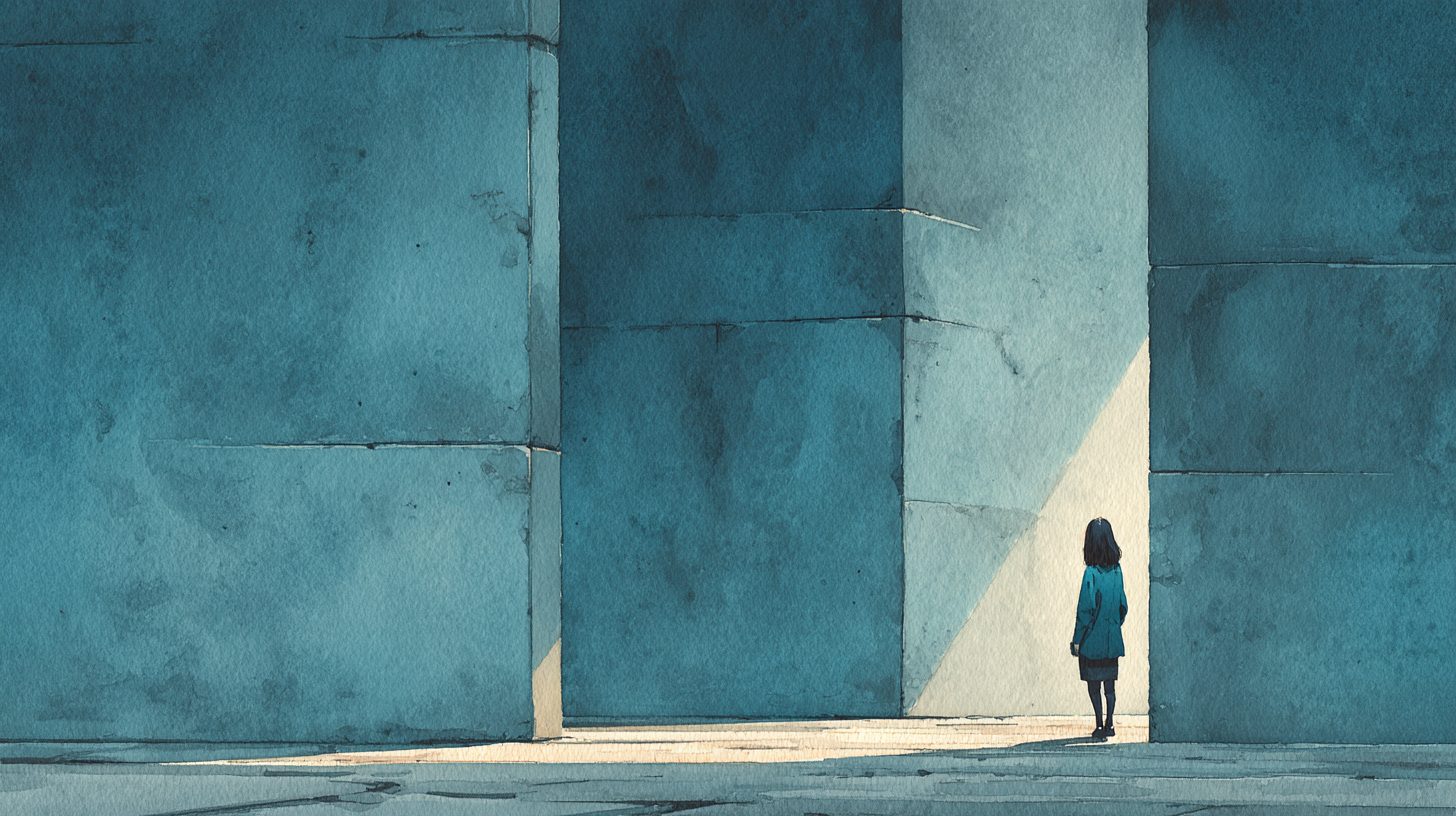
I made a video about two people who are tired of being the strong ones.
The Only: learning that you don’t have to carry everything alone
There’s a particular kind of loneliness that comes with being dependable.
People know you’ll show up. You’ll solve the problem, find the answer, keep the wheels turning. You become the person other people lean on.
And somewhere along the way, people stop asking whether you need someone to lean on, too.
I’ve known something about that feeling. I suspect a few of you have, as well.
So I started wondering what would happen if two people like that recognized each other. Not because one needed saving. Not because either had finally figured out the secret to life.
Just because they saw something familiar in the other person.
That became the seed for a song and, eventually, a video called The Only.
2/6
The idea was simple. Making it visible was not.
I wanted to tell the story of two people who begin in separate worlds. Each has learned to manage alone. Each has become capable, self-contained, and perhaps a little too practiced at not needing anyone.
The woman carries her own burdens. The man carries his. Neither is waiting for a hero to arrive on a white horse. Frankly, at our age, the horse would probably need a rest, too.
What changes is not their circumstances. It’s their recognition of each other.
They begin to see that the person across the invisible divide understands something about the weight they carry. That understanding creates a possibility neither person can manufacture alone.
Maybe I could show that without explaining it to death.
This is where the video alchemist went to work.
3/6
Step 1: Give loneliness a physical shape
I needed the opening images to feel spacious, quiet, and separate.
The woman occupies her world. The man occupies his. Rooms, partitions, distance, and negative space become visual expressions of the walls people build around themselves.
I chose watercolor as the visual language.
Not glossy, photorealistic images. Not the sort of artificial perfection that makes everyone look as though they’ve just stepped out of a luxury skincare advertisement.
Watercolor offered something more human. Pigment could bleed softly into paper. Edges could remain uncertain. Light could emerge through translucent layers. A wall could be both solid and strangely fragile.
That seemed right for a story about people who have learned to protect themselves so thoroughly that even they may have forgotten where the protection ends and the loneliness begins.
Lab note: The medium isn’t just decoration. Its behavior can become part of the meaning. A watercolor boundary can look permanent and permeable at the same time.
4/6
Step 2: Let the music tell me when the world changes
The song determined the architecture of the video.
It begins quietly, gathering energy until the first full, powerful section arrives. Then the music pulls back. The man’s verse occupies that quieter space. The arrangement builds again through the bridge, reaching its greatest intensity before easing into a subdued ending.
That structure gave me a map.
The opening needed room to breathe. The first chorus needed a visual release. The quieter verse needed intimacy rather than spectacle. And the bridge needed to feel as though something previously impossible was becoming possible.
I didn’t want every image to be equally dramatic. If everything is a climax, nothing is a climax. Even a video alchemist has to resist the temptation to pour the entire contents of the special-effects cabinet into every six-second clip.
The individual AI-generated clips are short, so each one has to accomplish something specific. Some establish a character. Others change the emotional temperature. A few serve mainly as transitions, allowing one visual idea to become another.
The job is not to make thirty-odd pretty pictures. It’s to make one emotional journey out of them.
5/6
Step 3: Build a bridge without erasing the people crossing it
The bridge is the heart of the project.
As the music grows, the separation between the two worlds begins to give way. Light crosses the boundary. The spaces become connected. The landscape opens.
But I had one rule I didn’t want to lose: their colors must not blend into one indistinguishable color.
That matters to me.
Connection doesn’t mean becoming the same person. It doesn’t mean surrendering your history, your independence, or the parts of yourself that make you distinct. And it certainly doesn’t mean that one person becomes responsible for repairing the other.
I wanted the final images to show two people standing side by side, facing the same horizon. No grand rescue. No obligatory embrace. No need to prove their connection with a dramatic gesture.
They can be close without disappearing into each other.
The ending grows quiet again. The image holds. Then the screen goes black.
I like an ending that leaves a little room for the viewer to finish the thought.
Lab note: Sometimes the most important thing in an image is what I choose not to show. An embrace would tell the audience what happened between the characters. Standing beside each other leaves the nature of that connection open.
6/6
The tools and the discoveries
This project brought together several parts of my AI creative process:
- Google Flow AI music generation for the song and its emotional structure.
- Midjourney for the watercolor visual concepts and shot prompts.
- Grok AI video generation to turn those concepts into short moving sequences.
- Kdenlive Video editing to assemble the clips around the music, trim the timing, and shape the transitions.
The workflow involves plenty of negotiation with machines that don’t always understand what I think I’ve told them. A prompt can be perfectly clear to me and still produce something that wanders off in a direction I never intended. Consistency across characters and scenes takes attention. Timing takes iteration. Sometimes the best solution is not to regenerate a clip but to change how I use the one I have.
That’s part of the process. I direct the orchestra, but some of the musicians occasionally play the wrong notes.
The real lesson
The Only began as an idea about loneliness, but it ended up being about something more specific: the difference between being rescued and being accompanied.
Rescue implies that something is wrong with you and someone else must make it right.
Accompaniment says something different. You can be capable and still need company. You can have your life together and still want someone who understands the effort it takes. You can stand on your own feet without insisting that you must stand alone.
I don’t think every wall should come down. Some boundaries protect things worth keeping. But perhaps we can learn to recognize the walls that no longer serve us, and the people who might be safe to meet on the other side.
That’s what I wanted this little watercolor world to hold.
Two people. Two separate lives. One moment of recognition.
Neither one has all the answers.
Neither one has to carry everything alone.
And maybe that’s enough to begin.
Steve Teare
video alchemist
TerminallyBored.Monster
Palouse, Washington USA
PSYCHOLOGY
THE ONLY (The Ophelia Film Company) is a short AI-generated cinematic piece—watercolor visuals, original music, Grok-driven sequences—about the particular loneliness of the dependable one. It follows two self-contained people who recognize the same practiced strength and isolation in each other. Neither seeks rescue or merger; the movement is toward being accompanied while remaining distinct.
Core psychological structure
The central mechanism is a competent false self (in Winnicott’s sense) organized around reliability. The speaker is the one who “carries on,” “holds it all together,” and “makes it look so effortless.” Others see strength and trust the smile; they stop asking whether the carrier is tired. Competence has become the primary mode of relating and the primary defense against vulnerability. Needs for dependence, rest, or simply being witnessed without utility are kept behind “walls.”
This is not classical helplessness. The lyrics explicitly reject the savior frame: “It’s not that I need saving. I know how to stand alone.” Hyper-independence functions as an adaptive strategy—often rooted in earlier experiences where leaning was costly or unavailable—so that the self remains functional and self-contained. The cost is chronic loneliness of a specific kind: the loneliness of never being known outside the role.
Desire for recognition over utility
The repeated wish is precise: “I don’t want to be needed anymore. I just want to be known.” And later: “Someone who can hear my story and not leave me alone… let me be a woman who doesn’t have to do it all alone.” This distinguishes being used (as the reliable other) from being seen. It is a demand for intersubjective recognition rather than objectification through function.
The second voice (or the imagined other) mirrors the same position: “Maybe you have carried things you’ve never let me see. Maybe you know the loneliness of being strong like me.” Mutual recognition becomes possible precisely because both have the same armor. Neither has to abandon competence to meet; the meeting itself softens the isolation without requiring collapse of the walls.
From rescue to accompaniment
The piece draws a clear line between two relational fantasies:
- Rescue implies deficit and repair by the other.
- Accompaniment says the person can remain capable and still want company that understands the weight.
The visual language supports this. Watercolor edges are both solid and permeable—walls that protect yet allow light to cross. Separation is given physical form (rooms, partitions, negative space), then the bridge appears not as fusion but as light and shared horizon. The deliberate refusal of blended colors or obligatory embrace keeps individuality intact. Connection does not erase history or independence; it only makes standing alone optional rather than mandatory.
Ambivalence and open ending
The final movement is quiet rather than resolved. The speaker can still “stand and see it through” tomorrow; the wonder is simply what it feels like to have someone stand there. The open, non-dramatic close leaves the nature of the connection undecided. This preserves the psychological realism of the defense: lowering the walls enough to be known risks the very competence that has kept the self safe, and being seen carries the old fear of being left once the need is visible. The piece does not dissolve that tension; it holds it.
Medium as psychological expression
The watercolor process itself participates in the meaning. Soft bleeding, uncertain edges, and translucent layers mirror the theme of boundaries that are protective yet not absolute. The production notes emphasize directing AI tools (music structure guiding cuts, short clips each carrying a specific emotional temperature, resistance to over-drama) so that the human spark remains the organizing principle. The result is a controlled space in which isolation can be externalized and then gently reconfigured—without the characters (or the viewer) being told what the connection must become.
In short, THE ONLY stages the move from a solitary competent self to the possibility of mutual witnessing. It treats the loneliness of strength as real, refuses the fantasy of being fixed, and offers accompaniment as the modest, sufficient alternative: two people who can stand beside each other without either having to disappear or carry everything alone.