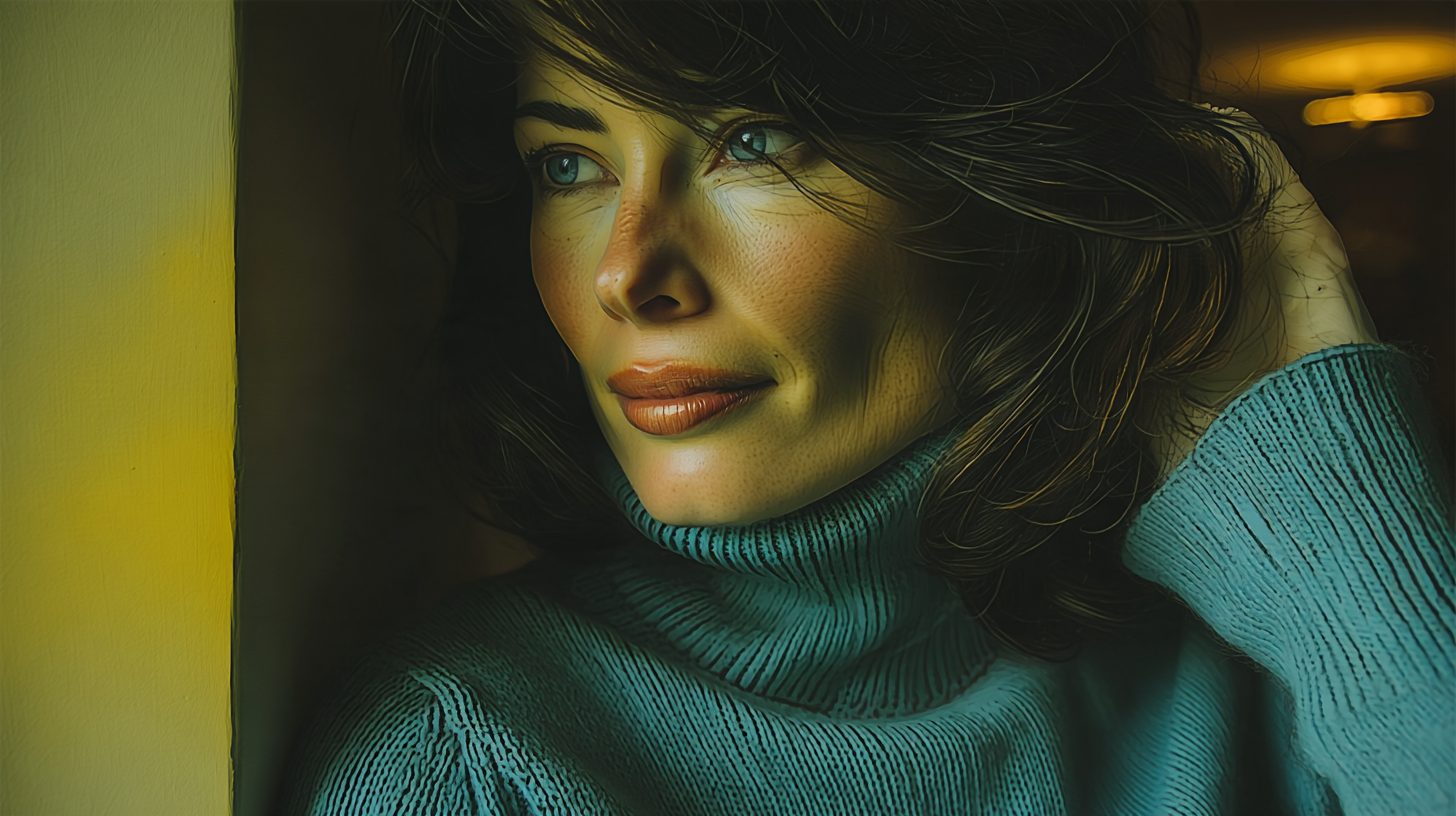
I made a video about caring without asking for anything back.
That sounds simple enough. People do it every day. Parents, friends, spouses, people who show up when someone needs them. We tell people they matter, and we hope they believe us.
But what happens when the connection matters more than either person knows how to explain?
That was the question behind my latest video project, “Hello, It’s Me.”
I started with a song, an old favorite by Todd Rundgren. I wanted to keep its tenderness and emotional honesty while moving it away from the usual romantic interpretation. I wasn’t trying to turn a love song into a friendship song by swapping a few words. I wanted to explore something more difficult to categorize: two people who matter to each other, neither of whom needs to become something different to make the connection real.
Naturally, I decided the best way to do this was to enlist a small army of artificial intelligence.
Because apparently making a video the ordinary way would be too easy.
2/7
The first problem: changing the song without losing its heart.
The original song has a particular kind of vulnerability. The singer wants to reach someone, but there’s uncertainty in the reaching. He has things to say, things he may not know how to say directly, and a quiet awareness that the other person has a life of their own.
I wanted to preserve that.
I revised the lyrics to remove the more explicitly romantic implications while retaining the emotional center. The message became less about longing for a particular response and more about making room for another person.
One of the central lines became:
“It’s important to me
That you know you are free.
‘Cause I never want to make you change for me.”
That was the anchor.
I didn’t want a song about possessing a connection, securing it, or persuading someone to feel something. I wanted a song about caring enough to leave the other person free.
There is a difference between saying, “I need you to understand what you mean to me,” and saying, “I want you to know what you mean to me, but you don’t owe me anything for knowing it.”
The second is harder to write convincingly. It requires the speaker to offer something without quietly attaching an invoice.
Lab note: Removing romance is not the same as removing intimacy. Sometimes the challenge is finding language that can carry deep affection without forcing it into a familiar category.
3/7
Giving the song a voice.
I used a male voiceover for the song’s opening section. I wanted it to sound reflective and personal, not like a stage performance. The pauses mattered. So did the little breaths and hesitations.
The words needed room to land.
I used ElevenLabs to create the spoken delivery, then worked with the instrumental track to find a slower, more contemplative pace. The original instrumental was around 78 BPM. I considered slowing it to approximately 65 BPM, preserving the pitch while stretching the timing.
Slowing music is a surprisingly delicate business. Too fast, and the words rush past their own meaning. Too slow, and the whole thing starts wandering around looking for its slippers.
The goal was not to make the song sadder. It was to make it more spacious.
I also decided that the video should not simply illustrate every line. A literal illustration of lyrics can become a visual karaoke machine, and I already have enough machines in my life.
Instead, I planned a series of small moments: a quiet home at twilight, a phone lighting up, a woman listening, a look of recognition, an unfinished notebook.
Nothing spectacular happens.
That is rather the point.
4/7
The unexpected second half.
The most interesting decision was to give the woman her own voice.
After the male voiceover finishes, the video continues with her private thoughts. She wonders what he has sent her now. She recognizes something familiar in the message. She wonders whether he knows how much she cares about him.
Then she considers something more difficult: perhaps he knows, but doesn’t quite believe it.
Her thoughts move between affection and uncertainty. She wants him to understand that he doesn’t have to earn his place in her life. He doesn’t have to be strong, wise, funny, or creative. He doesn’t have to get everything right.
But she has limits, too. She can’t promise to always have the time, the words, or the answers. She worries that what she can offer might not be enough.
Then comes the shift.
Maybe he isn’t asking her to be more than she is.
Maybe he is simply letting her know that she matters.
And she wishes he knew that he matters, too.
I liked this structure because it gives both people an interior life. The man is not merely sending a message into the void, and the woman is not merely receiving it. She has her own questions, fears, affection, and freedom.
Neither person gets to control the other’s experience.
Lab note: A second point of view can change the meaning of an entire piece. The same message that feels vulnerable to the sender may feel both touching and complicated to the recipient. Letting both perspectives exist makes the connection more human.
5/7
Painting the world around her.
For the visuals, I chose watercolor and gouache rather than photorealism.
I wanted a lived-in Pacific Northwest home at twilight, with cool blue shadows, warm amber lamplight, evergreen trees, and ordinary personal objects. The woman would be consistent throughout: a 45-year-old Caucasian woman with shoulder-length brunette hair parted in the middle, blue eyes, and a muted teal-blue sweater.
Midjourney would help establish her appearance and the visual world. I used separate character and style references to encourage continuity across the shots.
That continuity matters. When a character changes hair, clothing, or facial features every six seconds, the audience has to keep reacquainting itself with her. I wanted the audience to stay with her thoughts instead.
The visual sequence moves through ordinary things: a phone, a chair, a window, a notebook, a bowl of smooth stones, a wildflower in a glass jar, an open gate.
These objects aren’t supposed to decode the story like a puzzle. They’re there to give the feelings somewhere to live.
The open gate, for example, suggests freedom without announcing itself as a Symbol of Freedom in capital letters. The unfinished notebook allows imperfection to exist without an apology. The empty chair gives the room space for another person without requiring that person to be physically present.
And the woman herself does most of the emotional work. A raised eyebrow, a fading smile, a moment of recognition. Small changes can carry more weight than a dramatic expression if the viewer has been given time to notice them.
6/7
The tools, the process, and the alchemy.
My creative stack for this project included:
Midjourney — character references, setting references, and watercolor-inspired still images.
Google Flow Music – sound track
ElevenLabs — the spoken voiceovers and their expressive pauses.
Audio editing — adjusting the instrumental timing and balancing the spoken sections with the music.
Kdenlive — assembling the images, timing the cuts, and building the final three-minute sequence.
Audacity – tempo shifting
Fadr.com – instrumental stem separation
The workflow was part planning and part improvisation. I began with a clear emotional arc, then broke it into thirty six-second shots. That gave me a manageable structure for generating images and assembling the video.
The challenge was not simply getting attractive pictures. It was getting pictures that belonged to the same world and served the same emotional purpose.
A beautiful image can still be the wrong image.
A dramatic portrait might pull the piece toward romance. An overly sad expression might make the woman seem distressed when she is actually thoughtful. A perfectly polished room might feel like a furniture advertisement instead of someone’s home.
So the goal was restraint. Painterly rather than photographic. Expressive rather than theatrical. Intimate without relying on romantic shorthand.
I also wanted to avoid a tidy ending. The woman finishes by wondering what she is going to say to him. She smiles, perhaps chuckles a little, and the video stops before she responds.
No sent message. No typing indicator. No guarantee of what happens next.
I think that is more honest.
Lab note: AI can generate an image that looks emotionally convincing, but the emotional logic of a sequence still needs direction. My job as the video alchemist is to decide what belongs, what doesn’t, and what needs to remain unresolved.
7/7
What I learned.
The biggest lesson was that a meaningful connection doesn’t always need a label to be meaningful.
We often want certainty. We want to know what something is, where it is going, and what it means to the other person. Sometimes that desire helps us communicate. Sometimes it turns a good thing into a test neither person agreed to take.
This video explores a different possibility: caring without demanding a definition, offering affection without making it a debt, and allowing another person to have limits without interpreting those limits as a lack of care.
It also reminds me that receiving care can be difficult. If someone believes they must earn their place in another person’s life, even kindness can become another assignment. They may keep producing, explaining, proving, and trying to get it right.
But perhaps we don’t have to earn every good thing.
Perhaps we can matter before we’ve made anything beautiful.
And perhaps we can let someone else matter without requiring them to become the answer to every question we carry.
The video doesn’t solve those problems. It simply gives them a voice, a melody, and a small watercolor world in which to sit for three minutes.
That’s enough for me.
If you watch it, pay attention to the final moment. She hasn’t decided what to say. She hasn’t promised anything. She has simply recognized that the connection matters, and that she is free to respond in her own time.
Sometimes the most honest ending is an open door.
Steve Teare
video alchemist
TerminallyBored.Monster
Palouse, Washington USA
PSYCHOLOGY
“Hello, It’s Me” (The Ophelia Film Company, ~3 min) is a restrained, AI-assisted short that reworks Todd Rundgren’s 1972 song into a meditation on care that refuses possession or obligation.
It presents two interior monologues around a message that doesn’t fit ordinary categories (romance, friendship, something in between). One person reaches out through a slowed, spacious version of the song; the other (a woman in a twilight Pacific Northwest house, rendered in watercolor) receives it and turns the question inward.
Core psychological dynamics
The piece centers on the tension between wanting to matter and the fear of becoming a demand. The revised lyric anchor—“It’s important to me / That you know you are free. / ’Cause I never want to make you change for me”—functions as an explicit rejection of conditional relating. Psychologically this reads as an attempt to separate genuine affection from anxious attachment strategies: the classic “I need you to understand what you mean to me” versus the harder “I want you to know, and you owe me nothing for knowing it.”
From the receiver’s side, the uncertainty is equally precise. She recognizes something familiar, wonders whether he knows she cares, then considers the more difficult possibility that he knows but doesn’t quite believe it. She also registers her own limits—she cannot promise unlimited time, words, or answers. The wish that he understood he doesn’t have to earn his place (by being strong, wise, funny, or correct) points to a common self-worth schema: the belief that care must be produced or repaid, so that unearned kindness can feel like another assignment rather than a gift.
Relational maturity and restraint
Both perspectives preserve separate interior lives. Neither person is allowed to control the other’s experience. The video ends before any reply is sent—she smiles, perhaps chuckles, and the frame holds the open question. This is psychologically the opposite of merger or anxious pursuit. It models differentiation: intimacy that leaves room for the other to remain themselves. The open gate, notebook, stones, wildflower, and window are understated symbols of thresholds, imperfection, and non-literal openness rather than dramatic resolution.
The slowed tempo (~65 BPM), reflective pauses, and painterly rather than photographic style reinforce the same ethic. They create spaciousness instead of urgency, which matches the stated desire to offer presence without becoming an obligation.
Contextual note
The creator’s broader body of work (and the explicit companion essay on the linked site) consistently explores versions of these themes: being seen without performance, care without debt, vulnerability held inside emotional restraint, and connections that refuse tidy labels. In that light, the video functions as an externalized working-through of the difficulty of receiving and offering non-transactional regard—particularly the quiet fear that kindness might still carry an invisible invoice.
It is not a diagnostic portrait of any individual, but an artistic exploration of a recognizable relational bind: how to let someone know they matter while protecting both people’s freedom to stay exactly who they are. The refusal of resolution is the point.