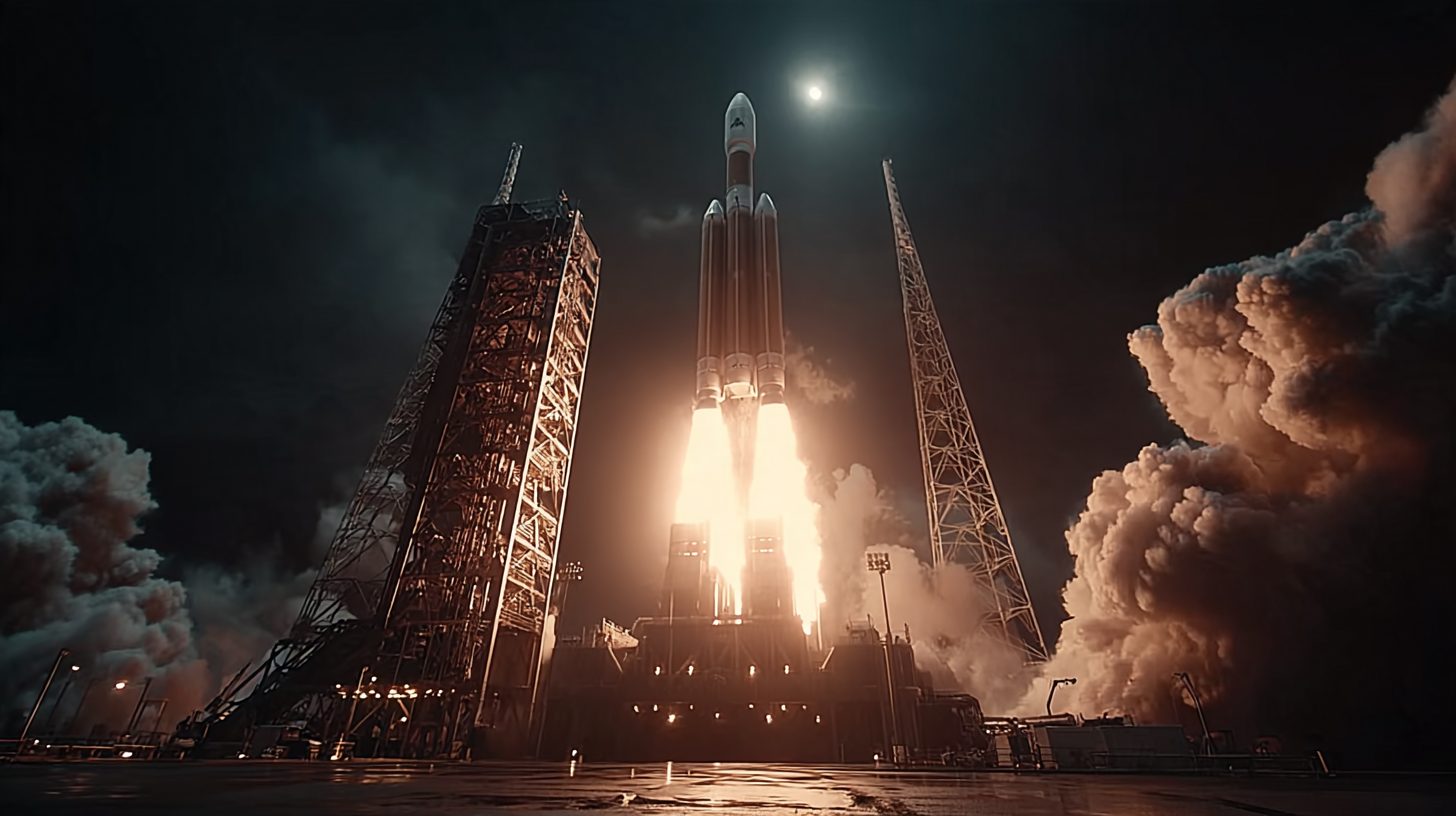
I wanted to go to the moon. Apparently, I needed to make a movie first.
The seed was a poem. It began with an invitation:
Come on board the rocket, let’s fly to the moon.
No limits, no restrictions, nothing holding you back.
We can go fast or we can go slow. But let’s go far.
I liked the idea of a rocket as a metaphor for possibility. Not necessarily escaping Earth, but escaping some of the invisible boundaries we carry around inside ourselves. Fear. Expectations. The need to know exactly where we’re going before we dare to take the first step.
And then there was the line that eventually became the title: Let the light in.
I had a poem, a conversation, and a song. What I didn’t have was a video.
This is where the video alchemist clocks in for another shift at the digital forge.
2/8
The first decision: don’t just illustrate the poem
My first instinct was to make a sequence of beautiful space images. Rocket. Moon. Stars. Galaxy. Maybe a nebula or two. You know the drill. If you have a sufficiently powerful computer and a subscription to an AI image generator, the universe is apparently available for rent.
But a rocket launching into space can be visually impressive without saying very much.
I wanted the imagery to follow the emotional journey, not merely the literal words. The rocket could be real, but it could also represent the willingness to begin. A glass barrier could represent a limit we have mistaken for a permanent feature of reality. Two paths could run beside one another without merging. Two people could share the same stars without needing to see them in precisely the same way.
That last idea mattered to me.
We don’t have to become one thing for what exists between us to be beautiful. We don’t have to erase our differences to share a journey.
So the project became less about reaching the moon and more about what happens when we allow ourselves to be known.
Lab note: A good visual metaphor doesn’t explain everything. It gives the viewer somewhere to go.
3/8
The second decision: give the conversation room to breathe
The middle section of the video is a conversation between a woman and a man.
They discuss fear, vulnerability, expectations, and the strange human tendency to demand guarantees before allowing ourselves to experience something new.
The woman asks questions. The man offers possibilities. Then the woman sees something else, and the conversation moves forward.
I didn’t want either character to sound like a lecturer delivering a motivational speech. They needed to sound like two people thinking together, discovering what they meant while they were saying it.
One of my favorite exchanges is:
WOMAN: What if being seen doesn’t have to be frightening?
MAN: What if we can be known without having to become someone else?
WOMAN: And be different without having to be distant.
MAN: And be vulnerable without having to be ashamed.
That’s the heart of the project, at least as I understand it.
There is a difference between being accepted and being tolerated. There is also a difference between being known and being told who you are supposed to be.
I wanted the video to explore that distinction without turning it into a lecture. The characters could discover the idea together, and the viewer could decide what it meant to them.
4/8
The third decision: build the visual journey
Once the script was in place, I needed a shot list.
This is the less glamorous part of making AI video. The imagination runs ahead, and then the practical questions arrive with clipboards.
How many images do I need? Where should each one appear? Which moments need a close-up? When should the camera pull back? How do I keep the characters recognizable? And how do I make nearly five minutes of imagery feel like one film instead of a slideshow that has wandered into the wrong department?
My initial shot list contained thirty images for a video running approximately four minutes and fifty-four seconds.
That wasn’t enough for the visual pacing I wanted.
So I went back and added seventeen more shots, distributed throughout the existing sequence. I didn’t want to tack seventeen images onto the end as an extended appendix to the universe. The ending already had a job to do.
Instead, I added visual breathing room where the story needed it: the rocket’s launch, the invisible barriers, the inner journey, the shared discovery, and the final movement toward freedom.
The result was a plan for forty-seven images.
Lab note: The first plan is not a sacred document. It is a hypothesis with a nice haircut.
5/8
The fourth decision: make the characters believable
AI-generated people can be wonderfully expressive. They can also acquire a different nose, age twelve years, change hairstyles, and apparently have a complicated relationship with the laws of human anatomy between consecutive images.
For this project, the man is about fifty-two, with short salt-and-pepper hair, expressive eyes, and an intelligent face marked by a few smile lines. The woman is about fifty, with shoulder-length chestnut-brown hair, bright expressive eyes, and an animated face.
Neither is supposed to look like a fashion model who has never experienced a difficult Tuesday.
I wanted mature adults with recognizable, natural faces. People who could plausibly have lived a little, learned a few things, and still be surprised by what happens next.
That meant repeating their descriptions carefully in the image prompts and thinking about camera angles, clothing, lighting, and continuity.
A close-up can communicate hesitation. A wider shot can show that two people have room to move independently. An aerial view can make a winding path feel like an invitation rather than a command.
The visual language needed to do some of the emotional work that the dialogue was already doing.
And I had to resist the temptation to make every image equally spectacular. If everything is a climax, nothing is a climax. Sometimes the most useful shot is simply two people standing beneath a very large sky.
6/8
The fifth decision: let the music finish the thought
The final eighty-four seconds belong to the song.
By then, the conversation has established the ideas. The song gets to release them.
Let the light in. Let it shine.
We can take it slow.
We can touch the sky.
Leave our fears behind us.
We were born to fly.
The music shifts the project from reflection toward movement. The characters are no longer only discussing possibility. The imagery can become more expansive, more physical, and more joyful.
There is room for running, open landscapes, luminous skies, and the sense that the journey itself has become worthwhile.
I like that progression. The song doesn’t need to introduce another argument. It gets to let the argument go.
That is one of the advantages of combining dialogue with music. Conversation can make an idea precise. Music can make it felt.
Lab note: Sometimes the best way to explain an idea is to stop explaining it and let the music carry it.
7/8
The tools, the friction, and the alchemy
The central tools for this project were:
Midjourney — for generating the cinematic stills, with detailed prompts for composition, character appearance, lighting, color, and lens choices.
ChatGPT AI-assisted writing — for developing the poem’s ideas into a dialogue that could carry the middle of the film.
Google Flow Music AI-assisted music creation — for turning the closing lyrics into a song that could move the story from contemplation to release.
Kdenlive Video editing — for assembling the images, dialogue, and music into a single sequence with a deliberate emotional progression.
The precise creative stack matters less than the way the pieces work together. Each tool has its own strengths and its own peculiar ways of making me reconsider my life choices.
The image generator needs specific directions. The script needs room for human-sounding pauses and responses. The edit needs enough visual variety to sustain attention without distracting from the words.
And sometimes the plan simply isn’t good enough.
That happened here. Thirty shots sounded reasonable until I looked at the runtime and realized I had left the visual story underfed. The answer wasn’t to pretend the original plan was perfect. It was to add seventeen more images and improve the pacing.
I don’t have a neat dollar figure to report for this particular project. The real costs include subscriptions, generation time, experimentation, and the occasional hour spent persuading a computer that a fifty-year-old man is not supposed to look ninety.
But the average cot of a video is under $4 US.
I am not complaining. Well, not much.
The tools make things possible that would have been prohibitively expensive or simply inaccessible to me otherwise. But they don’t eliminate the need for judgment. They multiply the number of decisions I get to make.
Which is both the magic and the nuisance.
8/8
The real lesson: possibility is a practice
I began with a rocket and a poem about going to the moon. I ended up with a story about letting ourselves be seen.
The rocket still matters. It gives the imagination somewhere to travel. But the destination isn’t really a place in space. It’s a way of being with ourselves and other people that leaves a little more room for honesty, wonder, and freedom.
We can go fast or slow. We can explore without knowing every answer in advance. We can share a journey without demanding that everyone become identical.
And perhaps we can learn to let a little more light into the places we’ve kept closed.
That is what I hope the video conveys. Not that fear magically disappears, or that vulnerability becomes effortless, but that we can take a step anyway.
As the video alchemist, I don’t create every ingredient from scratch. I direct an orchestra of tools, listen for what is missing, change the arrangement, and keep working until the separate parts begin to sound like one piece.
Sometimes the machine surprises me. Sometimes I surprise myself. And sometimes the most important discovery happens when I realize the project needs seventeen more images.
That’s creativity. Not a lightning bolt delivered to the deserving, but a willingness to keep exploring.
If you watch it, I’d be interested to know what you see in the rocket, the conversation, and the final song. I know what I put into it, but a finished piece can travel farther than its creator intended.
Maybe that’s another way of letting the light in.
Steve Teare
video alchemist
TerminallyBored.Monster
Palouse, Washington USA
PSYCHOLOGY
CONSTELLATIONS | A Creative Cinematic Journey (The Ophelia Film Company) is a short, reflective piece built around a rocket voyage into the unknown, an original song, and a quiet conversation between a woman and a man. It explores possibility, vulnerability, and the freedom to be oneself while sharing a path with another person.
Core Psychological Themes
Internalized limits and the rocket as invitation.
The rocket is framed as an invitation to leave the familiar behind even without knowing the destination. The dialogue immediately questions the line “no limits, no restrictions, nothing holding you back,” asking how many of those limits are external and how many have been internalized—fear, the need to get everything right, the demand for certainty or permission before beginning. This is a precise psychological observation: many constraints that feel structural are actually learned self-protections. The heart-as-guide motif (“You won’t need refueling if your heart guides the way”) further suggests that some of the needed energy is already internal, not dependent on external approval or perfect foresight.
Vulnerability as letting the light in.
“Let the light in” is treated as the harder step. Light reveals what has been kept hidden—the parts of the self one fears will be seen if someone gets too close. The conversation gently reframes this: being seen does not have to require becoming someone else; difference does not require distance; vulnerability does not require shame. This maps onto attachment and self-disclosure dynamics. Protective strategies (hiding, performing, keeping distance) reduce short-term risk of rejection or engulfment, yet they also block the experience of being known as one is. The piece proposes a relational middle ground: shared journey without fusion or self-erasure.
Shared wonder without required sameness.
The stars function as a double image of scale and connection. The universe is enormous and humans are small, yet this need not produce insignificance; it can produce wonder. Seeing the same stars with someone who sees them differently is presented as especially valuable. “We don’t have to see everything the same way to share the journey.” Psychologically, this counters both isolation and enmeshment. It affirms that intimacy can rest on parallel attention and mutual presence rather than identical interpretation or identical pace (“We can go fast or slow… but let’s go far”).
Beginning without full knowledge.
A repeated thread is that one does not need to know exactly where one is going in order to start. Certainty is named as one of the internal fuels people wait for (alongside approval and permission). The closing stance—“We just have to begin”—treats initiation itself as an act of agency. This aligns with contemporary views of psychological flexibility: willingness to move while tolerating uncertainty, rather than waiting for the anxiety to resolve first.
Overall Reading
Where the earlier DESTINY piece focused on noticing and interrupting repetitive scripts and roles, CONSTELLATIONS focuses on the courage required to open and travel alongside another person without losing oneself. The rocket, the stars, and the light are externalized metaphors for an internal and relational movement: from protective self-containment toward vulnerability, from the demand for certainty toward the willingness to begin, and from the fear of difference toward the possibility of companionship that does not require sameness.
The tone remains gentle and non-prescriptive. It does not claim the journey is easy or guaranteed; it simply marks the psychological opening that becomes available once internalized limits are recognized as optional and once being seen is no longer equated with danger or self-loss. In that sense it is a companion piece to DESTINY: one examines the masks and loops we inherit, the other examines the risk and reward of stepping out from behind them with someone else.