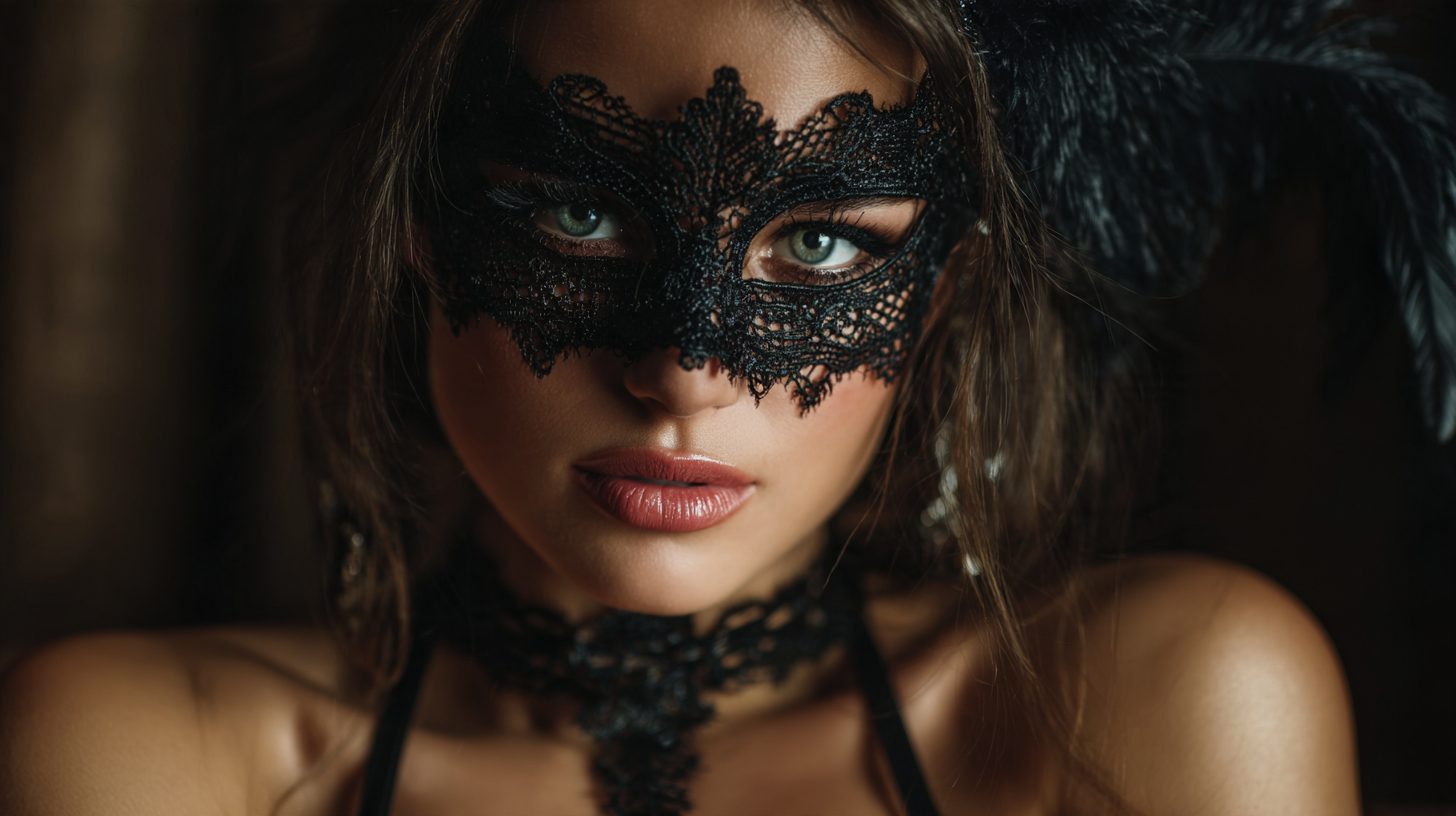
I thought I was making a video about destiny. Then I started thinking about masks.
There is something fascinating about the roles we play. We learn how to behave, how to protect ourselves, how to become the person other people expect to see. Eventually, we may forget where the performance ends and we begin.
I wanted to explore that idea visually. Not with a lecture or a talking head. I wanted a dream. A Venetian masquerade, two mysterious figures, a ballroom full of people hiding behind beautiful faces, and a theater where nobody is quite sure whether they are the actor or the audience.
Naturally, I recruited artificial intelligence to help me build the dream. Because apparently having an imagination isn’t enough. Now I need to direct an imaginary film crew that occasionally forgets what a mask looks like.
2/8
The idea behind DESTINY
The central question was simple enough: How much of what we call destiny is really a pattern we keep repeating?
We develop habits. We learn defenses. We inherit expectations. We become good at certain roles, sometimes because those roles help us survive. After a while, the familiar can feel inevitable.
But a pattern isn’t necessarily a prophecy.
That became the visual foundation for the project. The masquerade represents the roles we play. The mirrors represent repetition and self-recognition. The theater represents performance. And the masks represent the identities we show the world, whether or not those identities tell the whole story.
I chose a Gothic Venetian setting because it gave me the right combination of beauty, mystery, and theatricality. I wanted elaborate architecture, polished marble, velvet curtains, gilded mirrors, and formal clothing. The world needed to feel magnificent, but not entirely real.
This wasn’t supposed to be a horror film. Nobody needed to chase anybody down a corridor. The unsettling part was the possibility that we might keep playing the same role without realizing we have a choice.
Lab note: Sometimes a visual metaphor becomes more useful when you stop explaining it. A mask on a table can say something that three paragraphs of narration might only manage to describe.
3/8
Building two characters who could carry the idea
I gave the story two central figures.
The woman wears a fitted black Gothic evening gown and an elaborate black Venetian eye mask. The mask has intricate floral lace, scalloped edges, black satin ribbons, and a cluster of long black feathers sweeping upward from her right temple. Her long, dark-brown wavy hair and the dramatic silhouette of her costume make her recognizable even in a distant shot.
The man wears a tailored black Phantom-inspired tailcoat, black waistcoat, crisp white shirt, and white cravat. His smooth, matte-white half-mask covers the right side of his face. Unlike hers, his mask has no lace, feathers, or decoration. Its simplicity is the point.
Black and white. Ornament and restraint. Two different ways of being hidden.
I wanted the characters to feel like people who belonged in the same dream without making them interchangeable. Their costumes needed to remain consistent from portrait to portrait, ballroom to theater, mirror to empty stage.
That sounds straightforward until you ask an image generator to reproduce the same fictional person across dozens of separate images.
AI doesn’t maintain a wardrobe department behind the scenes. It doesn’t remember that yesterday’s mask had six feathers and today’s has suddenly acquired twelve. It responds to the prompt in front of it, and sometimes its interpretation of continuity is more of a philosophical suggestion.
4/8
The 76-shot problem
I developed a storyboard of 76 still images, divided into five visual movements.
The first establishes the dream: Venice at night, the opera house, the empty ballroom, the masks, and the two characters.
The second introduces the masquerade itself. We see the couple in formal portraits, surrounded by dancers, chandeliers, mirrors, and elaborate architecture. There are close-ups of gloved hands, lace, fabric, and small details that make the world feel tangible.
The third movement explores repetition. Corridors recede toward distant vanishing points. Mirrors multiply reflections. Identical doors line the walls. An empty stage waits beneath a single spotlight.
The fourth movement strips away the spectacle. The characters stand farther apart. The ballroom empties. The compositions become quieter, with more negative space and fewer distractions.
Finally, we reach the masks themselves.
I deliberately designed the ending so we never see the characters’ unmasked faces. The story doesn’t need to tell us exactly who they are underneath. It needs to leave room for the viewer to think about what happens when the roles are no longer necessary.
Lab note: A storyboard is not a shopping list of pretty pictures. Each image needs a reason to exist, and the sequence needs to develop an idea rather than merely decorate a soundtrack.
5/8
Teaching the camera to look
One of the biggest challenges was visual variety.
If every image is a medium shot of two masked people standing in a beautifully decorated room, the video becomes a slideshow of expensive wallpaper.
So I varied the visual vocabulary.
Some images are wide architectural establishing shots. Others are full-length portraits, overhead views, close-ups, extreme details, and still lifes. The camera might look down on a circular arrangement of dancers, peer through heavy theater curtains, or focus on a pair of masks lying several feet apart on a polished floor.
The objects matter as much as the people.
A white glove against black velvet. A black ribbon across a dressing table. An empty director’s chair. A clock above a corridor. A pair of masks reflected in an antique mirror.
These details give the viewer a chance to absorb the atmosphere without being asked to interpret every image immediately.
I also wanted the lighting to evolve. The ballroom could be rich with gold and warm highlights. The corridors could be cooler and more restrained. The later theater scenes could reduce everything to a small pool of light surrounded by darkness.
The point wasn’t to make every image look different. The point was to make every image feel as though it belonged to the same world while contributing something new.
6/8
Midjourney: directing the imaginary film crew
The prompts became the production documents for this imaginary film.
Each one specifies the subject, the composition, the setting, the lighting, and the details that must remain consistent. I included the character descriptions repeatedly rather than assuming Midjourney would remember them from the previous image.
I also specified the 16:9 aspect ratio for the widescreen format and used the version setting for Midjourney 8.2.
A prompt might describe an immense Venetian ballroom, but that alone doesn’t determine the image. The camera position matters. The distance between the characters matters. The lighting matters. The amount of empty space matters.
Compare a wide shot in which two figures are separated by a vast marble floor with a close-up of their gloved hands. Both might belong to the same scene conceptually, but they create very different experiences.
And then there is the delightful business of trying to get a fictional character to keep wearing the same fictional mask.
The best defense is specificity. Describe the mask’s shape, material, decoration, and orientation. Repeat the details that matter. Don’t rely on vague references such as “the same mask as before.”
Even then, the results need inspection. A prompt is an instruction, not a guarantee.
Lab note: AI image generation is less like commissioning a photograph and more like directing a talented artist who has a remarkable imagination, occasionally misreads the brief, and cannot always explain why the feathers have migrated.
7/8
The tools and the budget
The principal visual tool for this project was Midjourney, used to develop the 76 still-image concepts.
The production stack for DESTINY:
Midjourney 8.2 — generating the cinematic still images.
Grok imagine — image-to-video conversion.
Kdenlive — the editing environment for assembling and refining the video.
Audacity — sound editing
The storyboard — my attempt to make sure the images tell a coherent visual story rather than forming a random collection of attractive pictures.
The human brain sitting between all of them — deciding what matters, correcting mistakes, and trying to keep the whole thing pointed in the right direction.
I am not including a dollar figure here because I haven’t established a reliable project-specific cost total. Subscription costs and the time spent generating alternatives are different things, and pretending otherwise would make the accounting look more precise than it is.
The time is real, though. So is the iteration.
A finished image may look effortless. Getting there can involve rewriting a prompt, changing the camera angle, removing unnecessary details, or abandoning an attractive idea because it doesn’t serve the sequence.
That friction is part of the medium. It is also part of the creative process.
8/8
The masks are not the ending
The final images show the two masks lying on the stage floor after the people have left.
The black lace and feathers. The smooth white half-mask. A little light. A great deal of empty space.
I didn’t want to show what the characters looked like underneath. That would turn the ending into a reveal, as though the answer to the whole question were a face.
The more interesting possibility is that removing a mask doesn’t automatically tell us who we are. It simply gives us a chance to find out.
Maybe we will discover something familiar. Maybe we will surprise ourselves. Maybe some of the roles we learned to play will remain useful, while others can finally be put down.
And maybe destiny isn’t the opposite of free will. Maybe what we call destiny is sometimes a pattern we haven’t yet learned to recognize.
Once we see it, something changes. We may still choose the familiar path, but at least we have the possibility of choosing it consciously.
That is the idea I wanted DESTINY to leave behind.
I am the video alchemist here, directing the AI orchestra and occasionally reminding the violins that they are not supposed to be trumpets. The machines supply possibilities. I supply the intention, the judgment, and the stubborn refusal to stop at the first acceptable result.
The collaboration works best when I know what I am trying to say, but remain open to discovering something I didn’t know I was saying.
Sometimes the most revealing thing about a mask is not what it conceals.
It’s the moment we realize we are allowed to take it off.
Steve Teare
video alchemist
TerminallyBored.Monster
Palouse, Washington USA
PSYCHOLOGY
DESTINY (The Ophelia Film Company) is a short, contemplative cinematic piece set in a dreamlike Venetian masquerade. Two voices converse about roles, scripts, and second chances while a poem recites the experience of knowing the lines by heart and sensing something is wrong. The central question is whether we are producers of our own destiny or performers repeating a pattern we no longer notice.
Core Psychological Themes
Repetition compulsion and the familiar script.
The piece repeatedly returns to the idea that we reenact learned behaviors long after their original purpose has faded. These patterns once provided safety, belonging, or a way through difficulty; eventually they become automatic. The language of “live over / do over / refresh / restart / mulligan” frames the desire for a second chance, yet the dialogue acknowledges the risk that the same shot is taken again and again because the underlying driver remains unseen. This maps closely onto the psychodynamic concept of repetition compulsion: the unconscious tendency to recreate familiar relational or situational templates even when they are painful or outdated. The video treats the moment of noticing the repetition itself as the first opening of freedom.
Persona, masks, and the shift from actor to observer.
Venetian masks and limelight function as metaphors for the social and familial roles we inhabit. One voice initially equates the limelight with exposure and having nowhere to hide; the other reframes it as the possibility of finally watching oneself. “The actor becomes the observer. The person playing the part begins to notice the performance.” This is a classic movement toward reflective self-awareness. In Jungian terms it is the differentiation of the persona from the larger psyche; in narrative psychology it is the emergence of a meta-position from which the story can be examined rather than merely lived. The poem’s lines (“I know the lines. I know the part. The same old script, the same old start… But something tells me something’s wrong”) capture the subtle dysphoria that often precedes this shift—the sense that the role no longer fits even while it still feels like “who I am.”
Free will, authorship, and the illusion of control.
The dialogue holds a productive tension: “We are center stage, standing in the limelight, the producers of our own destiny” is immediately questioned. Decisions can be made without understanding what drives them; a familiar role can feel like identity even when it no longer serves. This echoes existential themes of bad faith versus authenticity—living as though one is freely choosing while following an unexamined script. It also resonates with contemporary views of agency that emphasize constrained choice: we are not blank slates, yet awareness of the constraint expands the range of possible responses. The video’s final suggestion is modest and psychologically realistic: destiny is not a fixed ending written in advance, but what becomes possible once the pattern is seen and a different choice is risked, even without guarantees.
Identity as performance versus identity as possibility.
The recurring question “Do we choose the parts we play or are they reenactments?” refuses a simple answer. The piece implies that both can be true until observation intervenes. A fresh start is not framed as erasing the past but as no longer allowing the past to make every decision. This aligns with therapeutic ideas of “updating the narrative” or interrupting automatic loops through mindfulness and deliberate experiment. The closing repetitions of the restart phrases, followed by the poem’s open question (“Or is it the same?”), leave the outcome suspended—consistent with the psychological reality that insight does not automatically produce lasting change.
Overall Reading
The video is less a dramatic story than a meditative invitation to meta-cognition. Its psychological force lies in treating self-observation itself as an act of agency. The masquerade setting externalizes the ordinary human condition of wearing roles so thoroughly that they become transparent. The gentle, non-judgmental dialogue models a stance that is neither fatalistic (“this is just who I am”) nor naively voluntaristic (“I can simply choose anything”). Instead it locates freedom in the narrow but decisive gap between noticing the script and deciding whether to continue it.
In short, DESTINY psychologizes the old question of fate versus free will as a practical problem of pattern recognition and the courage to try a different response once the pattern is visible. The masks, the limelight, and the repeated “do-over” language all serve that single movement: from unconscious performance toward the possibility of a more chosen life.