
1/9
I kept seeing her.
Same woman. Different centuries.
Same feeling… refusing to resolve.
I wasn’t trying to make a story.
I was trying to trap a sensation — that quiet tension when something is almost alive between two people… and never quite crosses the line.
2/9
The Spark
It started with a simple irritation.
I was staring at a Midjourney still, thinking:
“This looks good… but it doesn’t breathe.”
Not really.
No pulse. No hesitation. No micro-shift in awareness.
Just pixels pretending.
And I wanted that almost —
that moment where the collarbone rises slightly with breath,
where the eyes almost move,
where something is felt but not acted on.
So I thought:
What if she keeps resetting?
Same emotional state.
Different time periods.
Like she’s trapped in the same unresolved moment… forever.
3/9
Process: Building the Loop
I didn’t build a narrative.
I built a system.
Eighteen segments.
Ten seconds each.
Three minutes total.
Each one:
- Same woman (locked with
--cref) - Different historical era
- Same emotional position
And the key constraint:
Nothing resolves. Ever.
4/9
Step 1: Lock the Face, Break Time
Midjourney gave me the anchor.
A face that could hold tension without overacting.
Neutral… but not empty.
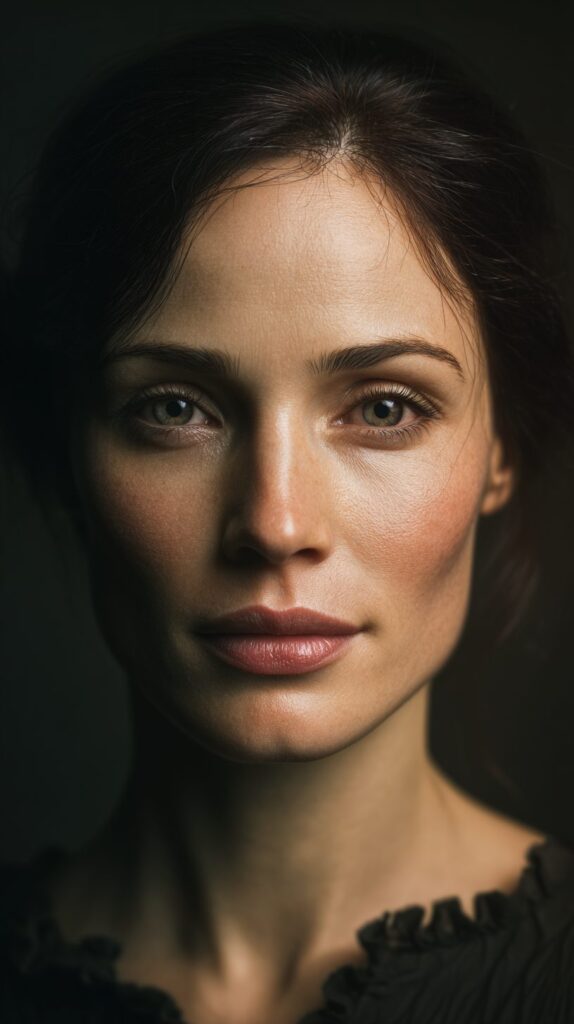
PROMPT: Caucasian woman approximately 30 years old, cinematic close-up headshot, neutral expression, soft warm light on face, smooth skin, subtle shadows, timeless look, historical realism tone, portrait quality, highly detailed, sharp eyes, symmetrical features, soft bokeh background, high resolution, cinematic lighting, soft focus edges
Then I forced the contradiction:
- Ancient Egypt
- Roman Empire
- Victorian London
- 1920s skyline
- Modern edge
Same woman.
Same age.
Time moves. She doesn’t.
Lab note:
Consistency is everything here. If her face drifts even slightly, the illusion collapses. You don’t get “timeless.” You get “casting error.”


5/9
Step 2: The Balcony Trick
Every scene needed a reason to look outward.
So I gave her a balcony.
Always elevated.
Always overlooking something vast.
Cities. Empires. Time itself.
But really?
She’s not looking at the city.
She’s looking toward him.
Or… where he would be.
Lab note:
The balcony is doing emotional work. It creates distance, perspective, and just enough separation to keep the tension alive. Ground-level kills the myth.
6/9
Step 3: Making Stillness Breathe
This is where things usually fall apart.
AI loves to overperform.
Too much motion. Too much “look at me, I’m alive.”
Nope. Not here.
I had to translate emotion into physical micro-instructions:
- slight head tilt
- slow gaze shift
- gentle chest rise and fall
- subtle exhale
- hair moving just enough to suggest air
Not poetry.
Not metaphor.
Physics.
Because the AI doesn’t understand longing.
But it does understand motion.
7/9
Step 4: Camera as Emotion
The camera became the emotional arc.
Every segment follows the same pattern:
- tight close-up
- slow dolly out
- reveal the world
- slight upward tilt
That last part matters.
She’s always, always ending in a slight lift.
Not quite looking at the sky.
But close enough to ask the question:
“Why am I still here?”
And then — reset.
Lab note:
Repetition isn’t boring if the viewer feels the difference. Tiny variations in timing and motion create a subconscious escalation.
8/9
Step 5: The Ghost That Never Lands
There’s a man in this film.
Sort of.
He never appears fully in the world.
He’s composited.
Transparent.
Bare-shouldered. Timeless.
Same face. Every time.
He’s not a character.
He’s a constant.
The thing she feels…
but never reaches.
And I made a deliberate choice:
Don’t sync him to the eras.
No costumes. No context.
Just presence.
Lab note:
The moment you contextualize him, you lose the myth. He has to feel like memory… or gravity.
9/9
What I Actually Learned
I thought I was building a sequence.
I was actually building a loop.
And the loop revealed something uncomfortable:
We don’t always want resolution.
Sometimes the tension is the experience.
The almost-touch.
The almost-choice.
The almost-release.
And when you remove the payoff…
you start to feel the structure underneath the emotion.
That quiet repetition.
That familiar ache.
That same place we keep returning to —
even as everything else changes.
Tools & Creative Stack
- Midjourney v7 — still image generation, character consistency
- Grok Imagine — image-to-video motion
- Kdenlive — timing, slow motion, compositing
- Producer.ai — soundtrack generation
- Manual SFX layering — environmental continuity (Pixabay free SFX)
The Real Lesson
If you want AI to feel human, stop telling it what to feel.
Tell it what to do.
And then…
Let the viewer feel the rest.
I set out to make something cinematic.
What I got was something quieter.
A woman standing at the edge of time…
feeling the same thing, again and again…
And never quite stepping forward.
Honestly?
That felt more real than resolution ever could.
— Steve Teare
video alchemist
TerminallyBored.Monster