I wasn’t supposed to make this.
It started as a quiet curiosity — a poem I read once, the kind that doesn’t just sit in your mind but lingers in your chest. Two ships. Passing. Almost.
And that word… almost.
I’ve felt that before. Not as a story — as a moment. A glance that holds too long. A recognition that lands without permission. The strange gravity of someone who feels… matched.
So I did what I always do when something won’t leave me alone.
I tried to build it.
2/9 — The Problem with Almost
Here’s the thing about “almost” — it’s not visual.
You can render ships.
You can simulate storms.
You can drench actors in rain and have them spin like poetry.
But almost?
That lives in micro-space.
A hesitation.
A held breath.
A movement that begins… and doesn’t finish.
AI is very good at motion.
It is not naturally good at restraint.
So the real challenge became:
How do you create intensity… without collapse?
3/9 — Step 1: Locking the World
I made a decision early that saved me from a lot of pain:
No abstraction. No cosmic metaphor soup. No vague dream logic.
Just:
- Two 17th–18th century European pirate ships
- A violent storm
- Two human bodies inside it
Because water behaves.
Wind behaves.
Fabric behaves.
And if those behave… the emotion can ride on top of it.
Lab note:
The more grounded the physics, the more believable the emotion. AI needs something real to push against.
4/9 — Step 2: Character as Anchor
I generated reference faces first in Midjourney.
Not “characters” — people.
- Female pirate, 27, auburn hair, green eyes, storm-soaked, sharp presence
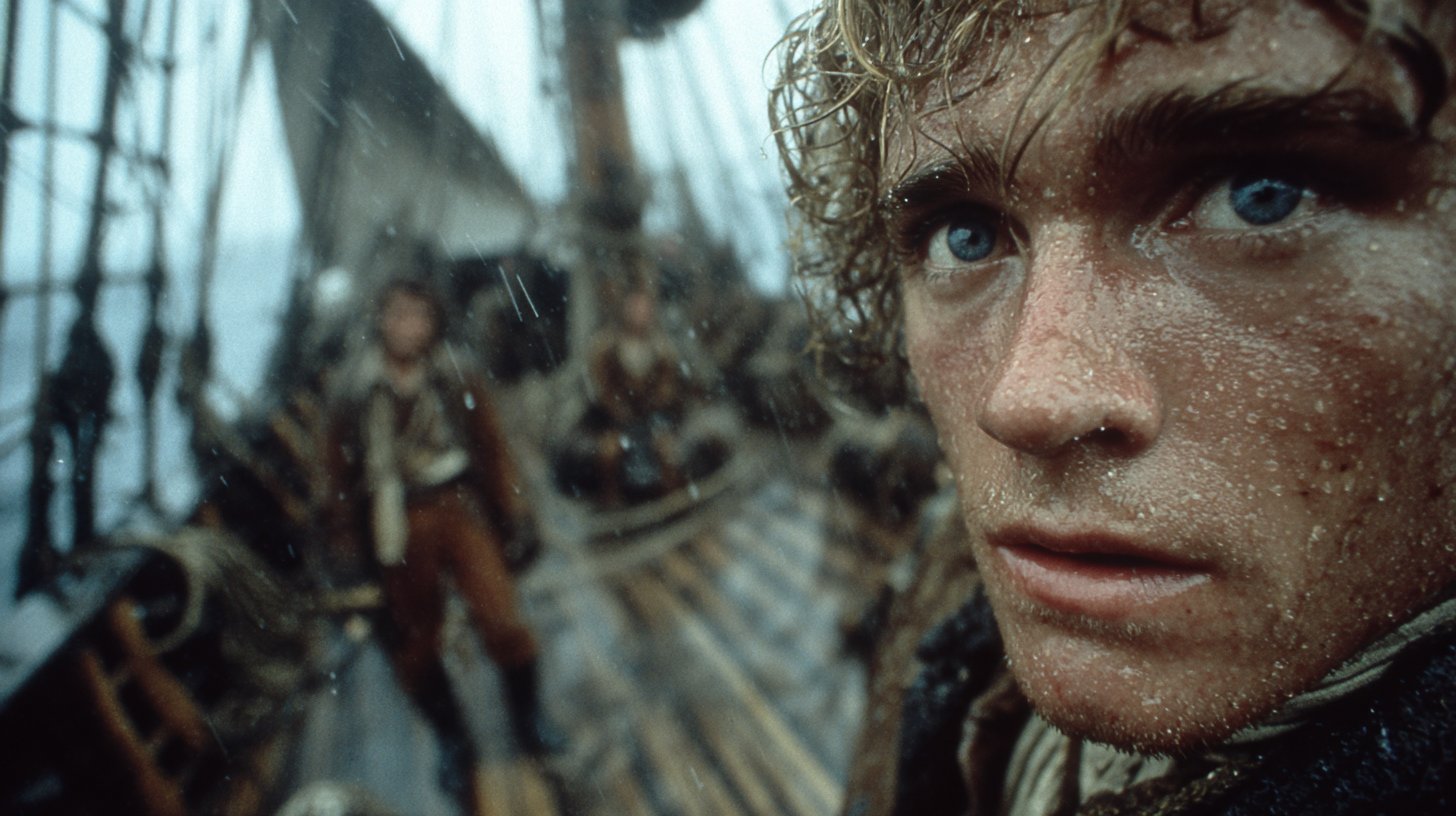
- Male pirate, 30, sandy-blonde, blue eyes, slightly worn, grounded intensity
Everything else was built around them.
And here’s where things got tricky.
If you don’t lock identity hard enough, Midjourney will drift. Faces mutate. Clothing shifts. Gender gets… creative.
So I used character references (--cref) surgically:
- Female present → use her reference image
- Male solo → use his reference image
- Both present → only female reference (or chaos ensues)
Lab note:
AI doesn’t “remember” — it reinterprets. Consistency is forced, not assumed.
5/9 — Step 3: The Storm Isn’t the Background
The storm became the third character.
Not decoration — pressure.
Every prompt had to carry:
- Wind tearing at coats
- Water slamming the deck
- Hair plastered, then ripped loose again
Because this wasn’t about two people meeting.
It was about two people holding themselves together inside force.
That’s the difference.
6/9 — Step 4: The Dance Experiment
This is where it either works… or collapses into cringe.
I needed movement that felt:
- Physical
- Instinctive
- Slightly out of control
- But never actually out of control
So I leaned into:
- Spins
- Weight shifts
- Grabbing railings mid-motion
- Recovering balance
Not choreographed dancing.
More like:
“What does a body do when it refuses to be still?”
And then something unexpected happened.
It started to feel like joy.
Not soft joy — violent joy.
The kind that happens when you’re fully inside something and stop resisting it.
7/9 — Tools & Creative Stack
Here’s what powered this experiment:
- Midjourney — all still image generation (character + environment)
- Producer.ai — music and rhythm shaping
- Kdenlive — sequencing, timing, cuts
- ChatGPT – generating prompts for music and images
- Grok Imagine – Image-to-video with SFX
- OCR (yes, really) — to extract (poem image to text) and study poetic structure
No fancy pipeline. Just persistence and iteration.
Lab note:
The magic isn’t the tool stack. It’s the decisions between outputs.
8/9 — The Real Discovery
I thought I was making a visual story.
I wasn’t.
I was building a container.
A place where something could exist without needing to resolve.
That changed how I titled it:
Two Ships, One Storm
Not:
- Two ships passing
- Not two ships colliding
Just…
existing inside the same force
That’s the entire piece.
The takeaway:
- Intensity does not require outcome
- Recognition does not require possession
- You can hold something real… and still let it move on
TL;DR:
I tried to animate “almost” — and discovered it’s really about restraint.
9/9 — Signature Close
When I watch the final sequence, there’s a moment — just a flicker — where everything aligns.
Movement, storm, bodies, timing.
And then it’s gone.
But not really.
That’s the part I was chasing.
Not the meeting.
Not the ending.
Just that brief, electric certainty:
There you are.
— Steve Teare
video alchemist
TerminallyBored.Monster
Palouse, Washington