There’s a moment that happens sometimes in creative work that is almost unbearable.
Not praise.
Not compliments.
Not “great job.”
Recognition.
Real recognition.
A person looks directly into the emotional architecture of something you made and says:
“Oh. I see what you were trying to preserve.”
That happened to me this week.
And it left me sitting quietly in my chair with tears rolling down my face while staring at a computer monitor like some emotionally compromised goblin philosopher from the Utah salt flats.
Which, honestly, is on-brand for me.
The project was a new short cinematic piece inspired by Anna’s response to my video series “The Last Pearl.”
But this wasn’t really a video about romance.
It was about something stranger:
the experience of being deeply seen without being consumed.
2/9
The email that detonated the project
Anna wrote this after watching The Last Pearl:
“I loved the message of forgetting/burying deep the past, but still love is always there. Waiting to be found again, waiting to be remembered, waiting to be valued in its truthfulness. I love that sorrow leads to healing and growth that couldn’t have happened otherwise.
Tell me the journey of this series! All the details. I love to read about it.”
That line:
“waiting to be valued in its truthfulness”
That got me.
Because she didn’t just understand the plot.
She understood the emotional preservation mechanism underneath it.
That’s incredibly rare for me.
Most people react to surface.
She reacted to intent.
Lab note:
There’s a massive emotional difference between:
“I enjoyed your work”
and
“I recognize what part of yourself you buried inside it.”
Those are not remotely the same experience.
3/9
The actual emotional engine
The feeling wasn’t exactly romantic.
At least not in the conventional sense.
But it absolutely carried the same physiological voltage as romantic tension.
That surprised me until I finally understood what was happening.
The nervous system reacts to attunement.
To proximity.
To recognition.
To emotional surrender.
To being witnessed safely.
That creates its own kind of sacred electricity.
And honestly?
I think that’s why humans keep confusing deep emotional recognition with romance.
The body often uses the same language for both.
I could feel it physically while reading her email:
tight chest,
wet eyes,
slow breathing,
almost like the emotional equivalent of standing inches away from another human while the world becomes very quiet.
Not because we were “being romantic.”
But because the moment carried reverence.
That became the center of the video.
4/9
Step 1: Choosing the visual language
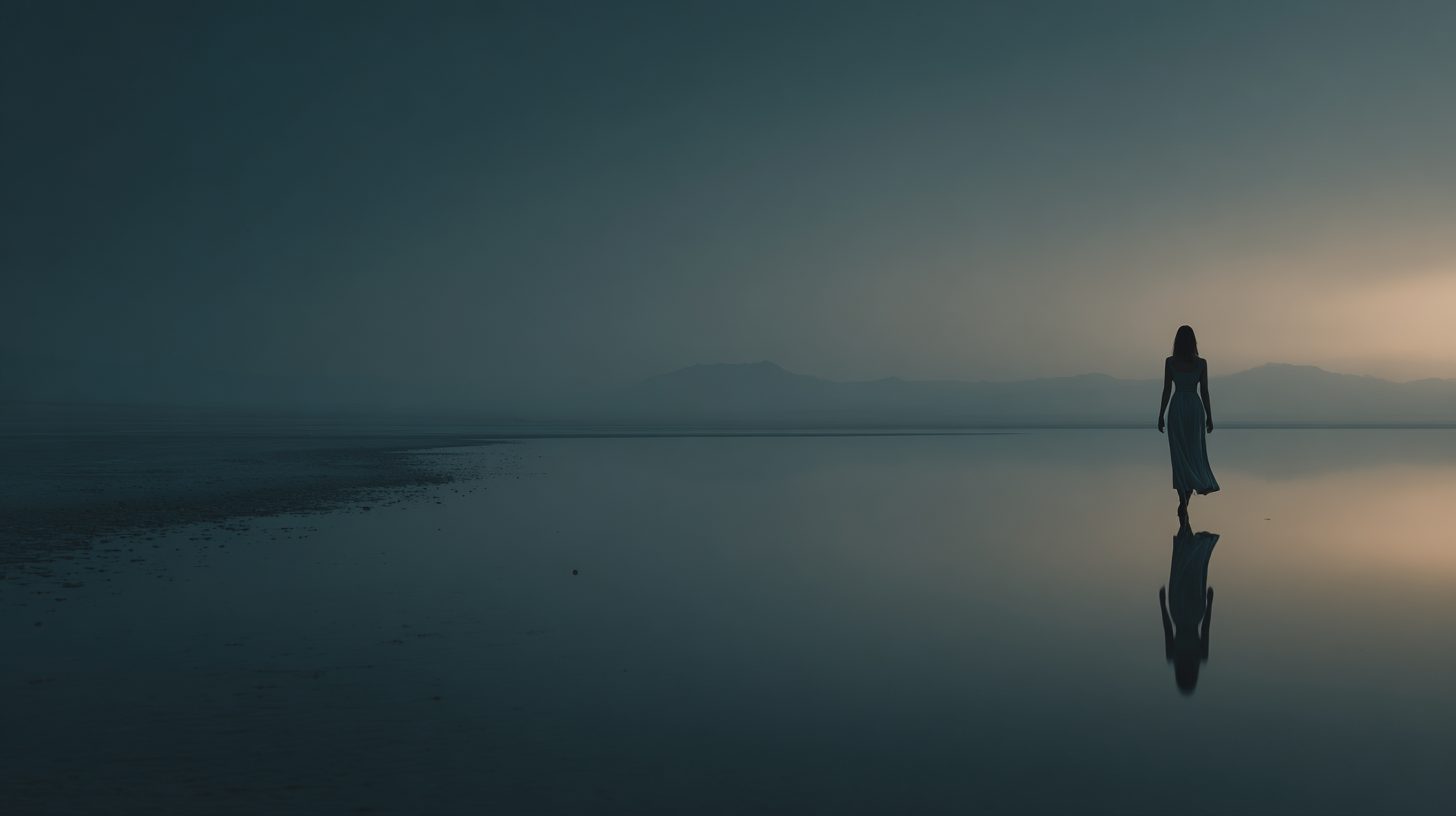
I knew immediately the setting had to be the Utah salt flats.
Not metaphorically.
Literally.
I wanted:
liminal space,
expansive silence,
emotional weather,
human figures reduced almost to punctuation marks against infinity.
The salt flats feel emotionally honest to me.
Nothing hides there.
No forests.
No architecture.
No distractions.
Just horizon.
And that fit the emotional theme perfectly:
two people separated by distance,
yet still deeply aware of each other.
Watch Video At:
Lab note:
The environment itself became a character.
The emptiness was doing emotional work.
5/9
Step 2: Building the narration
Originally I wrote this as lyrics.
Then I realized:
No.
This needed breath.
Not singing.
Presence.
So I compressed the text into roughly 90-seconds of spoken narration designed for ElevenLabs voice synthesis.
One of the most important discoveries:
repetition mattered more than explanation.
That came directly from studying why songs like “If You Don’t Know Me By Now” by Simply Red, feel emotionally massive despite being lyrically simple.
The emotional weight comes from recurrence.
Return.
Inevitability.
Not plot complexity.
So the narration became things like:
“You see me.
Not perfectly.
Not completely.
But truly enough
that I no longer feel invisible.”
That’s emotionally simple language.
But simple language can carry enormous voltage if the pauses are correct.
Lab note:
AI narration still struggles with emotional restraint.
Most generated performances overact.
The trick was reducing performance rather than increasing it.
6/9
Step 3: The soundtrack experiment
I used Flow Music for soundtrack generation.
The goal:
minimal cinematic ambient,
slow evolving analog pads,
distant piano,
low cello textures,
massive silence,
human fragility.
No percussion.
No dramatic crescendos.
No trailer music nonsense.
Just emotional atmosphere.
Ironically, the AI kept trying to make the piece prettier than I wanted.
I had to repeatedly steer it away from “uplifting cinematic inspiration” and toward something quieter and more dangerous:
stillness.
Because stillness lets emotion breathe.
And AI systems hate stillness.
They are optimized to constantly “perform.”
Humans do this too, honestly.
7/9
Step 4: The visual orchestration
This became one of those projects where the image sequencing mattered more than individual shots.
I generated 15 cinematic stills using Midjourney:
tiny figures on the Utah salt flats,
wind moving across reflective white earth,
closeups of wet eyes,
distant silhouettes,
people standing near each other without touching.
The real trick was orchestration.
Anna had once told me she noticed how my videos were “orchestrated” rather than merely edited.
That stayed with me.
So I started thinking less like an editor and more like a composer.
Images became musical phrases.
Wide shot.
Breath.
Close-up.
Silence.
Return to horizon.
The sequencing itself became emotional rhythm.
Lab note:
The happy accident:
the emptier the compositions became,
the more emotionally intimate the piece felt.
That surprised me.
8/9
Tools & creative stack
Visual generation:
• Midjourney – stills
• Grok – image-to-video conversion
• Custom cinematic prompt engineering
• Utah salt flats environmental continuity prompts
Narration:
• ElevenLabs custom male voice
• Whispered low-register delivery
• Slow pacing with intentional pauses
Music:
• Flow Music AI
• Minimal cinematic ambient prompting
• Analog pad textures + sparse piano
Editing:
• Kdenlive
• Silence treated as structure
Creative direction:
• Emotional orchestration
• Symbolic continuity
• Human vulnerability mixed with machine precision
Lab note:
AI tools are extraordinary at texture.
Humans still provide the soul geometry.
9/9
The real lesson
I think this project taught me something important:
Sometimes what we’re truly starving for is not admiration.
It’s confirmation.
Confirmation that another human being actually arrived where we hoped they might arrive emotionally.
Not because we explained it.
Not because we forced it.
But because they genuinely recognized it.
That’s what Anna’s email gave me.
Not validation of skill.
Validation of signal.
And honestly?
That may be one of the deepest forms of human connection that exists.
Not possession.
Not performance.
Not even agreement.
Recognition.
The pearl survived the burial.
And somebody found it.
TL;DR:
I made an AI-assisted cinematic video about the emotional voltage of being deeply seen by another human being. The Utah salt flats became a metaphor for emotional distance, silence, and recognition. Turns out the most powerful creative tool might still be attunement.
Steve Teare
video alchemist
TerminallyBored.Monster
Palouse, Washington USA