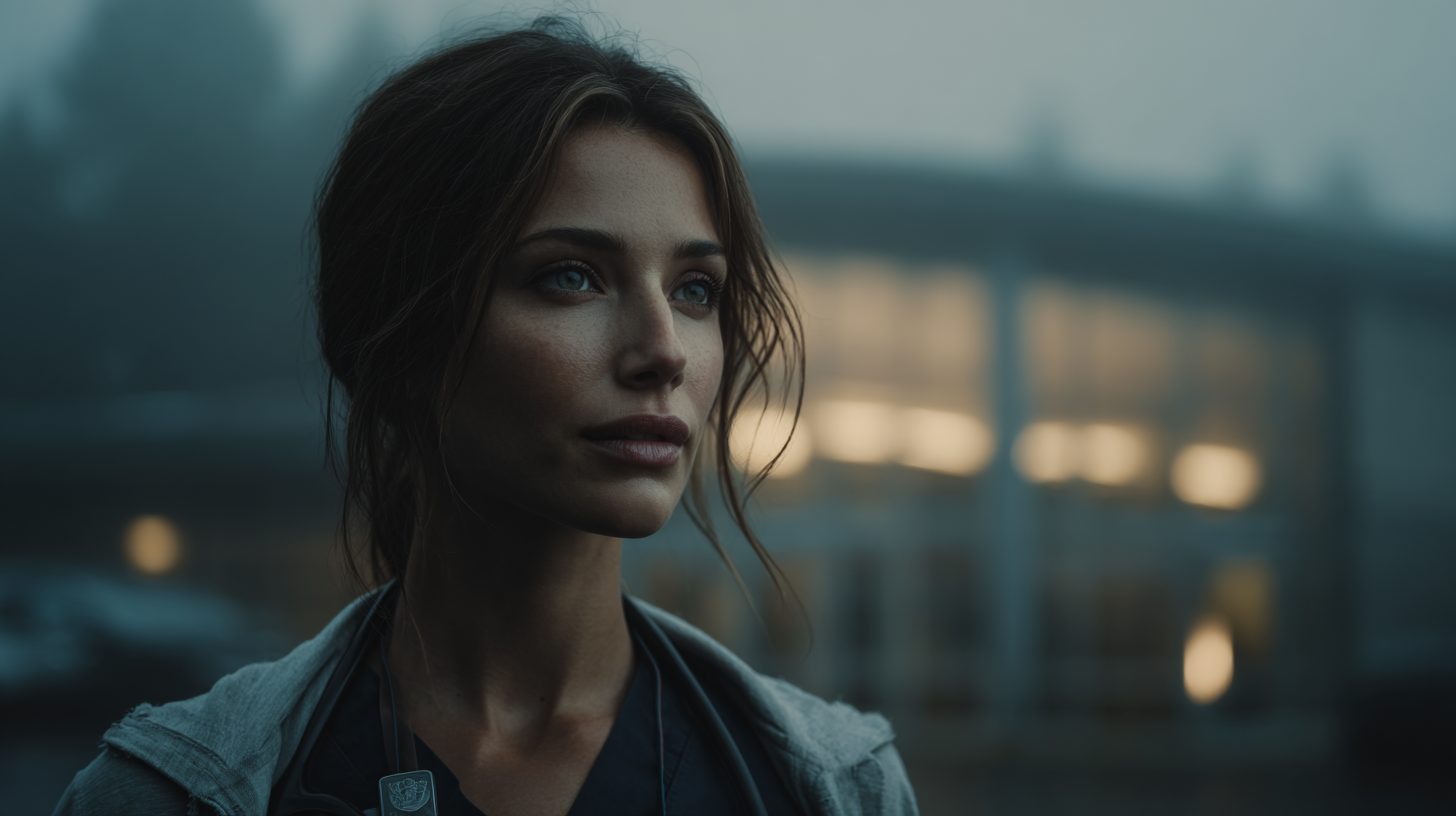
There’s a very specific kind of silence that only exists in hospitals at dawn.
It isn’t peaceful. It isn’t chaotic either.
It’s the moment where the world hasn’t decided what kind of day it’s going to be yet.
That’s where this project started.
A song called “Blue-Black Day”
A male voice singing the blues
And a woman I couldn’t stop seeing in my head: doctors walking through other people’s pain like it was weather they had to carry.
Not heroic. Not tragic.
Just… continuous.
2/10
The idea: a blues song without a stage.
I didn’t want a performance.
I wanted a witness.
So I built the structure like this:
- A male narrator sings the blues (but never appears)
- The camera follows a female doctor in a hospital shift
- Emotion is not expressed directly — it is absorbed, contained, redistributed
Lab note: this is where things got interesting. The moment you remove “performance,” everything becomes subtext. Even walking down a hallway starts to feel like dialogue.
The hospital became my instrument.
The doctor became the note.
3/10
Step 1: writing the emotional physics.
Before visuals, I mapped the emotional logic of the lyrics:
- Blue-black = emotional saturation without release
- Sunlight = partial relief, not salvation
- “Feeling everything” = functional overload, not breakdown
- Healing others = identity, but choice
I didn’t want melodrama.
I wanted pressure without collapse.
That distinction mattered more than anything.
4/10
Step 2: building the characters
She became very specific:
Caucasian female doctor
Early 40s
Slim athletic build
Dark brown shoulder-length hair
Hazel-green eyes
White lab coat over navy scrubs
ID badge, stethoscope always present
But the key decision was this:
Lab note: she is never visually deteriorating. Only internally weighted.
No extreme fatigue. No “movie illness face.”
Just the quiet reality of someone who has been awake too long inside responsibility.
That correction saved the entire visual language.
5/10
Step 3: turning lyrics into a 30-shot spine.
I broke the song into:
- Verse 1 → entering other people’s storms
- Pre-chorus → emotional overload containment
- Chorus → blue-black world state
- Verse 2 → identity of service
- Bridge → borrowed warmth
- Final chorus → return of light
Each 6-second clip became a psychological micro-state.
Lab note: 6 seconds is brutally short. You stop thinking in “scenes” and start thinking in emotional frames.
6/10
Step 4: the Midjourney prompt engine (where control meets chaos).
This is where I went full alchemist mode.
Every shot became a structured prompt with:
- consistent character identity
- controlled lighting per scene
- strict color grading rules
- cinematic lens choices
Example prompt block (from final system):
A21 Medium shot, Caucasian female doctor, early 40s, slim athletic build, dark brown shoulder-length hair neatly loose, hazel-green eyes gentle and attentive, wearing lab coat over navy scrubs, speaking calmly to patient family, professional empathy and fatigue mood, dystopian cinematic realism style, realistic, cinematic still, cinematic scene, soft overhead fluorescent lighting with window fill, muted cool tones, shot with a 35mm lens –s 250 –c 10
Lab note: the real breakthrough wasn’t realism. It was consistency of good-enough identity across emotional states.
7/10
Step 5: the lighting language (blue-black vs orange truth)
I locked the entire film into a two-world system:
Blue-black world:
- fluorescent hospital light
- indigo shadows
- emotional compression
- motion without resolution
Orange world:
- sunrise spill
- break room warmth
- steam rising from coffee
- emotional permission
Lab note: I didn’t “color grade” this project. I argued with it emotionally until it agreed with me.
8/10
Tools & creative stack
- Midjourney (primary visual generation engine)
- ChatGPT (structural design + prompt engineering)
- Grok Imagine – video conversion
- Conceptual script breakdown (manual mapping)
- Cinematic lens simulation (24mm / 35mm / 50mm / 85mm logic)
- Narrative pacing modeled as 6-second temporal blocks
- Flow Music – blues rock song (male singer tone)
- Kdenlive for hypothetical assembly
Budget breakdown:
Mostly time. And an uncomfortable amount of rereading my own emotional assumptions.
9/10
Discovery: the real subject wasn’t medicine
At some point I realized something simple:
This isn’t a story about doctors.
It’s a story about what happens when someone becomes the place other people unload their lives.
The hospital is just the container.
The blues singer is just the witness.
The women is the system absorbing everything and still choosing to stay kind.
Key takeaway:
Empathy without boundaries doesn’t make you noble. It makes you continuously operational.
And yet… she still stands in the sunrise at the end.
Not fixed.
Not broken.
Just still there.
10/10
The strange part about building something like this in AI is that you start with control — shot lists, prompts, structure, lighting rules.
And somewhere in the middle, it starts behaving like memory instead of design.
Like it already knows what the blue-black day feels like.
Like it’s been there before you wrote it.
Maybe that’s the real collaboration.
Not man versus machine.
Just two systems trying to translate weight into light.
Steve Teare
video alchemist
TerminallyBored.Monster
Palouse, Washington USA