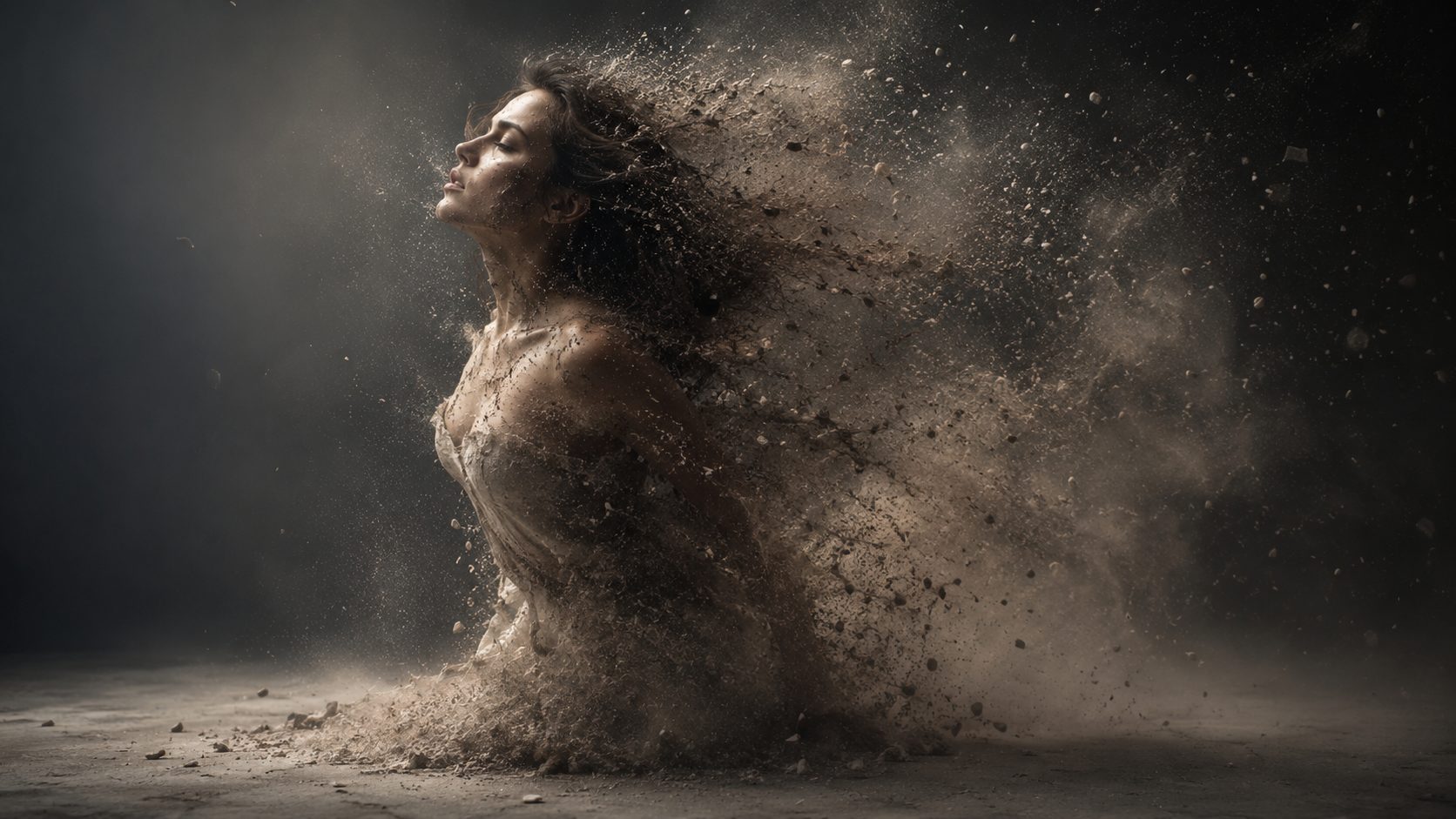
I set out to make a three-minute AI short inspired by a poem by Whitney Hanson.
The idea seemed beautifully straightforward.
A woman strips away everything she thought she was until only her true self remains. Not a story about becoming someone new, but about removing everything that never belonged in the first place.
Simple.
Except AI had other plans.
I recorded the narration first using an aristocratic voice that sounded wonderfully reminiscent of Sir Laurence Olivier. Fifty seconds. Slow. Reflective. Almost like listening to someone read a prayer.
Then I composed nearly two minutes of music to carry the emotional weight after the narration ended.
Everything was lining up.
Until the images arrived.
2/9
The original plan
The visual design was based on one woman.
One face.
One journey.
I wanted the audience to experience the poem through a single individual whose identity slowly dissolved before eventually revealing something authentic beneath.
That sounds easy until you remember one inconvenient fact.
Midjourney has absolutely no memory.
Every prompt is born alone.
There is no “same woman.”
There is no “her.”
There is only the next probability distribution.
That sounds obvious now.
It wasn’t obvious enough while I was building thirty production prompts.
Lab note:
Human language is full of references.
AI image generators don’t understand references. They generate images.
Those are two very different things.
3/9
The production pipeline
The workflow looked something like this:
- Record the narration.
- Compose background music underneath the voice-over.
- Write lyrics for the second half.
- Generate the music.
- Build a thirty-shot storyboard.
- Write thirty Midjourney prompts.
- Render the images.
- Animate the images into six-second clips.
It looked beautifully organized.
Reality rarely asks permission before changing the blueprint.
4/9
Where everything drifted
The prompts repeatedly referred to the character as the same woman.
That phrase has meaning to humans.
It has almost no operational meaning to Midjourney.
The renders came back.
Some women were blonde.
Others brunette.
Some had long hair.
Some short.
Some wore dresses.
Some wore coats.
Some wore clothing that was far more glamorous than I intended.
Instead of documenting one person’s transformation…
I had accidentally documented many women.
At first I saw this as failure.
Then something interesting happened.
5/9
I stopped fighting the machine
My normal instinct is not to remake work.
Once something exists, I become more interested in understanding it than replacing it.
So instead of rebuilding the entire project, I asked a different question.
“What film did the AI actually help me make?”
That question changed everything.
Instead of one woman finding herself…
I now had many women dissolving.
Not one identity.
Many identities.
Different faces.
Different bodies.
Different histories.
All disappearing into dust.
That wasn’t my original story.
But it was becoming another story.
6/9
The unexpected second act
I selected eighteen still images.
Instead of trying to force consistency back into the project, I sent each image into Grok Imagine with a very small prompt.
woman completely dissolves into dust, no talking, quiet
That was it.
No complicated instructions.
No elaborate choreography.
Just quiet disappearance.
Ironically, this simple prompt unified the project more effectively than all of my attempts at maintaining character consistency.
The audience has very little time to compare faces.
Instead, they watch form itself dissolve.
Lab note:
Sometimes animation hides inconsistencies that still images insist on exposing.
7/9
Tools & Creative Stack
Whitney Hanson’s poem
ElevenLabs narration
Google Flow Music
Midjourney – still images
Grok Imagine – image-to-video conversion
Kdenlive – editor
ChatGPT (occasionally helpful… occasionally educational in other ways.)
Budget cost
Approximately a half hour of production time was lost chasing a character consistency problem before I chose adaptation instead of reconstruction.
If it was rebuilt (an additional 30 minutes), an hour was wasted.
It simply purchased a different film.
8/9
The real lesson
AI collaboration is strange.
Sometimes the machine follows you.
Sometimes it resists you.
Sometimes it quietly changes the destination while convincing you you’re still driving.
This project reminded me that creativity isn’t always about controlling every outcome.
Sometimes it’s about recognizing when the work wants to become something else.
I didn’t make the film I intended.
I made the film that emerged after the conversation between my ideas and the machine’s limitations.
And strangely…
I think I like this version better.
Not because it’s perfect.
Because it’s honest.
TL;DR
I tried to tell one woman’s story.
The AI kept telling many.
Instead of starting over, I listened.
The film changed.
So did I.
9/9
Every creative tool leaves fingerprints on the work.
Paint brushes do.
Camera lenses do.
Film stock did.
AI does too.
The trick isn’t pretending those fingerprints don’t exist.
It’s learning when to wipe them away…
and when to let them become part of the art.
Steve Teare
video alchemist
TerminallyBored.Monster
Palouse, Washington USA