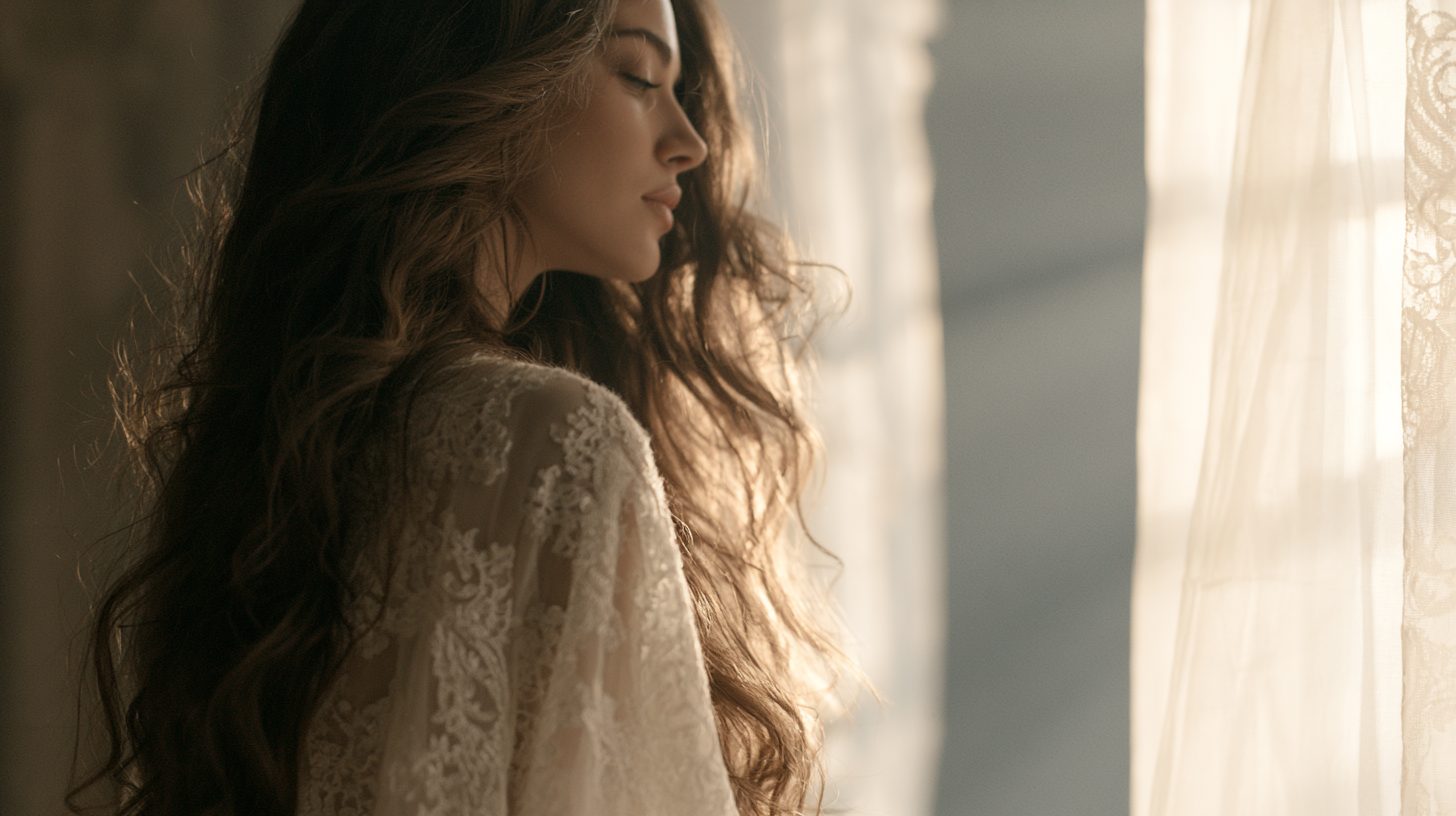
I started with a simple question:
What happens in the tiny space between wanting to hide and wanting to be seen?
That little crack between fear and curiosity has always fascinated me. It is where people make the biggest choices. Not the dramatic movie choices with explosions and orchestras. The quiet ones.
The moment before someone speaks.
The moment before someone reaches out.
The moment before someone finally turns.
That was the seed for this video.
The project became “AFRAID” — a cinematic AI experiment about vulnerability, trust, and the strange human desire to be recognized.
Of course, because I am me, I decided the easiest way to explore a complicated emotional moment was to create a miniature AI film involving multiple characters, synthetic voices, cinematic images, music, editing, and about a thousand tiny decisions.
Because apparently making a simple video is no longer allowed.
2/9
The idea: three women, one emotional journey
The original concept was more sensual. The imagery started with physical tension — a moment of hesitation, attraction, and anticipation.
But as I worked on the narration, something interesting happened.
The story changed.
The surface was about desire.
The deeper story was about recognition.
The question became:
Not “Will she give in?”
But:
“Will she allow herself to be seen?”
That shift changed everything.
I created three different women representing three emotional stages:
- The Turn
The woman who is caught between hiding and revealing.
She has not moved yet, but emotionally she already has.
- The Trust
The woman who has spent years protecting herself.
Her challenge is not surrendering to someone else.
Her challenge is trusting herself.
- The Recognition
The woman who finally stops performing.
She is no longer asking permission to exist.
She simply is.
Lab note:
This is one of the reasons I love AI filmmaking. The AI did not invent the idea for me. It did something stranger.
It helped me discover what I was actually trying to say.
Sometimes the machine is less like a camera and more like a mirror.
3/9
Building the visual language
For the three women, I wanted continuity.
Not three random AI-generated characters.
Three emotional echoes.
The visual style became:
• cinematic psychological drama
• realistic 35mm film aesthetic
• intimate close-ups
• dramatic but natural lighting
• restrained color palettes
The lighting became part of the storytelling.
The first woman:
Twilight.
Blue and silver.
The feeling of standing at the edge of a decision.
The second woman:
Warm shadows.
Burgundy and amber.
The feeling of lowering armor.
The third woman:
Morning light.
Gold and pale blue.
The feeling of acceptance.
Lab note:
One of the biggest mistakes beginners make with AI image generation is treating every image as a separate painting.
Movies are not paintings.
Movies are continuity.
The lighting, camera language, emotional tone, and visual grammar all have to belong to the same universe.
AI is incredibly powerful.
It is also incredibly forgetful.
4/9
The Midjourney challenge
The first challenge was creating characters who felt emotionally connected.
Midjourney is brilliant at creating beautiful people.
Sometimes too brilliant.
It happily gives you a perfect model when what you actually need is a person with a story.
I kept refining prompts around:
• posture
• expression
• emotional state
• lighting
• environment
• camera angle
The goal was not:
“Make a beautiful woman.”
The goal was:
“Make a person who looks like she has lived.”
Some of the strongest images were not the technically perfect ones.
They were the ones with tiny imperfections.
A hesitant expression.
A slightly uncertain gaze.
A moment where the AI accidentally created a little humanity.
Those are the happy accidents.
The places where the machine stops making a picture and starts suggesting a story.
5/9
Giving the narrator a voice
The male narration became an important part of the project.
I wanted a voice that felt like someone looking back on a meaningful moment.
Not a narrator explaining a woman.
Not someone claiming to understand everything.
A witness.
Someone who realizes:
“I don’t think she knows what I see.”
That led me toward an older, reflective voice style inspired by classic cinema.
I experimented with AI narration and landed on a voice with warmth, experience, and restraint.
The important thing was avoiding the obvious trap.
This was not supposed to sound like seduction.
It needed to sound like recognition.
A person quietly realizing that someone else has trusted them enough to be vulnerable.
Lab note:
AI voices are fascinating because the technology is not the hard part.
The hard part is directing emotion.
A perfect voice reading the wrong emotion is still wrong.
The soul is in the choices.
6/9
The music: creating the emotional floor
The music needed to support the story without overpowering it.
I did not want a “romantic seduction” soundtrack.
That would have been too easy.
The feeling I wanted was:
A quiet internal transformation.
The final direction became dark cinematic ambient:
• felt piano
• deep cello
• atmospheric synth pads
• subtle heartbeat percussion
• distant vocal textures
• slow emotional progression
The music moves through three stages:
Uncertainty.
Trust.
Acceptance.
The best film scores do not tell you what to feel.
They create a place where you can feel it yourself.
7/9
The creative stack
Here was the AI orchestra behind the project:
Visual creation:
• Midjourney — character development and cinematic stills
Animation:
• Grok Imagine / image-to-video experimentation — bringing still frames into motion
Voice:
• ElevenLabs — AI narration and vocal experimentation
Music:
• Flow Music – AI music generation tools — cinematic ambient composition
Editing:
• Kdenlive — final assembly, timing, transitions, and sound design
My role:
The video alchemist.
The conductor.
The person standing in front of the orchestra saying:
“No, not that note. Try again.”
Lab note:
The funny thing about AI creativity is that it does not eliminate the work.
It changes the work.
Instead of painting every pixel, I am shaping every decision.
The brush changed.
The artist did not disappear.
8/9
The real lesson
The biggest discovery from this project was not technical.
It was emotional.
The story began with a question about attraction.
It ended with a question about acceptance.
That happens a lot with these projects.
I start with an image.
Then a sound.
Then a movement.
Then suddenly the project starts talking back.
The final piece is often not what I planned.
It is what the collaboration between my imagination and the AI tools uncovered.
That is the part I find magical.
Not automation.
Discovery.
The machine is not replacing the creative spark.
It is giving me more ways to chase it.
TL;DR:
I thought I was making a story about turning toward someone else.
I ended up making a story about turning back toward yourself.
9/9
The moment before everything changes
Every person has a moment like this.
A moment where they could stay hidden.
Or they could turn.
The scary thing is that being seen is not just about letting someone look at you.
It is about allowing someone to know you.
That takes courage.
Maybe that is why these tiny moments fascinate me so much.
They are quiet.
They are invisible.
But inside them, entire lives change.
That is the strange beauty of creating with AI.
I bring the questions.
The machines bring possibilities.
Somewhere between the two, something unexpected appears.
And sometimes…
if I am lucky…
something human.
Steve Teare
video alchemist
TerminallyBored.Monster
Palouse, Washington USA