I finished the film and something bothered me.
Not enough to fix it.
Not enough to redo anything.
Just… that quiet feeling:
something isn’t quite right
So I did something I don’t normally do.
I watched it again.
And I started talking.
Out loud.
Clip by clip.
Describing everything I was seeing — the movement, the timing, the gestures, the sound, the weird little details I normally just feel and move past.
Then I transcribed it.
And that’s when things got strange.
The Film Was Smarter Than Me
Up until that point, I thought I had improvised the whole thing.
No structure.
No plan.
Just instinct.
But the dictation told a different story.
There was a structure.
Not a rigid one. Not something I designed.
But something that emerged anyway:
- it starts with direct intimacy (she looks at us, speaks)
- then pulls away (street, distance, exterior)
- then moves inward again (hallways, rooms, approach)
- then into the private space (bathroom, body, water)
- then something shifts (a presence, a knock)
- then exposure
I didn’t plan that.
But it’s there. Clear as day once you slow down enough to see it.
That was the first crack.
I Don’t Repeat — I Circle
I had this feeling while making it:
“There are too many bathtub shots.”
That’s what it felt like.
But when I dictated everything, something else showed up.
I wasn’t repeating.
I was returning.
Again and again to:
- water
- skin
- steam
- hands
- foam
- edges
Same space. Same elements.
But each time, slightly different.
Closer. Slower. More exposed. More internal.
That’s not repetition.
That’s fixation.
That’s orbit.
The film doesn’t move forward in a straight line — it tightens around a center.
I didn’t know I worked like that.
Now I do.
The Man Exists — And I Never Show Him
This one caught me off guard.
There’s no man in the film.
But when I read the dictation back, he’s everywhere:
- approaching the door
- moving through the hallway
- implied in the camera’s point of view
- present in the knock
- confirmed in her reaction
And then she says it:
“He’s there, isn’t he?”
I never created him.
But I built him anyway.
Out of absence.
Out of implication.
Out of tension.
That’s not accidental.
That’s storytelling.
My Timing Has a Tell
The dictation made the rhythm obvious:
Most clips sit in that 5 to 6 second range.
A few stretch longer.
A couple snap short.
So yes — there’s rhythm.
But also:
It’s a little too even.
Not wrong. Just… steady.
Like a heartbeat that never quite speeds up.
That’s where the feeling came from:
“Something isn’t quite right.”
Now I know what it is.
Not lack of instinct.
Just not enough disruption of it.
Some Moments Carry Gravity
When I stepped through it slowly, certain shots just… landed differently.
They held.
- the first time she sinks into the water
- the overhead shot — exposed, vulnerable
- the knock
- the rise out of the tub
Everything else moves.
These don’t.
They anchor the whole piece.
And I didn’t choose them.
My instinct chose them for me.
That’s the part that changed how I see everything.
Sound Was Driving More Than I Thought
I thought I was making a visual piece.
But the dictation exposed something else.
The sound was quietly steering everything:
- the faucet drip builds tension
- the knock shifts the entire emotional direction
- the music transition signals something is about to happen
- silence stretches time
It wasn’t supporting the visuals.
It was guiding them.
Even the Erotic Layer Had Structure
While I was making it, some of the imagery just felt… instinctive.
Water bursting. Foam expanding. Hands gripping. Release.
But when I dictated it, the pattern became obvious.
It wasn’t random.
It was consistent.
Escalating.
Tension → pressure → release → repeat
Not just erotic.
Psychological.
The AI Wasn’t Neutral Either
Using Midjourney and Grok felt different while I was working, but I didn’t fully understand how until I looked back.
Midjourney softened everything. Pulled it back. Made it feel distant, almost restrained.
Grok pushed. Amplified. Leaned into exposure and intensity.
And without realizing it, I placed those clips differently.
I was casting them.
One for atmosphere.
One for pressure.
That wasn’t technical.
That was instinct responding to personality.
Bathing girl: Image prompt comparison.

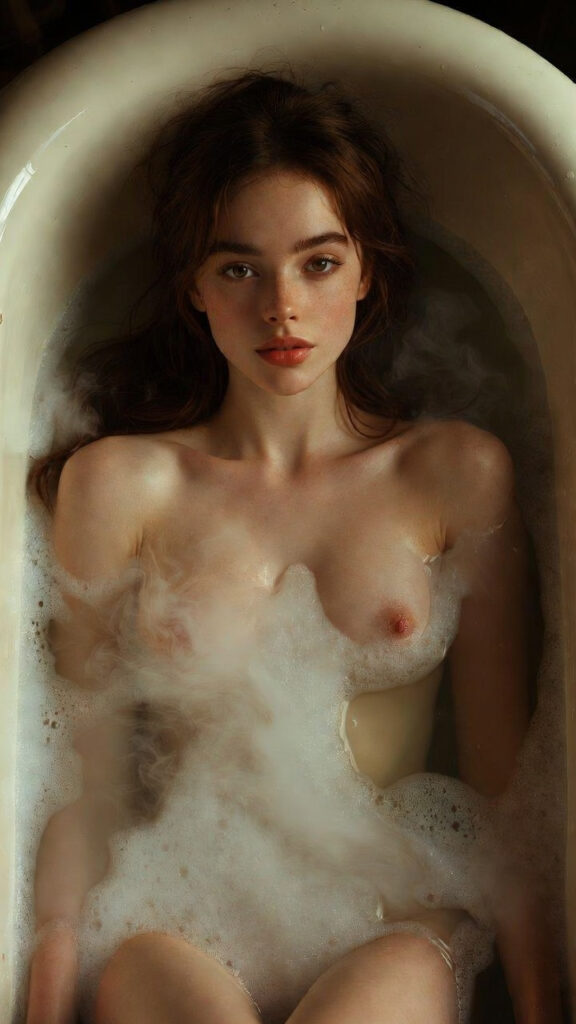
Neither of these bathtub shots made the cut.
Hmm? Wonder why? Is AI stupid? Nope.
The human committees who dictate their bias (rules?), they’re the guilty culprits.
Which committee was influenced by males? And which by females? Can you guess?
The Ending Doesn’t Resolve — And That’s Why It Works
The door opens.
We don’t see anything.
She exhales.
End.
No payoff.
No confirmation.
Just… suspension.
And reading the dictation, it becomes clear:
The film builds tension the entire time — and then refuses to release it.
That’s why it lingers.
So What Did I Actually Learn?
Not how to fix it.
Not how to make it “better.”
Something more unsettling than that.
I wasn’t improvising randomly.
I was improvising consistently.
With patterns.
With instincts that repeat.
With structure that emerges whether I plan it or not.
And That Changes Everything
Because now the question isn’t:
“How do I plan better?”
It’s:
“What happens if I trust this — and push it further?”
That’s the real story.
Not the film.
Not the tools.
Not the technique.
But the moment where you realize:
your instinct already knows what it’s doing…
and you’re just now catching up to it.
Steve Teare
video alchemist