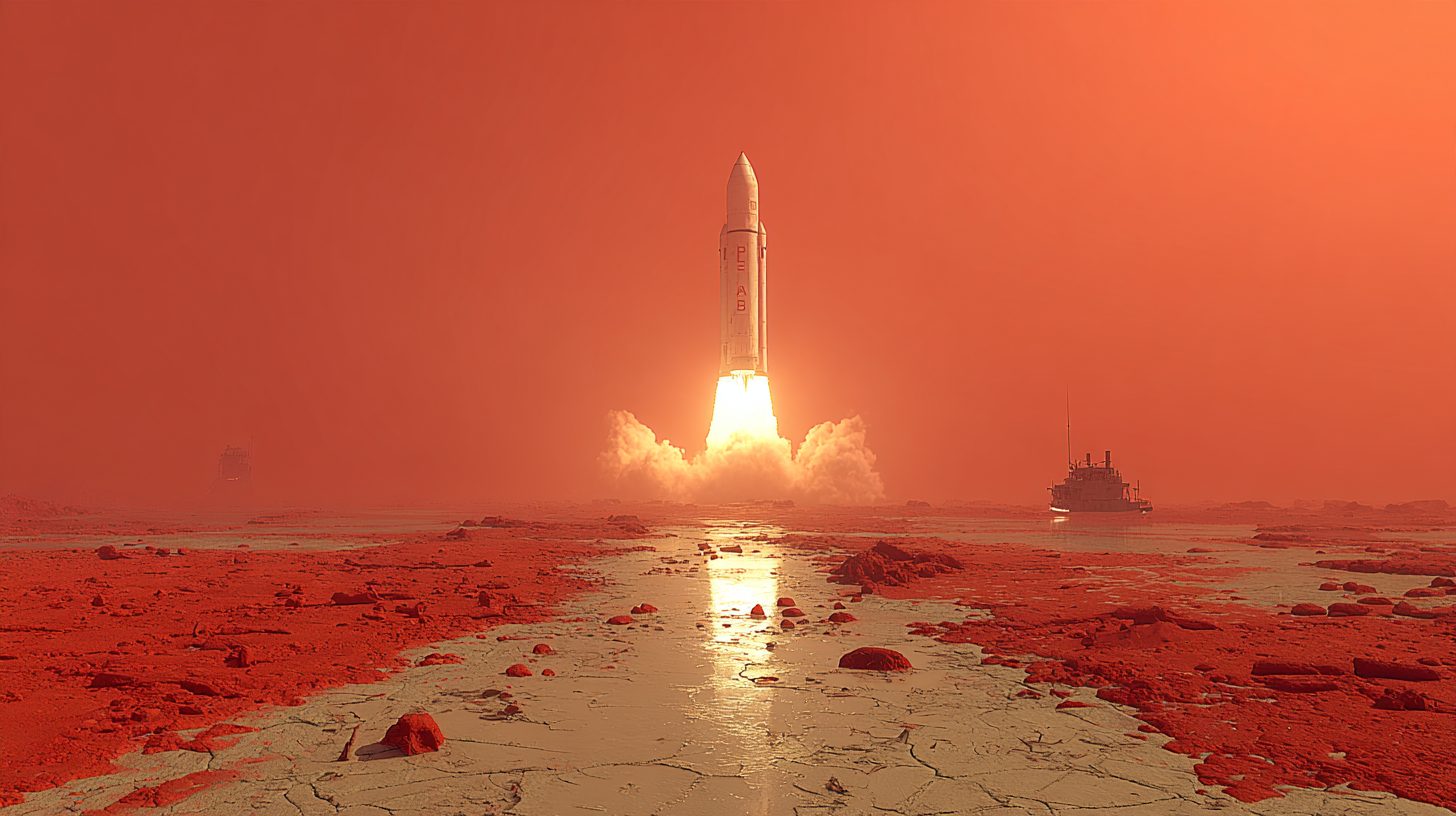
How I taught a dead planet to breathe (and what it taught me back).
I wrote a story about a man digging for water on a dying world. For years it sat in a drawer — the way stories do — quietly convinced it would never be anything more than pages.
Then I fed it to an AI. And the AI didn’t write a single word of it. It just started building the planet.
This is the story of how Last Rocket from Planet Longday — a novella I wrote with my own questionable brain — became an eight-episode vertical video series, with a killer sun, a sabotaged rocket, a hidden civilization, and a driller who becomes the most important nobody in the universe. All rendered by machines. All directed, cursed over, and occasionally wrestled to the ground by me.
2/9
The seed: a story that wouldn’t die.
Longday started as most of my stories do: with an image that wouldn’t leave me alone. A man in a metal suit, kneeling in red sand, fixing a stranger’s leaking sunsuit while a rocket waits to leave without them. Everything else — the betrayal, the buried city, the water — grew out of that single act of kindness between two people who hadn’t exchanged names.
Lab note: I keep noticing this with AI-assisted work. The machine gets all the attention, but the actual leverage is still in the human seed. A detailed, sensory-rich story turned out to be the perfect fuel. A vague idea would have produced pretty mud.
3/9
step 1: the autopsy
First I had to take my own story apart. 3-minute vertical episodes meant roughly 440 words of narration each — my prose had to be cut to the bone. Every episode needed a cold-open hook in the first 3 seconds, one story beat every 15–20 seconds, and a cliffhanger at 2:48.
Eight episodes. A1 through G2. Twenty clips per episode. Each clip exactly 6 seconds, because that’s what the image-to-video tool speaks.
Lab note: The discipline of the format improved the story. Compression is a ruthless editor. Things I thought were essential turned out to be me, humming.
4/9
step 2: building faces I could trust
Here’s the dirty secret of AI video: the tools don’t remember your characters. Every prompt is a fresh roll of the dice unless you anchor them.
So before a single episode frame existed, I generated reference seed images — a full-body shot of my driller, a helmeted military woman, a dream image of her standing waist-deep in a brook. Those became my –cref anchors. Every shot after that points back at those faces.
The friction was real:
- My first batch of faces drifted. The driller came back as four different men.
- I learned –cw (the weight control) doesn’t even exist in Midjourney v7. Half my early prompts were carrying dead weight.
- The two-shot — both leads in one frame — broke the rule of one reference per prompt. The fix became one of my favorite shots in the series: over-the-shoulder, her face sharp, him soft in the foreground. Limitation → grammar.
Lab note: The AI didn’t make my job smaller. It moved my job from “draw” to “cast, light, direct, and enforce continuity.” I am a film director now. I just have a crew that hallucinates.
5/9
step 3: stillness first, then motion
The pipeline runs Midjourney for stills, then Grok Imagine to animate each image for 6 seconds. One camera move per clip. No cuts inside a clip.
The magic trick is treating every still like a finished film frame before it ever moves. Camera angle, lens, lighting setup, color grade, emotional tone — all specified in the prompt, all consistent within a scene.
One lighting continuity rule saved me repeatedly: lighting never changes inside a scene. My surface scenes live in merciless white-orange daylight. The cabin is dim flickering amber. The crash is red emergency strobe. When my own bible accidentally wrote “night on the pad” for the launch — contradicting the burning daylight of every other surface scene — the rule caught it.
Lab note: Consistency isn’t an aesthetic choice in serialized AI video. It’s load-bearing structure. Break it in episode 1 and episode 7 falls down.
6/9
step 4: the voice of a ghost
For narration I wanted something old-fashioned — a voice with gravity, wit, and theater in it. So I built the delivery script for an AI voice in the style of Sir Laurence Olivier: measured, dry, intimate. Whisper the cliffhangers. Let consonants sharpen when the rocket spins.
The surprise was how much directing a voice-over line takes. Pauses marked. Stresses marked. Stability settings per segment — low for warmth, high for the metronomic dread of the crew roll call. The scariest line in episode 1 (“Soon… I’d be dead.”) is a full whisper, and it only works recorded in its own pass.
Lab note: I started this project thinking the AI voice would be the easy part. It was.
7/9
step 5: water as sound design
The score had one job: get out of the narration’s way. Dark drone, sparse metallic percussion — one pulse per second under the roll call, which turns the crew list into a eulogy without changing a word.
But my favorite decision is the water motif. Brook sounds. First heard in episode 5, the moment the driller descends into the living world. Water is what the whole story is about, and the soundtrack says so before the dialogue does.
8/9
the creative stack (and the honest bill)
Tools:
- Midjourney — character seeds, episode stills (–cref / –sref discipline)
- Grok Imagine — image-to-video, 6-second clips
- ElevenLabs — Olivier-register narration
- Google Flow Music — instrumental underscore
- Kdenlive — assembly, captions, end cards
- KIMI AI – Story bible.
Budget honesty: seeds and refs cost a few dollars of generations up front and saved me dozens of failed rolls later. The expensive mistake isn’t a subscription — it’s regenerating episode 5 because episode 1’s face wandered. Continuity is cheaper than repair.
9/9
what the planet taught me
Here’s the takeaway I didn’t expect: the AI didn’t dilute the story’s humanity. It demanded more of it. Every failure traced back to a vague human decision. Every happy accident — the soft-focus two-shot, the whispered cliffhanger — came from a constraint I stopped fighting and started composing with.
The machines rendered the planet. But the kindness of a driller kneeling in red sand to fix a stranger’s suit? Still mine. The tools just made sure a million people can now watch that moment breathe. I wish.
TL;DR: I wrote a dead planet back to life, one 6-second clip at a time. The secret wasn’t the AI. It was the story being worth building — and the stubborn human refusing to let the faces drift.
More experiments in progress, as always.
Steve Teare
video alchemist
TerminallyBored.Monster
Palouse, Washington USA