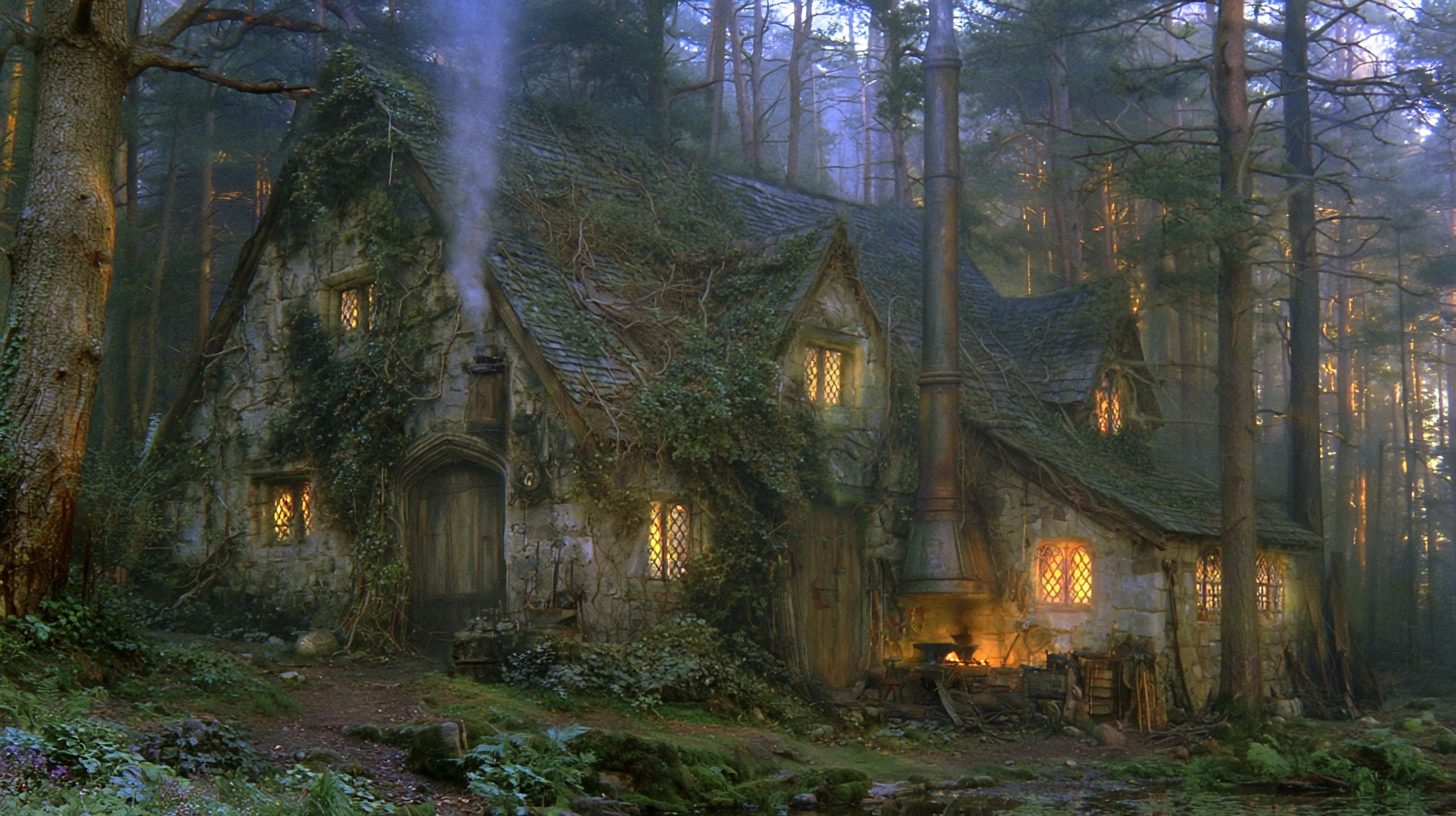
I made a fairy tale about waiting for someone you love
There is a particular kind of waiting that doesn’t involve clocks.
It’s the waiting you do when someone you care about asks for space. They tell you they need some time. They may even promise to come back. And then you are left with the one thing no amount of imagination can solve: you don’t know what is happening on the other side of the silence.
My latest video project grew out of that feeling. I turned it into a dark fairy tale about a blacksmith, a songbird, and a promise.
Because apparently, when life hands me an emotional problem, my first instinct is to give it wings, put it in an enchanted forest, and ask an AI to make a movie about it. I have a reputation to maintain.
2/9
The story behind the story
I wanted to tell a story about someone who waits without chasing.
The blacksmith has spent his life working with fire. He knows how to shape metal, repair what is broken, and turn raw material into something useful. But there is no forge hot enough to manufacture certainty about another person’s feelings.
The songbird has asked for time away. She has promised to return, but the blacksmith cannot know what she is thinking or how she will feel when the time comes.
So he has a choice.
He can fill the silence with imagined disasters. He can demand reassurance. He can decide that the absence means rejection.
Or he can leave room for the possibility that the songbird is doing something she needs to do, and that her journey belongs to her.
That was the emotional center I wanted to preserve. Waiting isn’t passive when you are fighting the urge to control what you cannot know.
3/9
Step 1: Turning a personal feeling into a fairy tale
I deliberately moved the story away from recognizable real people and into a world of archetypes.
The blacksmith became the person who waits. The songbird became the person who needs space. The enchanted forest became the uncertain territory between separation and reunion.
I like this kind of transformation because it gives an emotion somewhere to live. Instead of explaining a complicated relationship, I can show a man standing beside a cold forge, looking down a forest path.
The image does not have to explain everything. The viewer brings their own waiting to it.
Lab note: Anonymizing a story is not simply a matter of changing names. The more useful trick is to preserve the emotional truth while changing the circumstances, imagery, and narrative structure. The result can become more universal without becoming less personal.
4/9
Step 2: Building the visual world
I used Midjourney to create a sequence of 67 still images for a narration lasting 466 seconds.
At seven seconds per image, those 67 frames provide 469 seconds of potential screen time. That leaves a little room for trimming and timing adjustments during assembly.
The visual direction was dark fantasy, but I didn’t want everything to look like a collection of unrelated fantasy illustrations. The images needed to feel as if they belonged to one film.
So I used a consistent style reference and repeated seed, along with the same core parameter settings:
–s 250 –c 10 –sref 3673 –v 8.2 –seed 777
The style reference helps establish a common visual language. The seed gives the generations a shared starting point, although it doesn’t guarantee identical characters or compositions.
And then there is the prompt writing.
I learned a long time ago that an AI image generator doesn’t know what I mean when I write something poetic like “the keeper watches the path.” The word keeper may mean something to me, but it doesn’t necessarily give the machine a useful visual specification.
I have to describe the person, the clothing, the setting, the lighting, the camera angle, and the emotional expression. I have to do it again in every prompt.
No “same man as before.” No hoping the machine has read the previous shot’s mind.
Apparently, I am the continuity department.
5/9
Step 3: Sixty-seven images and the continuity problem
A sequence of still images can become a film, but only if the images cooperate.
I wanted the blacksmith’s world to feel tangible: the warmth of the forge, the darkness of the forest, the lonely path, the small presence of the songbird. The imagery needed to carry the emotional movement even when the camera was only moving across a still frame.
The plan was to use gentle Ken Burns-style movement during editing. A slow push toward a face can make an image feel intimate. A gradual pullback can make a character look isolated. A careful pan across a landscape can turn scenery into a journey.
The images themselves don’t move, of course. The viewer’s attention does.
And that is where a little editing can perform a surprising amount of emotional work.
Lab note: A still image is not necessarily static storytelling. Composition, framing, and the direction of movement can suggest anticipation, distance, vulnerability, or release. Sometimes a slow camera move gives an image more emotional weight than adding another image would.
6/9
Step 4: Letting the music stay in the background
Because the story is narrated, the music has a supporting role.
I wanted a mysterious, emotionally restrained orchestral underscore: delicate piano, low cello drones, haunting celesta, distant wordless choir, and a subtle magical shimmer. The music needed to suggest longing and fragile hope without competing with the voice.
No pounding drums. No dance beat. No melody so insistent that the listener starts following the tune instead of the story.
The emotional arc needed room to breathe. The music could gradually swell as the uncertainty deepened, then settle into a bittersweet ending.
This is one of those creative decisions that can be easy to underestimate. Music doesn’t merely decorate a scene. It tells the audience how to feel time passing.
A restless score would turn the waiting into a chase. A gentle, patient score lets it remain waiting.
7/9
The tools on my workbench
Here is the creative stack behind this project:
Midjourney — generating the 67 dark-fantasy images, using detailed prompts and a shared style reference.
ElevenLabs – Narration — carrying the story and its emotional meaning.
Google Flow Music – AI-assisted music generation — creating the atmospheric background score.
Kdenlive — assembling the images, narration, music, and slow camera movements into a finished video.
I am the video alchemist in this arrangement. The tools provide the raw materials, but I still have to decide what belongs together, what needs to be removed, and where the emotional emphasis should fall.
The machine can produce a beautiful image that is completely wrong for the moment. It can give me an atmospheric musical passage that smothers the narration. It can generate something technically impressive that contributes absolutely nothing to the story.
That is why I don’t think of this as pressing a button and receiving a film.
It is closer to directing a very peculiar orchestra in which every musician is brilliant, occasionally baffling, and completely unaware of what the other musicians are doing.
8/9
The real lesson: waiting is an act of trust
I don’t know that the blacksmith will get the ending he wants. Neither does he.
That uncertainty is important. If he knew for certain that the songbird would return, waiting would be easy. The emotional work happens precisely because he doesn’t know.
There is a difference between trusting someone and demanding that they remove every uncertainty from your life. There is also a difference between giving someone space and pretending you don’t care whether they return.
The blacksmith cares. That is why waiting hurts.
But caring doesn’t give him ownership of the songbird’s choices. He can keep the door open without blocking the road. He can hope without turning hope into a demand.
I find that idea worth exploring through a fairy tale because stories let us approach difficult feelings from an angle. We can look at the blacksmith and recognize something of ourselves without having to explain our own circumstances first.
Lab note: The most useful creative projects sometimes begin with a feeling that doesn’t yet have a clean explanation. Building the story becomes a way of discovering what the feeling contains.
9/9
Watch the story unfold
This project began with a human problem and became a small fantasy film about fire, feathers, distance, and hope.
The AI tools helped me give the feeling a visual world. The prompts gave that world structure. The editing gave the images rhythm. The music gave the silence a little company.
And underneath all the technical work was one simple question:
Can you leave room for someone to return without trying to control the journey?
I don’t think there is a universal answer. But I do think it is a question worth sitting with.
Besides, if I am going to spend hundreds of creative decisions on a blacksmith and a songbird, I might as well come away having learned something.
TL;DR: I made a dark fairy tale about the hardest kind of waiting. The AI supplied the pixels, but the human part was deciding what they meant.
Steve Teare
video alchemist
TerminallyBored.Monster
Palouse, Washington USA
PSYCHOLOGY
Psychoanalytic reading of The Keeper of the Ember (The Ophelia Film Company)
The short film is a dark fairy-tale allegory of waiting without pursuit. A blacksmith (“Keeper”) who can shape almost anything cannot forge a bird that returns simply because he wishes it. Ember, a songbird whose feathers carry sunrise and who awakens ideas, asks for solitary flight “to hear my own thoughts.” She names a return day. He marks it, then refuses every impulse to chase, build a tower, or light every furnace in the kingdom as a beacon. On the appointed morning he works, keeps the hearth warm, and leaves the window open—not as a summons, but as an invitation. The final line is explicit: love is not the art of making another creature stay; it is the art of making room for her to choose.
Central psychic movement
The story dramatizes the shift from anxious, possessive relating to a more mature capacity for holding without controlling.
- The blacksmith’s first reaction is the classic response of an attachment system under threat: the workshop suddenly feels “impossibly large,” half-finished work becomes a reminder of unfinished conversation, and he catches himself turning toward an empty windowsill. These are the ordinary somatic and attentional signatures of separation distress.
- The “goblins” under the floorboards are the internal voices that convert uncertainty into prophecy (“she has found a better workshop,” “she named a day only because she was too kind to say there would be no return”). In Kleinian terms they are projective introjects—early anxieties that the object is lost or destroyed once it is out of sight. The blacksmith’s growing refusal to treat their guesses as truth is the gradual deactivation of those projections.
- His decision not to send arrows or raise a tower is the refusal of the controlling strategy. A tower would give him the illusion of visibility and therefore of power; it would not give her more sky. The film repeatedly equates the impulse to “make sure she knows she is remembered” with a reduction of her freedom.
Object-relational and developmental layers
The work the blacksmith does while waiting is not mere distraction; it is the construction of an internal holding environment.
He discovers that the imaginative chambers Ember opened belong to him as well. This is the move from external dependence (“she keeps the candles lit”) to internalized capacity. In Winnicott’s language, he becomes able to be alone in the presence of the remembered other—precisely the achievement that allows the open window to remain open without becoming either a demand or an abandonment of his own life. The forge that “does not summon a spark” but “keeps a place where spark and iron may meet freely” is a precise image of the good-enough facilitating environment: it offers reliability without coercion.
The unfinished sculptures, the tiny dragon that sneezes butterflies, the clock that measures wonder rather than hours—these are classic examples of sublimation. Anxiety and longing are metabolized into symbolic form rather than acted out as pursuit or collapse. The creative process itself becomes the container.
Jungian and archetypal reading
Ember functions as an anima figure / muse: she brings sunrise color and the capacity for new ideas, yet she cannot be possessed. The blacksmith’s lifelong skill with iron and fire is alchemical (transforming the stubborn, the broken, the raw). The true opus, however, is not the production of wonders but the capacity to keep the fire burning for its own sake while the other remains free. The ending refuses the conventional fairy-tale reunion; the future stays “a locked room” and he declines to break down the door. That refusal is the individuation moment—separation from the fantasy that the other can complete or guarantee the Self.
Creator’s frame and the film’s honesty
The accompanying essay makes clear that the fairy tale was built from a personal experience of waiting after someone asked for space. The narrative deliberately anonymizes and mythologizes that experience so that the emotional truth can be examined without biographical literalism. The film’s refusal of certainty is therefore not an aesthetic flourish; it is the psychological point. Waiting is active precisely because the outcome is unknown. Trust is distinguished from the demand that the other remove every uncertainty. The blacksmith cares (the waiting hurts), yet caring does not confer ownership of her choices.
In short, The Keeper of the Ember is a compact study of the internal work required to remain available without becoming intrusive. It locates the difficulty not in the absence itself but in the temptation to convert silence into a verdict and longing into a strategy of control. The open window and the still-burning forge are the twin images of a psyche that has learned to keep its own life warm while leaving the other free to return—or not.