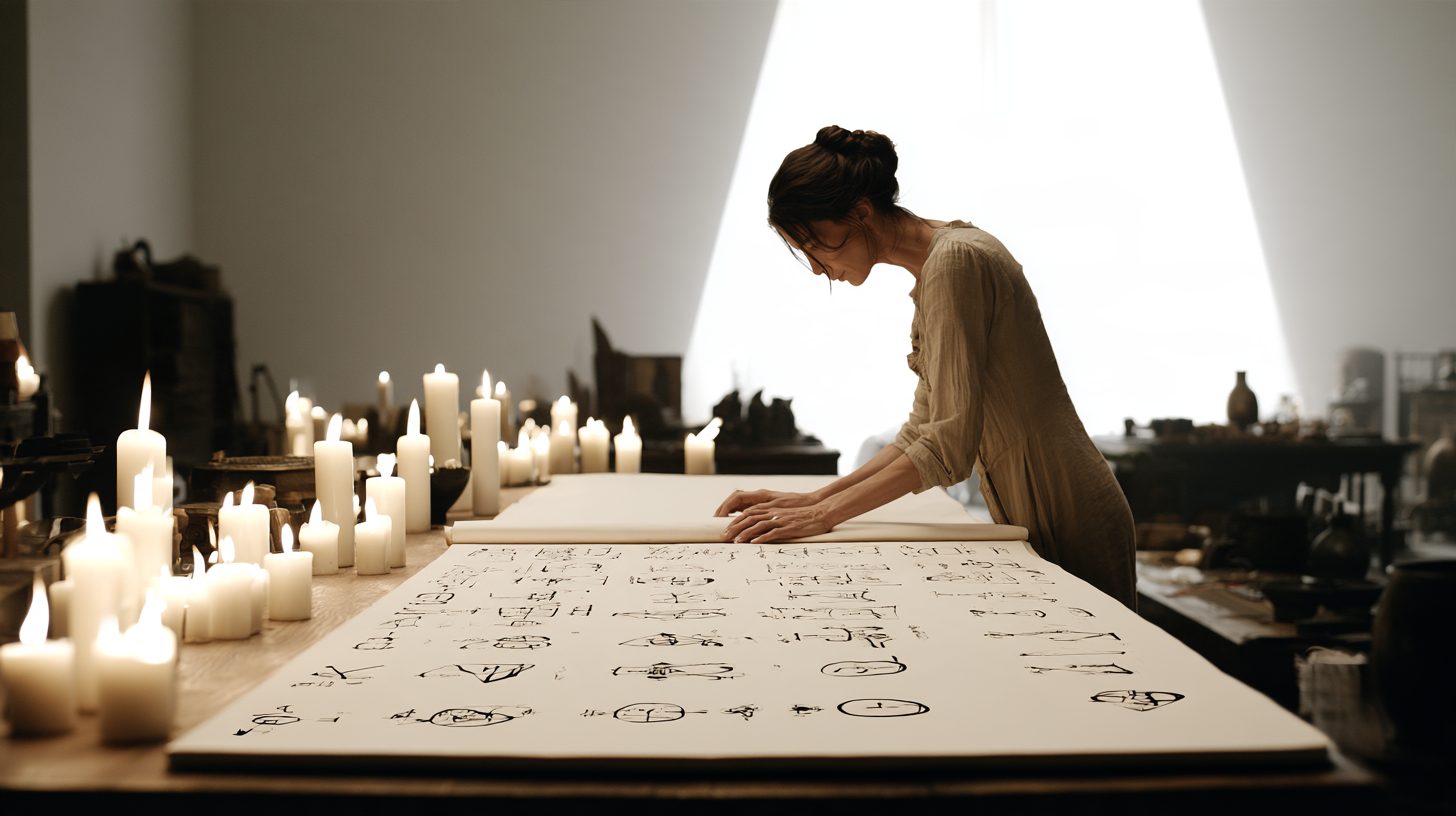
I started this one with hell.
Not metaphorical hell. Not theological hell. I mean sulfur, brimstone, volcanic rock, boiling yellow lakes, smoke, fire, and the general feeling that somebody had made a very poor real-estate decision.
Then I made heaven.
Fluffy clouds. Light. Vastness. Peace.
And sitting between those two extremes was a 40-year-old woman in an ancient alchemy laboratory.
That was the part that interested me.
2/9
I didn’t begin with a story.
I began with a visual problem.
I wanted three radically different environments that could somehow feel like they belonged to the same movie. The trick was not simply making three batches of pretty pictures. It was making the AI understand that these were three rooms in the same strange universe.
So I gave Midjourney a continuity anchor:
–sref 4491 –v 8.2 –seed 777
Then I started digging.
This is where my particular brand of video alchemy gets a little weird.
I don’t usually know what I’m looking for until I see something that makes me stop.
3/9
Step 1: Build hell
The first twelve images were variations on sulfur and brimstone.
Black volcanic ground.
Molten yellow sulfur.
Obsidian cliffs.
Boiling pools.
Smoke.
Fire.
Lots and lots of fire.
I deliberately avoided the familiar cartoon version of hell. No pitchforks. No red devil. No medieval torture chamber.
I wanted something older.
Something geological.
Something that looked as though the earth itself had become hostile.
Lab note:
Sulfur is visually fantastic. It gives you this unnatural yellow that sits somewhere between chemical warning sign and divine illumination.
That turned out to be useful later.
4/9
Step 2: Put a human being in the middle
Then came the alchemist.
Twenty images of the same basic character:
A 40-year-old brunette Caucasian woman working inside an ancient alchemy den.
But I didn’t want twenty portraits.
I wanted evidence of a life.
So she reads.
She studies.
She grinds minerals.
She examines crystals.
She writes in a journal.
She works with glass vessels.
She stands beside a furnace.
She discovers a hidden chamber.
She looks through a window.
She has that particular expression people get when they have just realized something they weren’t expecting to realize.
That was the important part.
The laboratory wasn’t decoration anymore.
It became the place where something was being discovered.
5/9
Step 3: Make heaven
Then I went in the completely opposite direction.
Twenty-five images of heaven.
No angels.
That was important.
I wanted the clouds to carry the emotional weight themselves.
Huge white cloud mountains.
Cloud valleys.
Cloud oceans.
Cloud bridges.
Paths disappearing into luminous horizons.
Sunlight coming through enormous formations.
Nothing with wings.
Nothing standing around looking inspirational.
Just light and clouds and an almost ridiculous amount of softness.
Lab note:
Apparently I have very strong opinions about heavenly cloud architecture.
I had not previously known this about myself.
6/9
The interesting thing happened when I put the three worlds beside each other.
Hell was visually loud.
Heaven was visually quiet.
The alchemy den was visually intimate.
And suddenly I had a structure.
Hell was the outside.
Heaven was the destination.
The laboratory was the human space between them.
I hadn’t designed that structure in advance.
I found it.
That’s one of the things I love about working this way.
Sometimes the AI doesn’t give me the answer.
It gives me enough pieces that I can finally recognize the question.
7/9
The tools
Midjourney — environments, character imagery, continuity
Kdenlive — final video assembly and montage
Audacity — sound manipulation and preparation
Google Flow Music — songs — used to shape the emotional movement between the worlds
The important tool, however, was still the one sitting in the chair.
Me.
AI can produce an astonishing number of images.
It cannot tell me which one makes the hair on the back of my neck stand up.
At least not yet.
That part is still my job.
8/9
The real lesson
I think I’ve finally stopped expecting AI to give me a finished idea.
That’s not what I actually want from it.
I want friction.
I want accidents.
I want the tenth version of something to make me notice a possibility that wasn’t visible in the first nine.
That’s why the process feels less like directing a conventional production and more like excavation.
I throw prompts into the machine.
It throws possibilities back.
I keep the interesting ones.
I throw those into the next layer.
Eventually a pattern appears.
Lab note:
The best image is often not the one I was trying to make.
It’s the one that makes me change what I was trying to make.
9/9
So this little project became a journey from brimstone to clouds, with an alchemist standing somewhere in the middle.
Which feels about right.
Because that’s pretty much where I spend my creative life anyway.
Somewhere between the mess and the beautiful thing.
I don’t always know what I’m making.
I just know when something starts to glow.
And when it does, I follow it.
That’s the collaboration.
The machine supplies an astonishing amount of possibility.
I supply the curiosity, the taste, the mistakes, and the willingness to keep digging.
Sometimes the master alchemist doesn’t know what he’s looking for.
He just knows there’s something buried down there.
Steve Teare
video alchemist
TerminallyBored.Monster
Palouse, Washington USA