I thought I was making a video about shame.
I wasn’t.
Well… technically, yes. The finished piece is called SHAME, and Snow Leopard’s poem is right there at the end, dark and raw and completely unwilling to make anybody feel better.
But the thing that grabbed me was what came before it.
An eighteen-year-old girl saying, with absolute confidence, “I’ve got this.”
And an older woman who knows exactly how much that sentence can cost.
2/9
This one started with a problem I keep running into when I make AI videos.
AI is very good at making people look like they understand things.
It is remarkably good at making an eighteen-year-old sound like a forty-something therapist who has spent twenty years reading Brené Brown.
That was not what I wanted.
The young woman needed to be eighteen.
Not “eighteen, but secretly carrying the wisdom of the entire human race.”
Actually eighteen.
Intelligent. Determined. A little stubborn. Certain she could figure life out.
And confidently wrong about some things.
That was much harder.
3/9
Step 1: Building two voices
The central idea became a conversation that isn’t really a conversation.
Young Spark speaks.
Older Spark listens.
Then Older Spark responds, but she isn’t answering Young Spark. She is remembering her.
That distinction turned out to be important.
The older woman isn’t there to lecture her younger self. She doesn’t get to say, “Let me tell you what you’re going to learn.”
She doesn’t even want to change anything.
She just wishes she could sit beside that girl for a little while.
Lab note:
That may be one of the strangest things about getting older. Sometimes wisdom isn’t knowing what you should have done differently.
Sometimes it’s finally understanding why you did what you did.
4/9
Step 2: Don’t heal her
This was another trap.
I didn’t want the older woman to sound healed.
That would have ruined it.
She is still angry.
She is still trying to understand what happened to her.
She still has scars she can see and scars she can’t.
And forgiveness is still complicated.
There is a line where she says:
“People make forgiveness sound simple.
It isn’t.
I don’t know if I’m there yet.”
That felt much more honest than giving her some tidy cinematic revelation.
AI loves tidy cinematic revelations.
I don’t trust them.
5/9
Step 3: Making eighteen sound eighteen
This was where the AI voice work got interesting.
I used ElevenLabs for the young woman’s voice and deliberately avoided anything too polished.
She needed natural conversational rhythms.
“Like…”
“I mean…”
“You know?”
“Okay…”
Not because I wanted to sprinkle teenage vocabulary on her like seasoning.
Because eighteen-year-olds actually talk themselves into certainty while they’re talking.
They start a thought.
They adjust it.
They convince themselves.
They say something absolutely certain and then add, “I think.”
That little “I think” may be my favorite part of the whole voice.
6/9
Step 4: Two colors, no faces
I also made a decision that probably sounds slightly ridiculous until you see it.
I didn’t want faces during the dialogue.
No beautiful AI woman staring soulfully into the middle distance.
No symbolic candles.
No rain on windows.
No lonely person walking through a field.
Nothing that would tell the viewer what to feel.
Instead, I created two abstract visual fields.
The young woman gets muted amber — warm ivory, honey, antique gold.
The older woman gets muted cerulean blue and blue-gray.
That’s it.
Two visual identities.
Amber speaks.
Blue listens.
Lab note:
I originally asked the image generator for an abstract color field and got something that looked like a photograph taken by a camera that had forgotten how to focus.
Apparently “abstract” plus “soft” plus “cinematic” translates into “please make this blurry and boring.”
So I changed the prompts.
Sharper tonal planes. Graphic structure. Texture. Crisp boundaries.
Much better.
7/9
Step 5: Then Snow Leopard walks into the room
Except she doesn’t.
That’s important.
Snow Leopard’s poem, SHAME, isn’t the older or younger woman’s poem.
It isn’t an explanation of them.
It isn’t supposed to resolve the dialogue.
It is another young woman’s voice.
Raw.
Dark.
Uncomfortable.
I kept her words exactly as she wrote them.
That became the visual transition too.
The dialogue is restrained — amber and blue, voice and memory, lots of empty space.
Then the spoken section ends.
Black.
And Snow Leopard begins.
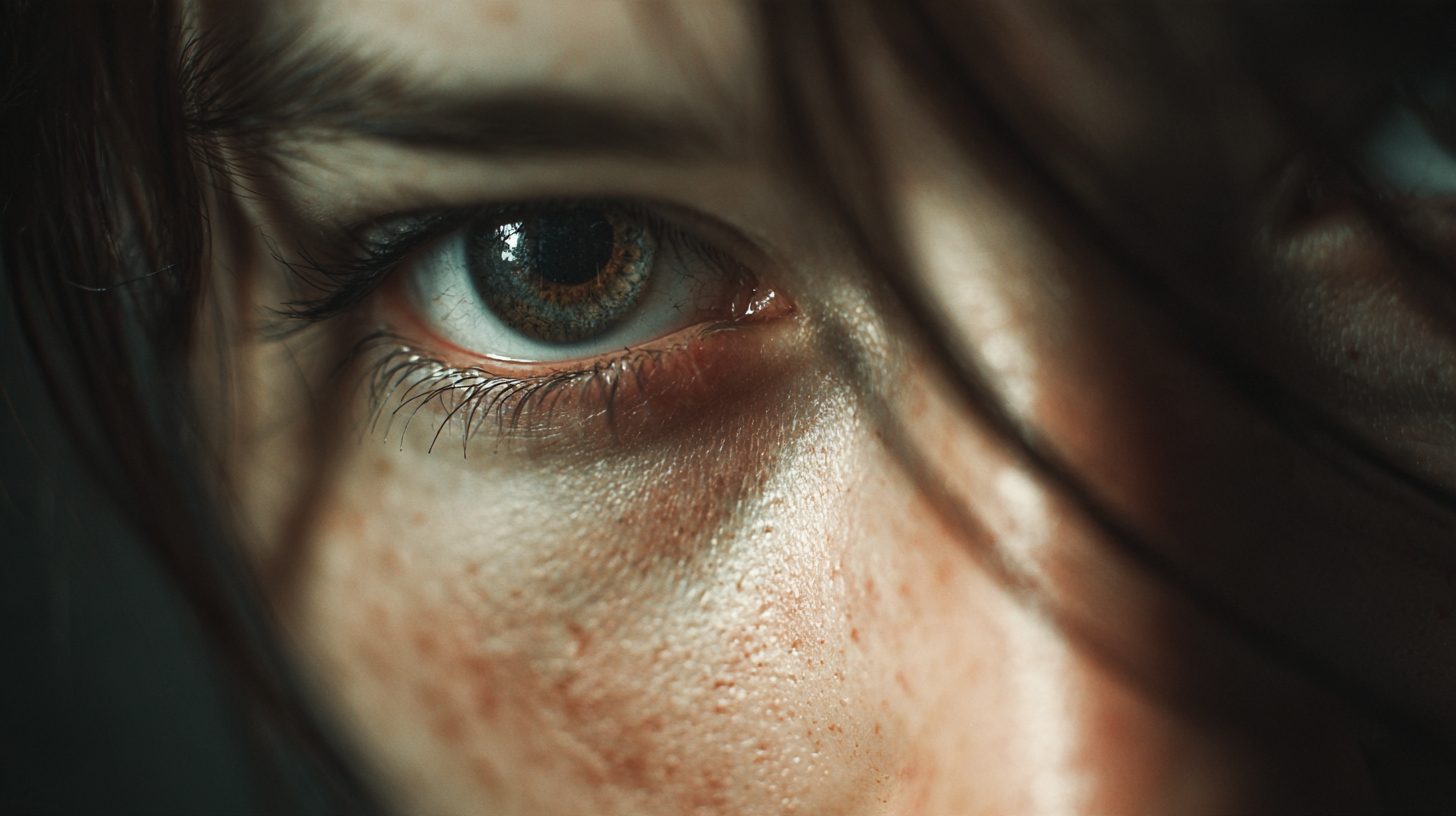
The images become intrusions rather than illustrations — an eye, fingers against skin, a reflection, fragments of a face, distortion, fracture.
Fifteen visual moments across a song that’s about two and a half minutes long.
Not a slideshow.
More like something trying to break through the black.
8/9
The tools
ElevenLabs — Young woman’s voice
Midjourney — cinematic visual elements for the SHAME section
Grok Imagine — experiments with the abstract color fields
Kdenlive — editing, timing, markers, transitions, and the inevitable moment when I stare at a timeline and wonder where thirty seconds went
Google Flow Music — Music generation — two pieces deliberately built from the same sonic family, with the dialogue music restrained enough to stay out of the way and the SHAME track allowed to become much heavier
And me, sitting in the middle of all of it, moving pieces around until something starts to breathe.
That’s the part I like best.
I’m not really making individual images anymore.
I’m directing an orchestra that doesn’t know what music is.
9/9
The real lesson
The interesting thing I discovered making SHAME is that the most powerful AI-generated image in the project may be the image I deliberately didn’t generate.
A face would have told you who the young woman was.
A dramatic scene would have told you what happened.
A literal illustration would have told you what the scars meant.
Instead, I gave you amber.
Then blue.
Then black.
And let the voices do the work.
That’s one of the things I love about this strange little AI laboratory I’ve built for myself. The tools don’t just execute ideas. They push back. They misunderstand. They give me something awful. Occasionally they give me something I didn’t know I wanted.
And sometimes the failure is the thing that points toward the real idea.
SHAME ended up being less about what happened to a young woman than about what an older woman wishes she could give her younger self.
Not an answer.
Not forgiveness.
Not a warning.
Just a place to sit.
Maybe that’s enough.
TL;DR:
Sometimes the most honest thing an older self can say to a younger self isn’t “I know what you should have done.”
It’s:
“I wish I could sit beside you.”
And maybe AI is most interesting when it helps us find the pictures we couldn’t quite see in our heads.
Steve Teare
video alchemist
TerminallyBored.Monster
Palouse, Washington USA