I used to think getting close to someone meant moving closer.
More words. More time. More certainty.
Lately, I’ve been wondering if I had it backwards.
I made a three-minute video called SEEING about what happens when someone lets you glimpse something real — and you discover that seeing it doesn’t give you ownership of it.
That sounds like a fairly simple idea.
It wasn’t.
Lab note: Apparently, I can turn almost anything into an existential filmmaking problem.
2/9
The seed of the idea
The project started with a person who fascinated me.
Not because she was easy to understand.
Almost the opposite.
She was contained. Strong. Private. There was something underneath the surface that I could sense but couldn’t quite name.
And, for reasons I still don’t completely understand, she let me see some of it.
Not everything.
But enough.
That became the emotional center of the film.
I didn’t want to make a video about romance. I didn’t want to make a video about longing. And I definitely didn’t want to make a video explaining what another person was thinking.
I wanted to make something about perception.
About being allowed to see.
And about what happens after the invitation ends.
3/9
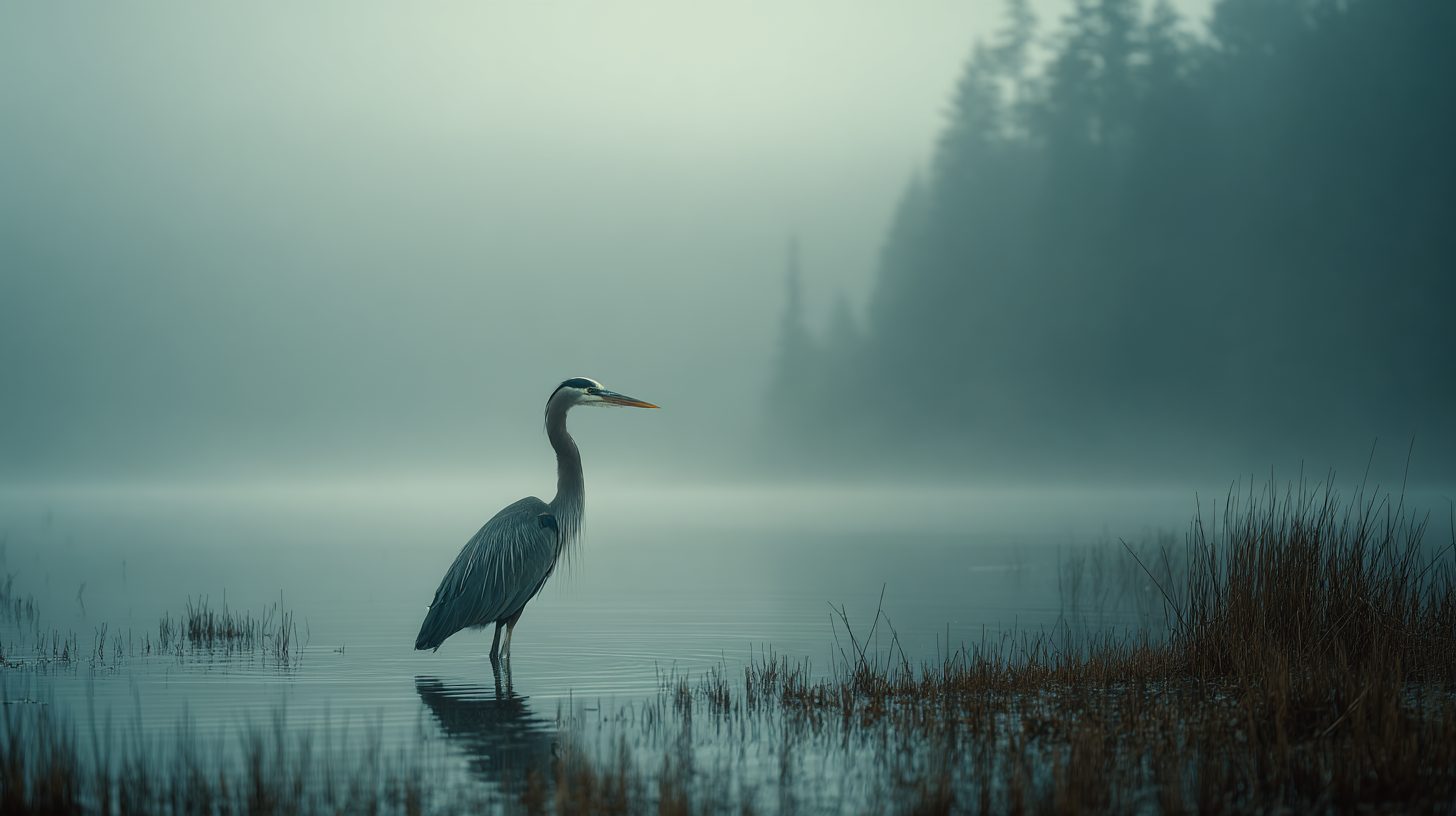
Why a Great Blue Heron?
The Great Blue Heron showed up almost immediately.
That may sound like one of those mystical sentences people write just before buying a crystal.
But the choice actually made sense.
The heron is an extraordinary visual metaphor for contained intensity.
It stands still for what seems like an unreasonable amount of time.
It watches.
It waits.
It doesn’t chase the water around demanding that something happen.
And then, when the moment comes, it moves with astonishing precision.
I began researching the cultural significance of the Great Blue Heron, particularly among Indigenous peoples of the Pacific Northwest.
The more I learned, the more interesting the bird became.
Patience. Solitude. Self-reliance. Watchfulness. Guardianship. Connection to water and shoreline.
Not one universal meaning.
Several meanings, depending on the culture.
4/9
Building the visual language
I decided to work with three kinds of imagery.
First: the actual bird.
Great Blue Herons in marshes, standing in shallow water, reflected in the surface, hunting, walking away, and finally flying.
Second: Indigenous artwork connected specifically to Northwest Coast traditions.
Coast Salish. Tlingit. Haida.
Not as an attempt to recreate sacred objects or ceremonies, but as visual reminders that the heron has existed as a meaningful cultural presence for a very long time.
Third: women.
Different women. Different faces. Different cultural contexts.
I didn’t want one actress playing “the woman.”
I wanted something more archetypal.
A woman beside the water.
A woman partially hidden by reeds.
A woman looking directly at the camera.
A woman turning away.
A woman walking into the distance.
The heron remains constant.
The women change.
That was intentional.
5/9
The 30-shot experiment
I built the video around 30 shots.
At roughly six seconds each, that gives me three minutes.
Conveniently, I have discovered that three minutes is also approximately the amount of time my brain can remain convinced that a complicated filmmaking plan is under control.
The shot structure became a kind of visual conversation:
Heron.
Woman.
Artwork.
Heron.
Woman.
Water.
Reflection.
Artwork.
Distance.
I didn’t want to illustrate every sentence literally.
If the narration says:
“There was something underneath the surface…”
I don’t need a picture of a mysterious woman staring meaningfully into the camera.
I can show a heron’s reflection breaking apart in water.
If the narration says:
“The fact that someone lets you in doesn’t mean you get to stay.”
I don’t need to show a door closing.
I can show the heron walking away.
The audience gets to make the connection.
That is much more interesting.
6/9
The music
For the score, I went in a different direction than some of my more dramatic pieces.
I asked Google Flow Music AI for something extremely restrained.
Sparse felt piano.
Soft ambient pads.
Very subtle low strings.
No vocals.
Almost no percussion.
No giant cinematic swell announcing that I had discovered the meaning of life.
The music needed to sit underneath the voice rather than compete with it.
I wanted the beginning to feel curious and slightly mysterious.
The middle could become warmer as the narrator realizes what he has actually learned.
Then, instead of building toward a huge emotional climax, the music should gradually become more spacious.
That turned out to work beautifully.
Lab note: One of the strangest things about AI music is that you don’t really know what you have until you hear it. Sometimes the prompt describes the music you think you want. Then the machine hands you something better because it misunderstood you in exactly the right way.
7/9
The voice
The voiceover is the spine of the whole piece.
I wrote it conversationally because I didn’t want it to sound like a poem being performed.
It is more like someone thinking out loud after the fact.
The most important realization comes fairly late:
“There is a difference between being invited somewhere and believing you have a right to return whenever you want.”
That sentence changed the entire film for me.
Because that’s the difference between intimacy and possession.
Someone can let you see something precious.
That doesn’t mean you own it.
It doesn’t mean you get unlimited access.
It doesn’t even mean the other person understood the experience in exactly the same way you did.
And that’s okay.
I don’t have to know.
8/9
The ending
The final sequence is deliberately simple.
The woman walks away.
The heron walks away.
Then the heron takes flight.
The final shot is a huge marsh landscape with the bird becoming smaller against the sky.
The narration ends with:
“Because she let me see something real.
And I won’t forget that.”
Then I want the voice to stop.
No explanation.
No inspirational quotation.
No “Like and subscribe” barging into the moment with a leaf blower.
Just the heron continuing into the distance.
Lab note: I think this is one of those occasions when restraint is actually the special effect.
The video isn’t really saying, “Look how important this person is to me.”
It’s saying something quieter:
I saw something.
It mattered.
I was allowed to see it.
And I can be grateful without needing to possess it.
9/9
The real lesson
The funny thing about making this video is that the filmmaking process mirrored the thing I was trying to say.
At first, I wanted to control everything.
The meaning.
The symbolism.
The woman.
The story.
The viewer’s interpretation.
But the more I worked on it, the more I realized that the images needed room to exist on their own.
The heron doesn’t explain itself.
The water doesn’t explain itself.
The woman doesn’t explain herself.
And maybe that’s the point.
SEEING isn’t really about figuring somebody out.
It’s about noticing what is there.
Sometimes someone lets you get close enough to see something extraordinary.
You don’t have to turn that moment into a contract.
You don’t have to demand another one.
You don’t even have to know what it meant to them.
You can simply receive the gift of having seen it.
That’s a surprisingly difficult lesson for a guy who has spent most of his life trying to understand everything.
But perhaps that’s why I’m making movies.
AI gives me an interesting collaborator in this process because it is constantly forcing me to relinquish control. I provide the intention. It provides possibilities. Then I decide what survives.
I’m still the video alchemist.
But increasingly, I’m learning that the best alchemy sometimes happens when I stop trying to force the transformation.
TL;DR:
Sometimes getting closer means moving closer.
Sometimes it means knowing when to step back.
And sometimes the most beautiful thing you can do with something precious is simply remember that you were allowed to see it.
Steve Teare
video alchemist
TerminallyBored.Monster
Palouse, Washington USA