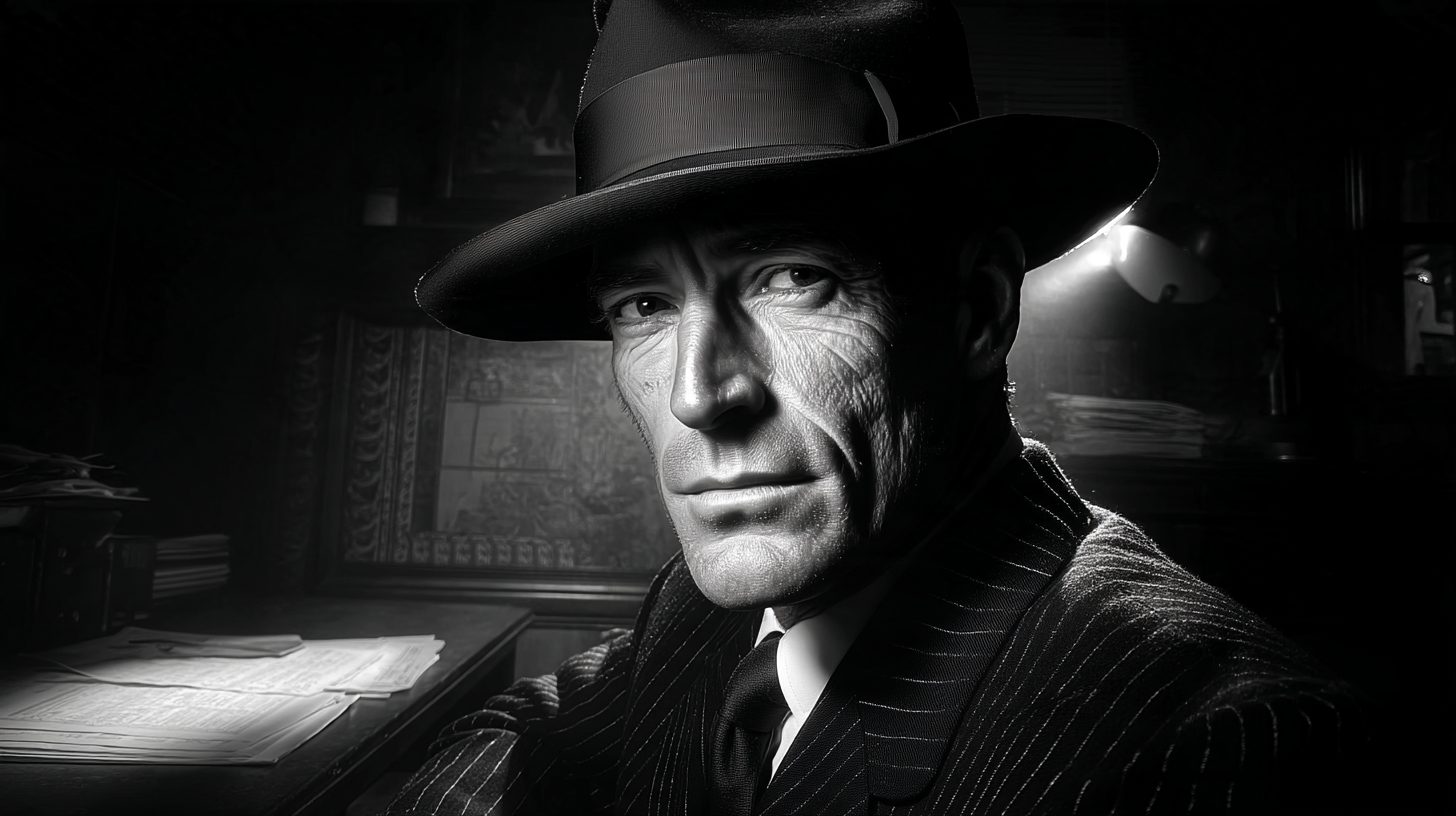
I went looking for the weather. I found a garden. And possibly a dame with a thing or two on her mind.
There are worse ways to spend an afternoon.
I thought I was making a film noir. I may have wandered into a garden.
It started with a poem called WEATHER (WHETHER).
That little wordplay was the seed of the whole thing. Weather is what happens around us. Whether is the uncertainty we carry inside us. One is about the conditions. The other is about possibility.
And somewhere in that intersection, I found a garden.
Not an ordinary garden, either. This one was a place of peace. Flowers blooming. A fountain murmuring. Birds in the trees. Sunshine warming everything. The sort of place where you might finally stop bracing yourself for the next thing to go wrong.
Except there’s always that little voice.
What if it rains?
What if the sunshine doesn’t last?
What if I get attached to this beautiful place and then lose it?
I recognized the territory. I’ve spent enough time exploring the human tendency to anticipate trouble to know that sometimes we can turn a perfectly lovely afternoon into a forecast for disaster.
So I decided to make a movie.
2/9
THE GARDEN CASE became a three-minute excursion into the world of classic film noir.
I wanted a private detective who looked as though he’d seen everything, trusted almost nothing, and had a cigarette he probably shouldn’t be smoking. I wanted a woman who could walk into his office and rearrange the atmosphere without raising her voice.
You know the type.
A little Bogart. A little Bacall. Black-and-white photography. Venetian blinds. A desk lamp. A rotary telephone. A mysterious woman with a question she isn’t quite ready to ask.
And, naturally, a garden.
The premise was simple. A woman hires a detective to investigate the weather. But as he listens, he begins to suspect that the weather isn’t really the case.
She’s worried about what might happen if she allows herself to enjoy something beautiful. What if she becomes attached? What if she starts wanting more? What if she falls in love?
The detective’s job is not to predict the future. It’s to help her recognize that she’s treating uncertainty as though it were evidence.
That’s a pretty good mystery to investigate.
3/9
Step 1: Build the world
The first challenge was establishing two very different visual environments.
The detective’s office needed to feel enclosed, shadowy, and a little claustrophobic. A place where secrets accumulate in filing cabinets and the truth usually arrives wearing a hat.
The garden needed to be the opposite.
I wanted it luminous, open, peaceful, and almost impossibly inviting. Not a colorful fantasy garden, though. The entire film would remain black and white.
That was important.
I wanted the garden to communicate warmth without relying on color. The flowers, fountain, birds, and sunlight would have to do the emotional work through light, texture, composition, and atmosphere.
The office was noir. The garden was possibility.
Lab note: Black and white doesn’t mean emotionally monochromatic. Light can be warm without being yellow. A garden can feel alive without a single pixel of green.
4/9
Step 2: Cast the suspects
I developed two central characters.
The detective was middle-aged, lean, weathered, clean-shaven, and dressed in a dark pinstripe suit. A fedora completed the uniform. He needed to look skeptical without looking unkind.
His personality was more important than his wardrobe. I wanted dry humor, quiet confidence, and the occasional flash of genuine empathy.
The woman was elegant, brunette, and self-possessed. She had the confidence of someone who knows exactly how much a raised eyebrow can accomplish.
But underneath that composure was vulnerability.
That contrast was the whole point. She wasn’t a helpless woman looking for a man to solve her problems. She was intelligent and capable. She simply had a mystery she couldn’t quite solve on her own.
I used Midjourney’s character reference tools to help maintain visual continuity. That required some care, especially in scenes where both characters appeared together.
The reference system is useful, but it isn’t a substitute for directing. I still had to specify the characters, clothing, setting, camera position, and composition.
Lab note: AI will happily give you a beautiful shot of a man who looks nothing like the man in the previous shot. Continuity is apparently an optional feature in the artificial universe.
5/9
Step 3: Give them something worth saying
The dialogue was where the project became more interesting.
I didn’t want a conventional detective story with a mystery, a culprit, and a tidy solution. I wanted the conversation to uncover something about the woman without turning the detective into a therapist delivering a lecture.
The central exchange revolves around her fear of becoming attached to the garden.
She asks what happens if the weather changes.
The detective answers:
“Then you deal with the weather. You don’t have to burn down the garden because it might rain.”
I liked that line because it captures something I’ve been thinking about for a long time.
We sometimes destroy our own opportunities for happiness in an attempt to protect ourselves from future disappointment. We confuse preparation with prediction. We mistake the possibility of pain for a guarantee of pain.
The detective doesn’t promise her that everything will work out. He doesn’t tell her that she won’t get hurt.
He simply points out that she doesn’t have to abandon something beautiful because the future is uncertain.
There’s a difference between having a feeling and deciding what to do with it.
That distinction became the emotional center of the film.
6/9
Step 4: Find the voices
A film noir without the right voices is just two people having a conversation in a dark room.
I wanted the detective to have a deep, slightly gravelly American baritone. Deliberate pacing. Dry delivery. A little weariness around the edges.
The woman needed a lower, smoky contralto. Intelligent, poised, confident, and just a little flirtatious. Her vulnerability should emerge gradually, not arrive wearing a name tag.
I used ElevenLabs to develop the two voices.
I wasn’t trying to reproduce Humphrey Bogart or Lauren Bacall exactly. I wanted to borrow the qualities that made their screen presence so distinctive without turning the result into an impersonation.
The pauses mattered. So did the restraint.
The detective shouldn’t sound as though he’s delivering a speech to an audience. He should sound as though he’s thinking while he talks. The woman shouldn’t sound as though she’s reading a script. She should sound as though she’s deciding how much of herself to reveal.
Lab note: A good voice doesn’t just deliver the words. It changes what the words mean.
7/9
Step 5: Let the ending flirt
The ending needed to resolve the immediate mystery without resolving the future.
The woman invites the detective to see her garden.
He isn’t much of a gardener. She isn’t either, apparently. But she knows when flowers are blooming.
Then he asks what happens if it rains.
She tells him:
“Then I suppose we’ll find out whether you’re as tough as you think you are.”
And she leaves.
I wanted that little exchange to do several things at once.
It needed to be playful. It needed to suggest a connection. It needed to leave the door open without promising what might happen next.
The detective’s closing narration reflects on the possibility that she didn’t really hire him to investigate the weather. Perhaps she hired him to investigate her.
Either way, the case isn’t closed.
I particularly liked ending with the detective looking forward to the next case. For a man who has spent his life expecting trouble, that’s a rather pleasant development.
8/9
The creative stack
Here’s the collection of tools that helped bring THE GARDEN CASE to life:
- Midjourney: Character development, environments, and cinematic still images.
- ElevenLabs: Distinctive voices for the detective and the woman.
- Grok Imagine: image-to-video conversion.
- Kdenlive: Video assembly, timing, transitions, and final editing.
- Me: Script development, visual direction, character continuity, and the occasional argument with an AI that apparently has never watched a movie.
I was the video alchemist, directing the orchestra. The tools supplied the instruments, but the decisions about mood, meaning, pacing, and story remained human decisions.
There were iterations. There were adjustments. There were moments when the technology did something unexpected and I had to decide whether it was a mistake or a happy accident.
That’s part of the fun.
AI creativity isn’t always a straight line from idea to finished product. Sometimes the interesting discovery happens because the first attempt didn’t work.
The real lesson
I started with a poem about weather and uncertainty. Somewhere along the way, it became a detective story about the courage to enjoy something beautiful without demanding a guarantee about how it will end.
I suppose that’s why I like working with these tools. They let me take an idea that begins as a few words and explore it through different creative languages.
A poem becomes a screenplay. A screenplay becomes a film. A metaphor becomes a garden. And a garden becomes an invitation.
The technology doesn’t have to understand the meaning for me to use it to express the meaning.
That’s my job.
And perhaps the little moral of this particular mystery is worth remembering:
You don’t have to know whether the sun will shine tomorrow to enjoy the sunshine today.
You don’t have to burn down the garden because it might rain.
Sometimes you just have to accept the invitation.
Steve Teare
video alchemist
TerminallyBored.Monster
Palouse, Washington USA
PSYCHOLOGY
“WEATHER OR WHETHER?” stages a compact psychological drama about anticipatory self-protection. The surface mystery (a woman hiring a detective to investigate the weather) is a displacement. The real case is her (and the viewer’s) tendency to treat uncertainty as if it were already evidence of future loss, and then to act on that feeling by destroying or abandoning the very thing that feels valuable.
The central split: weather versus whether
The poem’s homophone supplies the structure. “Weather” is external conditions—what actually happens around you, outside your control. “Whether” is the internal uncertainty you carry: the open question of possibility, attachment, and choice. The film keeps returning to the moment when these two get collapsed. The woman looks at a luminous garden (flowers, fountain, birds, sunlight) and immediately hears the counter-voice: “What if it rains? What if the sunshine doesn’t last? What if I get attached and then lose it?” Possibility is rewritten as prophecy.
This is classic anticipatory anxiety and catastrophic thinking. The mere existence of a future in which loss could occur is treated as diagnostic of loss itself. The garden is not enjoyed; it is put on trial. In the noir framing the detective’s office is enclosed, shadowy, and full of accumulated secrets, while the garden is open and luminous even in black-and-white. The visual contrast keeps the emotional temperature of possibility available without color, underscoring that warmth and invitation can exist inside constrained or skeptical conditions.
Defensive preemption
The key line—“Then you deal with the weather. You don’t have to burn down the garden because it might rain”—names the defensive move with precision. Preemptive destruction (or withdrawal) restores a sense of control: if the loss is something I initiate, I am no longer the one who can be surprised by it. Psychologically this is self-sabotage in the service of avoiding vulnerability. It confuses preparation with prediction and mistakes the possibility of pain for a guarantee of pain. The feeling of fear is treated as an obligation to act, rather than as information that can be registered without dictating the next move.
The woman is not portrayed as helpless. She is elegant, self-possessed, intelligent, and capable; the vulnerability sits underneath the composure. She has a mystery she cannot solve alone—the distinction between having a fear and deciding what to do with it. The detective functions less as a solver of external crimes and more as an observing figure who refuses to turn uncertainty into destiny. He does not promise that the sun will keep shining or that she will not get hurt. He simply points out that she is not required to abandon the beautiful thing in advance.
Agency and the open ending
The closing exchange moves from diagnosis to a small enactment. She invites him to the garden; he notes he is not much of a gardener; she replies, in effect, that if it rains they will find out whether he is as tough as he thinks. The flirtation is restrained and open-ended. The detective’s final narration entertains the possibility that she hired him to investigate her rather than the weather, and he looks forward to the next case—a noticeable shift for a man whose default posture is to expect trouble. The case is deliberately left open. Certainty is not delivered; the invitation is simply accepted as something that can be entered without a guarantee of outcome.
Broader reading
The short is a study in the difference between feelings and obligations, and between external conditions and internal choice. It dramatizes how easily a present good (beauty, peace, the beginning of connection) can be converted into a forecast of disaster, and how the cost of that conversion is often the good itself. The noir register keeps the stakes dry and adult rather than sentimental: skepticism is allowed to remain, but it is no longer required to dictate the response. You do not have to know whether the sun will shine tomorrow in order to stand in the sunshine today.
The piece fits the larger pattern of the maker’s work—short cinematic explorations of emotional restraint, the risk of being seen or attached, and the internal work of remaining available without demanding control of the outcome. Here the garden becomes both the object of potential loss and the site of an invitation that does not require the future to be secured first.