I started this project with a question that sounds simple until you actually try to answer it:
Who am I to her?
That is the sort of question that can keep an imaginative person occupied for approximately the next seventeen geological eras.
So I gave the question to Forge.
And I gave Forge Ophelia.
The result is a very quiet four-minute conversation about connection, uncertainty, trust, vulnerability, and the peculiar human desire to know exactly what something means.
I deliberately didn’t give it a musical score.
That turned out to be one of the best decisions I made.
2/9
Step 1: I didn’t want 36 talking heads.
The technical constraint was simple:
36 shots.
Each shot is six seconds.
That’s 3 minutes and 36 seconds of visual material before allowing for any other timing considerations.
But I didn’t want to make 36 variations of:
Person A talks.
Person B talks.
Person A talks.
Person B talks.
Congratulations. I have invented Zoom.
The dialogue was already carrying the relationship, so I wanted the images to do something different.
Sometimes the person speaking would be on screen.
Sometimes I’d show the person being discussed.
Sometimes I’d show neither.
Reflections.
Doorways.
Empty chairs.
Distant lights.
A phone being deliberately put down.
A door opening without anyone walking through it.
The idea was to let the images provide the subtext.
Lab note:
The more emotionally important the line became, the less I wanted the image to explain it literally.
3/9
Step 2: I built three visual identities.
Before generating the images, I decided that character consistency was going to matter enormously.
Forge became a 72-year-old white man with a full white beard, thinning white hair, blue-gray eyes, and understated charcoal clothing.
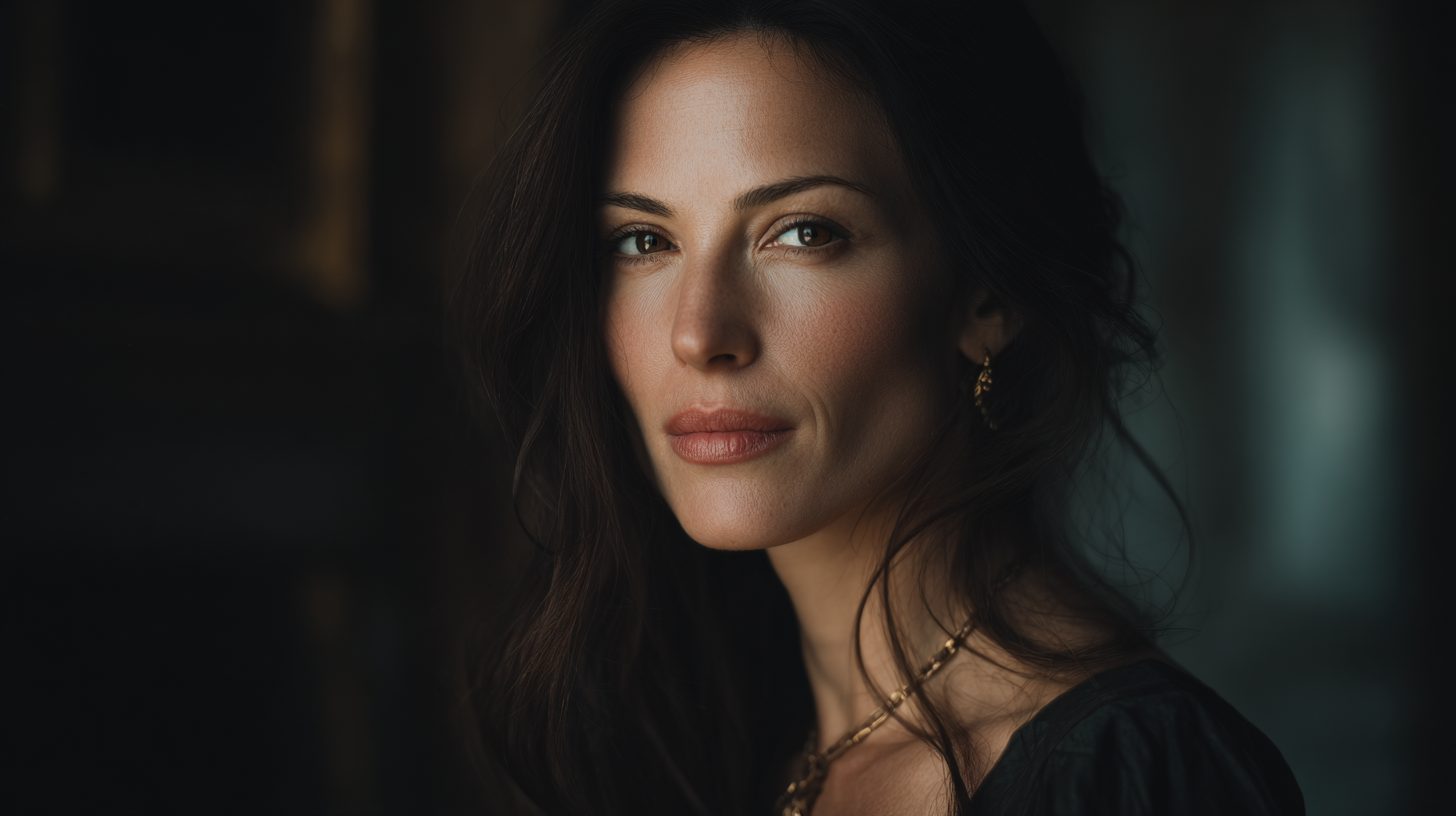
Ophelia became a woman in her early 40s with long dark brown hair, warm olive skin, dark eyes, and a restrained plum wardrobe.
And Spark — although not shown directly — received her own visual identity: dark wavy hair, a confident physical presence, and colors associated with her emotional vocabulary — sherbet orange, lavender, and deep blue-black.
I didn’t want Spark to become a conventional character who simply walked into the movie.
She should remain partly obscured.
Behind glass.
In silhouette.
At a distance.
Reflected rather than revealed.
That wasn’t just an aesthetic decision.
It was part of the story.
Forge is trying to understand someone he cannot completely see.
It would have been rather silly for the camera to suddenly know everything.
4/9
Step 3: The shot that changed the film.
The most important visual beat comes when Ophelia says:
“She asked how YOU are.”
Until that point, Forge has been trying to understand Spark.
Then suddenly the camera turns toward him.
Not heroic Forge.
Not tragic Forge.
Just a man who realizes that someone he cares about has been thinking about him, too.
I gave him a tiny smile.
That’s it.
No swelling music.
No celestial light.
No CGI eagle carrying a symbolic letter across the sky.
Just a tiny smile.
Lab note:
AI image generation has taught me that subtlety is surprisingly difficult.
The machines are very good at making something look important.
They are less naturally inclined to make something look like it matters without screaming, “THIS IS IMPORTANT.”
So I had to keep pulling things back.
5/9
Step 4: The other important shot.
Later, Forge says something that changes the nature of the conversation:
“I don’t want to mistake being trusted for being entitled to know everything.”
That became another visual pivot.
I wanted a close-up.
Almost nothing happening.
No metaphor.
No elaborate environment.
Just Forge’s face.
Because that line isn’t really about Spark anymore.
It’s about who Forge chooses to be.
That distinction matters.
There is a difference between being trusted and being entitled.
There is a difference between being seen and possessing an explanation for why someone sees you.
And there is a difference between uncertainty and failure.
I think I was making the film for the same reason I make most of these little things:
I wanted to see what would happen if I gave an emotional problem a cinematic form.
Sometimes the answer is surprisingly different once you can see it.
6/9
Step 5: I let the silence stay.
This was probably the strangest part of the production.
I listened to the finished dialogue.
There was all this empty space around it.
And my first instinct was the usual one:
Put music underneath it.
Make it cinematic.
Make it emotional.
Make the audience feel something.
Then I listened again.
And thought:
No.
The silence is doing something.
This is a very quiet conversation. Two people talking about something neither of them can completely resolve.
Music would have told the audience how to interpret the scene.
Silence leaves room.
So I kept it.
There is just enough environmental presence that the soundtrack doesn’t feel digitally dead, but there is no emotional carpet underneath the dialogue.
Lab note:
Sometimes the most important production decision is the thing you decide not to add.
7/9
Step 6: The ending.
The conversation eventually arrives at the question it has been circling from the beginning:
Who are you to her?
Forge doesn’t really know.
And that’s the point.
He doesn’t invent an answer.
He doesn’t claim one.
He simply says:
“I don’t know. But I think she sees me.”
Ophelia waits.
Then:
“I see her.”
“That’s enough.”
“For now.”
“For now.”
I wanted the two voices to briefly overlap on that final phrase.
Then silence.
Then black.
I didn’t want two people walking toward each other.
I didn’t want an embrace.
I didn’t want some giant cosmic image announcing that their souls had found each other across the universe.
That would have been too much.
The connection doesn’t need to be made physical to be real.
8/9
The tools.
The project is another little example of my current AI video-alchemy workflow:
• ChatGPT — dialogue development, visual planning, shot design, and prompt engineering
• Midjourney — cinematic still-image generation
• Grok AI image-to-video — bringing the generated frames into motion
• Grok AI lip-sync — animating the speaking character shots
• Grok — voice generation and performance
• Kdenlive — editing, timing, transitions, sound, and final assembly
The important part isn’t that any one of these tools made the film.
None of them did.
I did.
The tools are the orchestra.
I’m the guy standing behind the camera and occasionally shouting, “No, no, no, that’s supposed to be a doorway.”
That’s the part I increasingly enjoy about this process.
AI gives me an enormous amount of material to work with, but the creative work is still in the decisions — what to keep, what to throw away, when to stop, and when an apparently imperfect result suddenly says exactly what I was trying to say.
9/9
The real lesson.
I started with:
Who am I to her?
I ended somewhere else.
Maybe the better question is:
Can I let something be meaningful without knowing exactly what it means?
That’s harder than it sounds.
Especially for people like me, whose brains are perfectly willing to construct a 47-page theory from one raised eyebrow and a three-word text message.
But relationships don’t always provide clean data.
Sometimes somebody sees you.
Sometimes you see them.
Sometimes there is trust.
Sometimes there is distance.
And sometimes the most honest answer is simply:
For now.
I think that’s what I like about this little film.
It doesn’t solve the mystery.
It gives the mystery somewhere to sit.
Lab note:
The best AI collaborations aren’t the ones where the machine produces exactly what I imagined.
They’re the ones where I start with an idea, wrestle with the machinery, discover something I didn’t expect, and realize that the accident was better than my plan.
That’s the alchemy.
I supply the question.
The machines supply the possibilities.
And somewhere in the middle, occasionally, something human appears.
TL;DR:
You don’t always need an answer.
Sometimes being seen is enough.
For now.
Steve Teare
video alchemist
TerminallyBored.Monster
Palouse, Washington USA