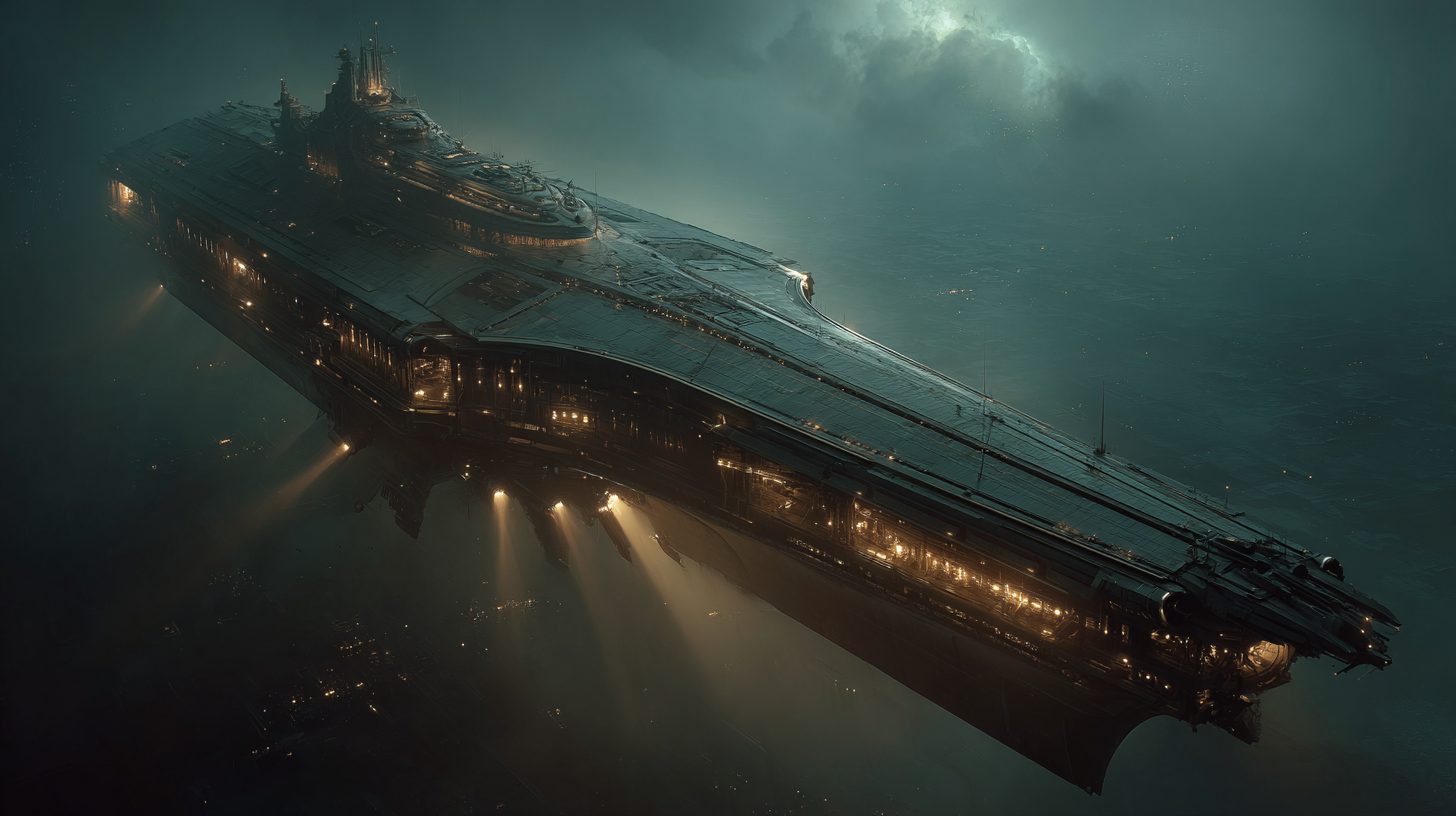
Sometimes a video starts with an idea.
This one started with a feeling I couldn’t quite explain.
I took a slowed-down instrumental version of Hotel California, shifted it into G minor at 59 BPM, and put Sir Laurence Olivier’s voice over it, reading the lyrics.
That combination immediately did something strange to my brain.
The song stopped feeling like a song about a hotel.
It became a psychological landscape.
And then I had the image:
A spaceship.
Not an AI spaceship. Not a dystopian spaceship. Not some shiny piece of technological propaganda.
A hotel in space.
And somewhere inside it is a woman.
The camera belongs to a man we never see.
He is watching her.
And gradually, he is getting closer.
2/9
The important person who never appears.
The most interesting character in the film is the guy we never see.
Everything is his point of view.
We never see his face.
We don’t even need to know exactly who he is.
We know him by where he looks.
That turned out to be enormously useful.
Instead of having two characters constantly interacting, I could build the entire relationship through POV.
The woman is initially small in an enormous environment.
Then she gets closer.
The spaces get smaller.
The camera gets closer.
Her gaze begins to find the camera.
And eventually she is looking directly at him.
That is the entire relationship arc.
No dialogue between them is necessary.
Well… almost none.
3/9
“We are all just prisoners here of our own device.”
That line is spoken by the woman.
It was important that she actually say it.
I didn’t want a narrator explaining what the movie meant while she stood around looking mysterious.
She needed to become a person.
And this created an interesting problem.
How do you show vulnerability in a still image?
Midjourney is very good at giving you beautiful people looking dramatically beautiful.
It is less interested in subtle human psychology.
Ask for “vulnerability” and you can get melodrama.
Ask for “exhausted” and you may get someone who looks like she has been sleeping under a bridge.
Ask for “intimacy” and things can become… considerably more enthusiastic than intended.
So I backed away from adjectives.
I started thinking in terms of things I could actually photograph.
Distance.
Gaze.
Privacy.
Space.
Those became my vocabulary.
4/9
From the enormous to the personal.
The first shots are deliberately huge.
The spaceship is enormous.
The woman is small.
She is surrounded by architecture, windows, corridors and empty space.
She looks competent.
Composed.
Self-contained.
The camera observes her from a distance.
Then something begins to change.
Not her costume.
Not her hairstyle.
Not her makeup.
The camera simply gets closer.
The environments become more private.
The observation deck becomes a corridor.
The corridor becomes a small room.
The small room becomes her personal space.
And finally, the camera is close enough that there is nowhere left for either of them to hide.
Lab note:
I think this is one of those cases where the AI accidentally helped me understand my own idea.
I didn’t want to make a science-fiction video.
I was actually making a film about psychological distance.
5/9
The woman.
I wanted her to be beautiful.
But not in the usual AI-video way.
The easiest thing in the world is to make an impossibly glamorous woman with perfect skin, enormous eyes and a body apparently designed by an advertising department.
I’ve done enough AI work now to know that the machines will happily take you there without being asked.
So I deliberately backed away from it.
She is Caucasian, mature, striking, elegant and genuinely attractive.
She has long dark brown hair, hazel-green eyes and a distinctive face.
Her clothing is sophisticated and restrained.
Most importantly, she doesn’t spend the movie performing emotion for us.
She simply exists.
And the man watches.
That distinction matters.
He isn’t particularly interested in the mask she presents to the world.
He’s interested in the possibility that there is someone underneath it.
Someone real.
Someone vulnerable.
Someone he might actually know.
That is a much more dangerous thing to want.
6/9
Teaching Midjourney to see what I meant.
This was also a prompt-engineering exercise.
Midjourney doesn’t understand:
“He realizes that she knows he is watching her.”
That’s a piece of story information.
So I had to translate it into something a camera could see.
Her eyes shift toward the camera.
Her head turns.
Her attention changes.
She looks directly at the unseen observer.
That’s photographable.
The same principle applies throughout the film.
Instead of telling the image generator what the character is feeling, I try to tell it what the camera would actually observe.
That sounds obvious.
It isn’t.
It’s surprisingly easy to write prompts like a novelist instead of a cinematographer.
The AI doesn’t need my psychology lecture.
It needs a picture.
7/9
The tools
The current creative stack for this little experiment looks something like this:
• Midjourney — initial still images and character consistency
• Grok Imagine — image-to-video conversion
• Kdenlive — editing, pacing, transitions and final assembly
• ElevenLabs – Sir Laurence Olivier — the voice of the lyrics
• Hotel California instrumental — slowed dramatically to G minor and 59 BPM
The 30-shot structure was designed around the stills first.
That matters.
I’m not generating a continuous movie and hoping something usable comes out.
I’m creating individual photographic moments and then asking the video model to breathe some movement into them.
Sometimes that works beautifully.
Sometimes it produces something that makes me wonder whether the AI has recently consumed a bottle of tequila.
That is part of the process.
8/9
And then I changed the ending.
The biggest discovery came late.
The film had been following the Hotel California imagery quite closely.
Then I realized I didn’t want the ending to simply illustrate the lyrics.
I wanted it to say something about what the experience had done to the man watching.
So after the lyrics, I added a completely different piece of narration:
Some experiences change you.
You don’t get to go back to who you were before them.
You can’t unlearn or unsee what you’ve become aware of now.
Awareness is irreversible.
It changes everything.
And suddenly the entire three minutes changed meaning.
The spaceship wasn’t really the point.
The woman wasn’t really the point.
Even the hotel wasn’t really the point.
The point was recognition.
There are things you discover about yourself, another person, or the world that cannot be undiscovered.
You can pretend you didn’t see them.
You can distract yourself.
You can go back to your old routines.
But you cannot actually become the person you were five minutes earlier.
That is the uncomfortable little monster hiding inside this video.
9/9
The real lesson
I think I’ve become increasingly interested in making videos that don’t tell me what they mean.
I want them to create a space where I can discover what they mean while I’m making them.
That’s probably why improvisation keeps working for me.
I start with Hotel California.
I slow it down until it becomes almost dreamlike.
I give Olivier the words.
I put a woman inside a spaceship.
I put an invisible man behind the camera.
Then I start moving the camera closer.
And somewhere along the way, the thing begins telling me what it is about.
That’s the part I love about this strange collaboration with machines.
I’m not really directing an AI.
I’m more like a video alchemist standing in the middle of an orchestra where none of the musicians can actually read the score.
I give them fragments.
They give me accidents.
I notice something.
I follow it.
Eventually, something emerges that I couldn’t have designed from the beginning.
Lab note:
Maybe that’s what creativity actually is.
Not having the answer.
Not even necessarily having the question.
Just being willing to notice when something unexpected is trying to tell you what the question was.
TL;DR:
I thought I was making a three-minute science-fiction video.
Apparently I was making a movie about distance, recognition, vulnerability and the unpleasant fact that once you really see something, you can’t go back to not seeing it.
Which is considerably more interesting.
And somewhat less convenient.
Steve Teare
video alchemist
TerminallyBored.Monster
Palouse, Washington USA