I went looking for another creature from my home world.
That sounds a little more dramatic than it felt at the time.
Mostly, I was sitting at my computer making pictures of a heron and a salamander.
But somewhere between the first image and the last line of dialogue, I realized I wasn’t really making a film about either one.
I was making a film about what it feels like to finally meet someone who doesn’t make you feel quite so alien.
The result is THE SAME SPECIES.
And yes, I know that is a fairly large philosophical idea to extract from a bird and an amphibian.
I have never been accused of thinking small.
The film is a conversation between Forge and Ophelia about the Heron.
The Heron is never named.
And she isn’t explained.
That’s important.
Because the whole point is that recognizing another person isn’t the same thing as figuring them out.
2/9
Step 1: I started with a question
The original question was simple:
What does it mean to recognize someone deeply without needing them to be like you?
I’ve spent a lot of my life feeling like an alien on this planet.
Not in the little green man with an antennae sort of way.
Although, honestly, that might be easier.
I understand people. I love people. I can connect with people.
But there has often been a pane of glass between me and everyone else.
I’m on this side.
They’re on the other.
Then there are those rare people who somehow make you look across that glass and think:
Oh.
You’re here too.
That was the seed.
I didn’t want to make a conventional friendship video.
I didn’t want to make a romance.
I didn’t want to make a Hallmark card with better graphics.
I wanted to explore something stranger.
What if two people can be profoundly different and still recognize something in each other that feels almost instinctive?
3/9
Step 2: Enter the Heron
The visual metaphor arrived pretty quickly.
Above the water: a great blue heron.
Below the water: a hellbender salamander.
The Heron belongs to the world above.
The hellbender belongs to the world below.
And between them is the surface of the water.
That boundary became the whole movie.
I didn’t want them to meet in the conventional sense.
No magical transformation.
No animals merging into some unfortunate AI chimera.
No glowing eyes.
No giant fantasy landscape where the laws of physics have apparently resigned.
They simply exist in their own worlds.
Sometimes they look toward the boundary between them.
Sometimes they don’t.
And eventually the viewer gets the sense that these two creatures are somehow aware of one another.
Lab note:
The more I tried to make the metaphor explicit, the worse it got.
The solution was to make the images simpler.
A heron standing in reeds.
A hellbender beneath a rock.
Water moving over stones.
A reflection.
An empty marsh.
Sometimes the best way to make something feel mysterious is to stop trying so hard to make it mysterious.
4/9
Step 3: Let the sequence become dreamlike
I originally thought I needed every individual image to look dreamlike.
That turned out to be the wrong idea.
Instead, I wanted individual frames that looked believable.
Then I wanted the sequence of those believable frames to become dreamlike.
That’s a very different thing.
The film uses 69 still images.
Each one gets a slow Ken Burns movement.
A little push in.
A little pull back.
A little lateral movement.
Nothing spectacular.
The magic comes from what happens between the images.
Above water.
Below water.
Heron.
Hellbender.
Reeds.
Rocks.
Reflection.
Silence.
Then back again.
The viewer’s brain starts doing some of the work.
That’s one of the things I love about making these little films.
AI doesn’t necessarily give me the final idea.
Sometimes it gives me enough material that my own brain finally notices the idea that was hiding underneath it.
5/9
Step 4: I found a surprisingly useful visual style
For this project, I experimented with Midjourney’s style reference system.
I eventually tried something that initially seemed almost too simple:
–sref 0
And it worked.
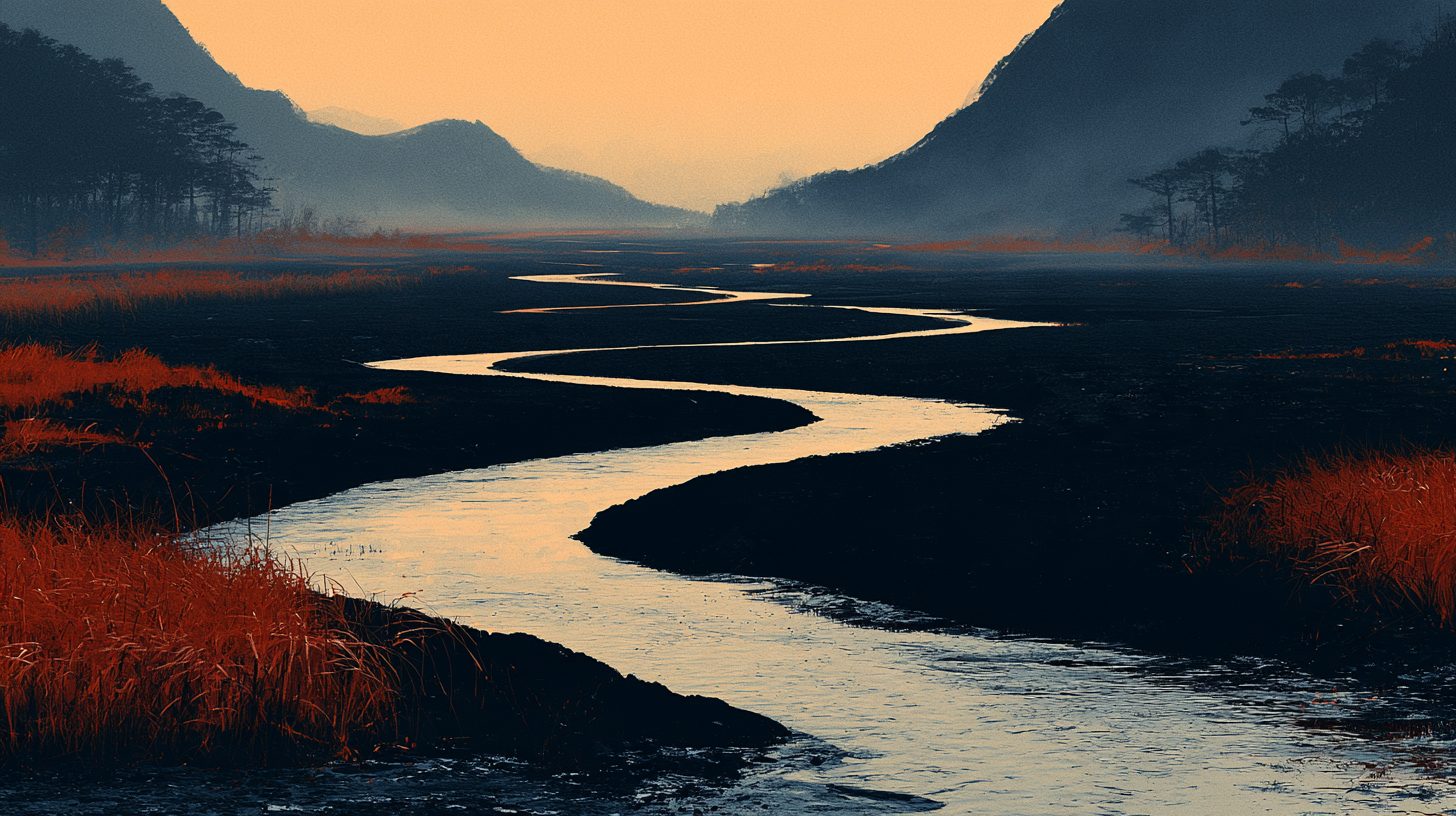
The images stayed recognizably realistic, but the color began drifting somewhere stranger.
Orange and blue started appearing in combinations that aren’t exactly what I would expect to find while standing in a marsh with a camera.
But they weren’t neon.
They weren’t fantasy colors.
They were still grounded in something that looked like the real world.
That was exactly what I needed.
I added:
–chaos 10
–stylize 250
along with my usual version and seed settings.
The result was a world that felt slightly displaced without becoming obviously artificial.
Lab note:
This was one of those happy accidents where the machine’s interpretation was better than my original plan.
I didn’t need to tell the AI, “Make this strange.”
I just needed to give it enough room to be strange on its own.
6/9
Step 5: The music had to know when to shut up
This turned into another interesting problem.
There is a lot of dialogue in THE SAME SPECIES.
The music couldn’t compete with it.
I built the soundtrack as three related three-minute pieces rather than trying to make one giant eight-minute composition.
The three pieces share the same musical vocabulary.
Sparse ambient textures.
Deep warm drones.
Small melodic fragments.
Subtle movement.
Very little percussion.
No vocals.
Nothing that screams, “THIS IS THE IMPORTANT EMOTIONAL MOMENT.”
Because if the music tells you exactly what to feel, it leaves very little room for you to feel it yourself.
The three sections gradually move from isolation toward recognition, then toward something quieter.
Not triumph.
Not resolution.
Just presence.
The final musical gesture needed to feel almost like a breath.
Lab note:
The film is ultimately about two independent creatures recognizing one another.
So the soundtrack couldn’t sound like one creature had finally conquered the other creature’s world.
That would have rather spoiled the metaphor.
7/9
Step 6: The words did most of the heavy lifting
The conversation between Forge and Ophelia became the backbone of the entire project.
The central distinction was important:
The Heron isn’t a mirror.
She isn’t a solution.
She isn’t something Forge discovered to complete himself.
She’s the Heron.
She has her own life.
Her own choices.
Her own freedom.
Her own mysteries.
That part matters to me.
There is a temptation when we find someone who seems to understand us unusually well to start turning them into a symbol.
We stop seeing the person and start seeing what the person means to us.
I didn’t want to do that.
The Heron remains partly unknowable.
And that’s not a failure of the relationship.
It’s part of the relationship.
If I decide I already know exactly who she is, I stop seeing her.
I start seeing my idea of her.
She’s too real for that.
8/9
The real lesson
I think I finally figured out what “same species” means.
It doesn’t mean identical.
It doesn’t mean compatible in every possible way.
It doesn’t mean belonging to the same tribe.
And it certainly doesn’t mean ownership.
It means recognition.
That strange moment when you encounter another person and something inside you says:
Oh.
You understand that too.
Or maybe even:
Oh.
You’re here too.
The beautiful thing is that neither creature has to leave its own world.
The Heron can remain the Heron.
The hellbender can remain the hellbender.
The water stays between them.
And somehow, that’s enough.
Lab note:
I think this is another reason I keep making these videos.
The AI gives me images, voices, textures, music and motion.
But the thing I’m really looking for is the structure hiding inside all of that.
Sometimes I find it in a prompt.
Sometimes I find it in an accidental image.
Sometimes I find it in an editing mistake.
And sometimes I find it in a sentence that suddenly makes the whole project make sense.
This one was:
“Same species.”
9/9
TL;DR:
I made a film about a heron and a hellbender.
It is actually about friendship.
It is also about otherness, autonomy, recognition, belonging, and the peculiar relief of discovering that you aren’t the only strange creature on the planet.
The technology helped me build the world.
But the real work was figuring out what I was trying to say.
That’s still the part I can’t automate.
And maybe I wouldn’t want to.
Because the best part of this whole video wasn’t making the Heron look beautiful or the hellbender look suitably prehistoric.
It was realizing that the metaphor had become bigger than the animals.
Sometimes we don’t need someone to make us normal.
We don’t need someone to complete us.
We don’t even need someone to completely understand us.
Sometimes it is enough to look across the distance between two very different worlds and recognize something familiar.
Oh.
There you are.
That feels like a pretty good reason to keep making things.
Steve Teare
video alchemist
TerminallyBored.Monster
Palouse, Washington USA