I thought I was making a song about eighty percent.
That was the number that caught my attention. Scar maturation can take two years to reach eighty percent of the previous tissue strength. Two years. And even then, the tissue isn’t what it was before.
That seemed like a pretty good metaphor for emotional wounds.
So naturally, I did what I always do when something gets under my skin.
I made a video.
But somewhere along the way, I realized I had been looking at the wrong number.
2/9
The poem came from a friend.
I originally turned it into a song called “Eighty Percent.” It was a duet, with heavy bass and a big drum stomp. I liked it.
But the more I listened to the words, the more I kept coming back to something that bothered me.
Eighty percent wasn’t really the point.
It was the doorway.
The real idea was much more interesting:
You can’t simply decide to be healed.
A wound has its own timetable.
Physical tissue has to remodel itself. Emotional wounds have to do something similar. There is inflammation. There is pain. There is anger. There is exhaustion.
And there is the particularly inconvenient requirement that you actually have to feel the thing you want to stop feeling.
Lab note: Apparently the human nervous system did not consult my calendar before beginning the healing process.
3/9
So I rebuilt the song.
This time I wanted something darker.
Rap seemed right.
My friend likes rap, and the clipped rhythm gave the words somewhere to land without turning them into a sentimental ballad. I wanted heavy live bass, enormous acoustic drums, low drones, industrial textures and enough empty space that the words could breathe.
The vocal begins almost conversationally.
Then it gets harder.
The song moves through hurt, betrayal, injury, survival, resilience, anger, forgiveness and remodeling.
Not “everything is wonderful now.”
Something more honest.
“I’m still here. And something inside me is changing.”
That became the emotional center of the project.
4/9
Then came the mountain.
I could have illustrated every line literally.
Blood for blood.
Cracks for wounds.
A sad woman sitting in the rain for emotional pain.
I have made enough AI videos by now to know where that road leads.
It leads directly to Stock Image Hell.
Instead, I wanted one visual metaphor that could carry the whole thing.
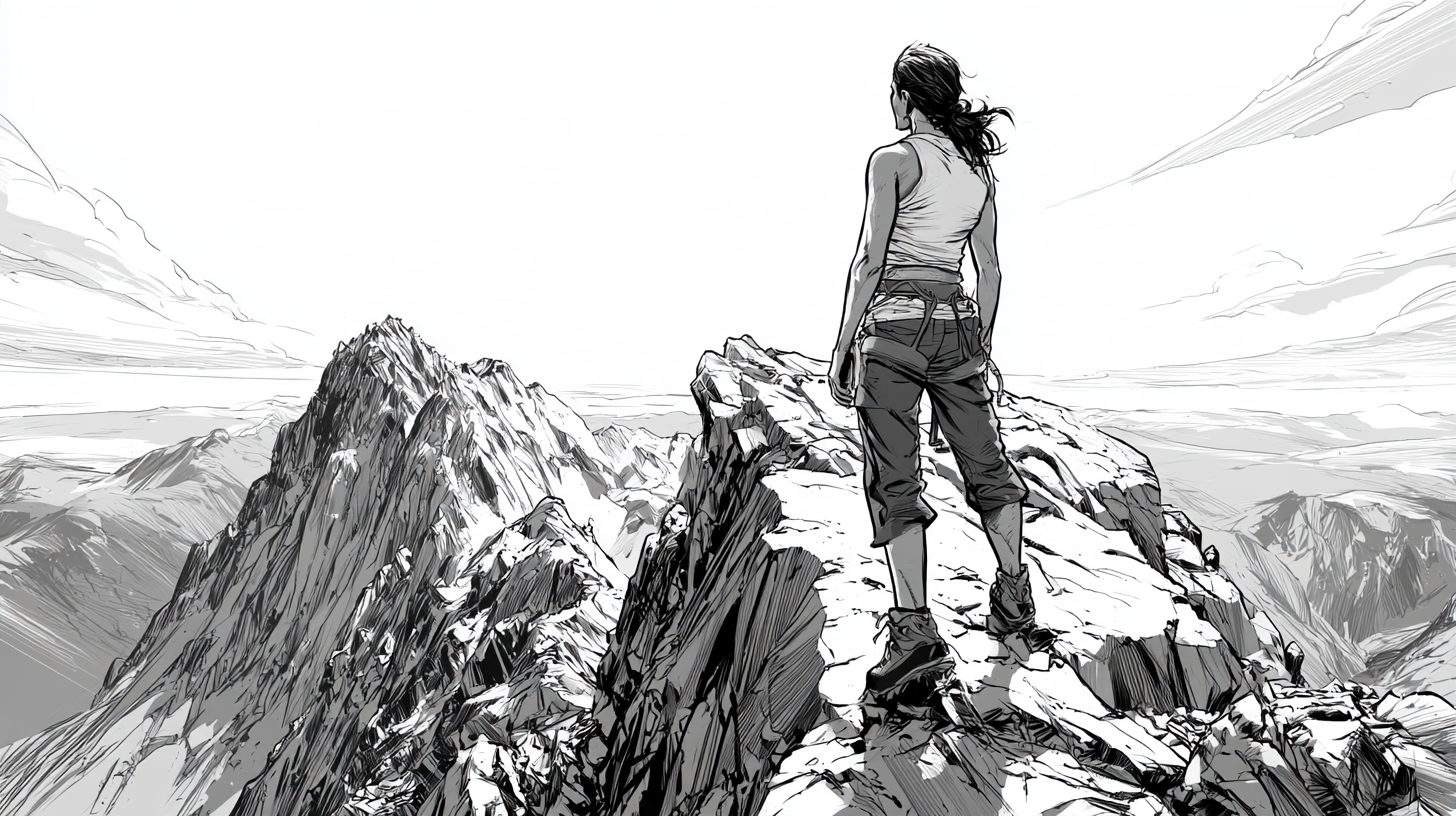
A woman climbing a cliff.
Not because climbing a mountain is inherently inspirational. That metaphor has been beaten about the head and shoulders pretty thoroughly.
I wanted the climb to feel difficult.
Sometimes terrifying.
Sometimes pointless.
Sometimes almost motionless.
The mountain wasn’t supposed to represent achievement.
It represented the process.
5/9
I designed thirty images to follow the emotional progression of the song.
The first image is almost absurdly simple: a woman’s hand resting against rough stone, with a healed scar running across it.
Then we pull back.
She is standing at the bottom of an enormous cliff.
Then she starts climbing.
The rock becomes fractured.
Her hands become scraped.
She struggles.
She stops.
She rests her forehead against the stone.
She looks down.
She releases a piece of broken rock.
She does not cross the chasm.
She keeps climbing.
That distinction mattered to me.
Forgiveness in the poem isn’t reconciliation.
It doesn’t rebuild the bridge.
It doesn’t require opening the door again.
Sometimes forgiveness simply means you stop carrying the piece of someone else’s damage around with you.
Lab note: AI is very good at making dramatic mountain vistas. Getting it to understand that “quietly releasing something” is more important than “triumphantly conquering something” takes a little more persuasion.
6/9
The visual style became part of the storytelling.
I wanted black ink on stark white paper.
Aggressive cross-hatching.
Sharp graphic-novel linework.
Controlled gray halftone areas for shadow.
Something that looked printed, physical and slightly dangerous.
No color.
No text.
No literal hearts.
And definitely no inspirational-poster mountain climber throwing both arms into the air while the sun explodes behind her.
The woman isn’t a superhero.
She’s a strong forty-year-old woman because she needs to be strong.
There is a difference.
I wanted her body to look capable without looking like she had just stepped out of a fitness advertisement.
The climb should cost her something.
7/9
Midjourney handled the visual alchemy.
I used a consistent character description, seed and style reference across the sequence, then varied the camera angles, scale and physical situation.
The final recipe was:
Midjourney
–ar 9:16
–sref 3657
–v 8.2
–seed 777
–s 250
–c 10
The 9:16 format made sense because the cliff is vertical, and I wanted the images to feel like they were pulling the viewer upward.
The seed and style reference helped keep the visual world coherent.
The stylize setting gave Midjourney enough room to make the images feel like art instead of technical illustrations.
And chaos 10 gave me a little serendipity without turning thirty shots of the same woman into thirty completely unrelated people.
That balance is one of the ongoing tricks of AI video work.
Too much control and the images become lifeless.
Too little control and suddenly your protagonist has three different hairstyles and appears to have changed species somewhere around frame seventeen.
8/9
The most important change happened in the story itself.
At first, I thought the ending should be about reaching the top.
But that didn’t feel right.
Healing isn’t a victory lap.
So she reaches the summit without celebrating.
She doesn’t throw her arms into the air.
She doesn’t smile at the camera.
She simply stands there.
The scar remains.
The mountain remains.
What happened remains.
But she is different.
That’s the part I wanted the final images to say without actually saying it.
You don’t go back to who you were.
You become someone new around the wound.
The scar is evidence that something happened.
But it is also evidence that the body did something about it.
And maybe that’s what I like about the eighty percent idea after all.
Not because eighty percent is some magical destination.
Because it proves that healing can be happening even when you don’t feel healed.
Lab note: This is one of those projects where the AI didn’t exactly tell me what I was trying to say. It helped me discover what I was trying to say.
9/9
That is one of the reasons I keep doing this strange little video-alchemy thing.
I start with an idea.
Then I make something.
Then the thing I made starts arguing with me.
Sometimes the argument is about an image that doesn’t work.
Sometimes it’s a prompt that refuses to behave.
Sometimes it’s a song that wants to be a different song.
And sometimes the project quietly points at something I hadn’t noticed when I started.
This one did that.
I began with eighty percent.
I ended with remodeling.
The wound becomes the scar.
The scar remains.
The person remains.
Changed.
Still carrying the evidence.
Still climbing.
Still here.
That’s enough.
TL;DR: I thought I was making a video about eighty percent. Turns out I was making one about the fact that healing is a process, not a decision.
Steve Teare
video alchemist
TerminallyBored.Monster
Palouse, Washington USA